Science

Mostly Cloudy with Showers 6° London Hi 9°C / Lo 6°C

Aesop's fable? This one turns out to be true

Scientists re-enact tale of crow that managed to drink from half-full pitcher of water
By Steve Connor, Science Editor

The story of the crow and the pitcher may have had a basis in real life

ALAMY

The story of the crow and the pitcher may have had a basis in real life

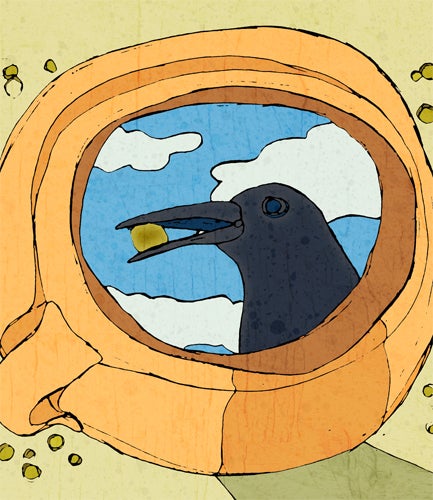
One of Aesop's fables describing a thirsty crow which was able to drink from a half-full pitcher after raising the water level by adding pebbles may have had a basis in real life.

Scientists have found that rooks – a member of the crow family – were able to figure out how to raise the water level in a laboratory container by dropping stones inside to retrieve a tasty worm floating on the surface.

Four different rooks, called Cook, Fry, Connelly and Monroe, quickly discovered that they could raise the water level in a transparent container by adding stones, just like the mythical crow in the fable, which illustrates the virtue of ingenuity and how necessity is the mother of invention.

The only other animal shown to be able to perform the same task is the orang-utan, which was able to grasp a floating peanut by spitting water into a tube. Scientists believe the demonstration shows that, in many respects, rooks and crows have comparable intelligence to primates when it comes to the use of tools.

"We have performed a large number of studies on both corvids [members of the crow family] and apes, and have found that the crow's performance is on a par or often superior to apes. However, it is not particularly useful to say that one species is more or less intelligent than another because often the playing fields aren't even," said Nathan Emery of Queen Mary, University of London, who carried out the work with Christopher Bird at Cambridge.

"This [study] suggests that they can not only think through complex problems requiring the use of tools, but imagine the consequences of their actions without trial-and-error learning, and create novel solutions to these problems that have never been encountered before," Dr Emery said.

"This has only ever been shown in the great apes and humans and is more surprising because the birds have brains the size of walnuts and these birds do not use tools in the wild."

The latest research, published in the journal Current Biology, follows earlier studies of the same group of hand-reared rooks showing that they were able to fashion a simple tool out of wire to help them retrieve food from an empty container. Other scientists have discovered that wild crows living in the French territory of New Caledonia can make similar tools to retrieve grubs from tree holes.

"We believe that intelligence in rooks and other crows evolved primarily to solve social problems, as almost all crow species live in large social groups, but they also mainly form pair bonds, like human marriages, and some of their cognitive abilities appear to have evolved to help them predict what others are going to do next – so-called mind reading," Dr Emery said.

"This may have developed into understanding about the psychological properties of unseen forces that are important in using and making tools."

Post a Comment

View all comments that have been posted about this article.

Offensive or abusive comments will be removed and your IP logged and may be used to prevent further submission. In submitting a comment to the site, you agree to be bound by the Independent Minds Terms of Service.

Comments

Feeling Intelligent Today?
[info]fourpie wrote:
Thursday, 6 August 2009 at 04:15 am (UTC)
Feeling intelligent today? Don't crow about it. I thought the fable was going to be the one about the fox and the crow. A tale about vanity and deception. Aesop's fables should be taught in every school.
Thirsty Crows
[info]rsbarker wrote:
Thursday, 6 August 2009 at 06:56 am (UTC)
What a wonderful piece of research!! To what use will it be put? How much did it cost? Did Dr. Emery have a 'Eureka' moment or did he just read Aesops Fables
Re: Thirsty Crows
[info]frwilliams wrote:
Sunday, 9 August 2009 at 11:32 am (UTC)
What a depressingly negative response! If Man had not been curious about the behaviour of other animals throughout our history there are many things we take for granted now that we would not have learned - the medicinal properties of many plants for a start. But in any case, if we can't afford to spend a little money on finding out more about nature (and how much do you think an experiment like this would cost anyway?) then we really are in a bad way.

Please try to adopt a more positive outlook, RSBarker, and you may find you will gain a little more pleasure in life.
Here is the Fable
[info]evan_millner wrote:
Thursday, 6 August 2009 at 08:53 am (UTC)
Many readers of this article will not know the fable:
Here is a delightful illustrated version in Latin and English, put together by Laura Gibbs.
There are many more of Aesop's fables on the tar heel reader site.

http://tarheelreader.org/2009/06/12/cornix-et-urna-the-crow-and-the-pot/
Crow operating water tap.
[info]panchan_aruliah wrote:
Thursday, 6 August 2009 at 09:05 am (UTC)
Crow operating water tap.

Your article is very interesting and is certainly in line with the following:

Many years ago in old Ceylon, I personally witnessed to my amazement a crow ingeniously helping itself to water from a sprung push tap. The crow alighted on the water pipe head leading to and ending in the push tap. Next, standing on the pipe head on one leg, it placed its other leg on the push stud to hold it down, and with its beak to the outlet, helped itself to the flow of water. This it did a few times before flying away.

This was not an isolated incident. Rather, it was pointed out to me for the first time by a neighbour, who had seen it happen often before.

Panchan Aruliah.

[info]tyrell wrote:
Thursday, 6 August 2009 at 11:26 am (UTC)
Corvids are very intelligent. In a study a few years ago, they worked out they needed to make a tool in order to make another tool, which could be used to get food. They then used both tools.
http://news.bbc.co.uk/1/hi/sci/tech/6948446.stm

Crows drop nuts from a great height to break them open. They worked out that dropping them on a road will help them be crushed by vehicles and people walking. Then they realised that if they dropped the nuts on a zebra-crossing, they could wait for the lights to change and retrieve them safely!

These kind of observations have been around for years, I easily found articles on the net from 2-5 years ago.
Truth in a Tale
[info]frigalo wrote:
Thursday, 6 August 2009 at 11:55 am (UTC)
I can well believe this story! I had a pet rook, which I found on barbed wire, as a fledgling. near my home. We also had two pet geese and two cats. The cats were terrified of the gander but the female rook worked out how to get hold of their grain. Shw would strut up and down in front of the gander, pretending to pick up the odd blade of grass/straw etc. As the gander hurtled towards her, head and neck stretched out in sheer fury that she should invade his space, she would drop the "tool" nimbly side-step and make a short flight/hop/skip jump behind him, quick as a flash and steal the food and then jump/fly back beyond the fence. Other ploys were tweeking the gander's tail whereby he would swing round towards her with his lugubrious, lumbering body, and she would again jump to the side almost underneath him and grab the food before he could lift his head and work out what was happening! How we all used to laugh at her antics. One day we returned home from shopping to find that the rook had obviously misjudged the gander and he had finally caught up with her - she had a number of feathers missing from her head and neck and looked decidely dejected. Her air of confidence had disappeared totally disappeared.....Fascinating research, which helps us understand the world and our fellow creatures better.

Most popular