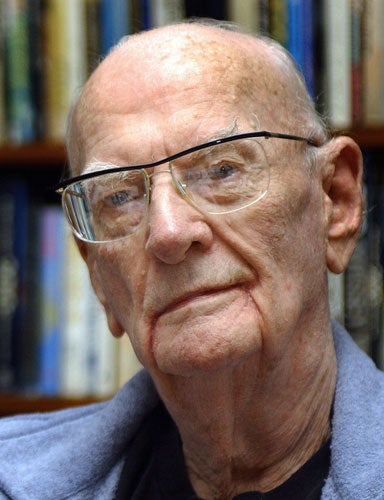
Arthur C Clarke: science fiction turns to fact
The futurologist, engineer and writer, who died last week aged 91, showed an uncanny ability to predict technological advances
Sunday 23 March 2008
Latest in Science
On Facebook
From the blogs
More than half of Afghanistan’s families live in extreme poverty
Leila is watching her baby intently, as his mouth moves trying to swallow the small blob of yellow p...
Time for a new approach to alcohol
Ambulances were called and three drunk teenagers were brought to my care. One was so drunk we had to...
Bahrain: One year on
I am used to endless lies and criticism from the BNP and its favourite blogster, as well as Islamist...
Paul Volcker stands tall against the banking lobby
Why is Europe, which likes to present itself as an opponent of speculative "Anglo-Saxon" finance, li...
Five he got right:
1. Clarke was the first to suggest that satellites which remain at a fixed point relative to Earth could be used for worldwide communications. The geostationary orbit is now known as the "Clarke orbit".
2. The father of the internet, Sir Tim Berners-Lee credits Clarke's short story, Dial F for Frankenstein, as an inspiration.
3. In his novel Rendezvous With Rama, Clarke created "Project Spaceguard", a system to track asteroids that might collide with Earth. When such a system was set up in 1996, it was called "Spaceguard", in homage.
4. The space station, now under construction, was put on screen in 1968 by Clarke and Stanley Kubrick in 2001: A Space Odyssey.
5. In 1951 Clarke envisaged nuclear-powered spacecraft, a prediction that came true with several satellites, launched by the Soviet Union, which had small reactors on board.
Five yet to come true:
1. In The Fountains of Paradise (1979), a "space lift", a geostationary satellite tethered to the Earth's surface, allowed people and goods to travel up and down without having to blast into orbit. Carbon nanotubes may make the 22,000-mile-long tether feasible.
2. Prince Harry, are you aware that in 2001, Clarke predicted that you will go into space in 2013?
3. By 2025 the brain's functions will be fully mapped, allowing us to experience full sensory immersion, making today's virtual reality seem tame.
4. In a decade or so artificial intelligence will catch up with the human brain. Then there will be two intelligent species on Earth – biological and non-biological.
5. By 2040, a "universal replicator", capable of cloning anything from caviar to diamonds, will create a society in which information is the only thing of value.
- 1 No secularism please, we're British
- 2 Apple admits it has a human rights problem
- 3 'Drunk tanks' and minimum prices to help Britain sober up
- 4 Working as a jail torturer ruined my life
- 5 Lightning kills an entire football team
- 6 Reinstate Knox's murder charge, Italian court told
- 7 Caught in his own blast: an Iranian targeting Israel
- 1 Spotify: 1 million plays, £108 return
- 2 How Koscielny became prince of the Emirates
- 3 Apple admits it has a human rights problem
- 4 Mark Steel: If religion is 'marginal', I'm the Pope
- 5 No secularism please, we're British
- 6 Lightning kills an entire football team
- 7 Matthew Norman: There's always the Human Rights Act, Trevor
- 8 Special report: The hungry generation
- 9 I was born to be a killer. Every night I see the Devil in my dreams
- 10 Six Grammys, five years off: Adele puts love before career
Free trial of new Independent iPad app
Get your daily dose of the best of British journalism, sponsored by American Airlines
Win a three-week coastal jaunt
Spend three weeks exploring every nook and cranny of gorgeous Atlantic Canada.
Amazing restaurant offers
Three glasses of free champagne and a special menu at 46 top London restaurants.
Latest Independent competitions
Win anything from gadgets to five-star holidays on our competitions and offers page.
Commercial thought leaders
Watch the best in the business world give their insights into the world of business.
Career Services
Day In a Page
No secularism please, we're British


Comments