Attack of the killer tomatoes
Botanists at Kew discover the plant is carnivorous, with ability to trap insects
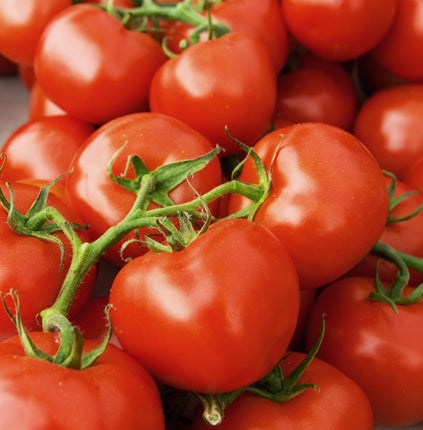
Vegetarians, look away now.
Potatoes and tomatoes make good eating but they may also have a vicious side that makes them deadly killers on a par with venus fly traps and pitcher plants.
They have been identified as among a host of plants thought to have been overlooked by botanists and explorers searching the world’s remotest regions for carnivorous species.
Researchers at Royal Botanical Gardens Kew now believe there are hundreds more plants that catch and eat insects and other small animals than they previously realised. Among them are species of petunia, ornamental tobacco plants, potatoes and tomatoes and shepherd’s purse, a relative of cabbages.
“Widely recognised carnivorous plants number some 650 and we estimate that another 325 or so are probable additions – so an increase of about 50 per cent,” said Dr Mike Fay, of Kew.
Researchers realised the plant world was more bloodthirsty than had been realised when they carried out an assessment of carnivorous plants to celebrate the bicentenary of Charles Darwin’s birth.
Darwin himself had been fascinated by carnivorous plants and conducted many experiments in which he fed them meat, and in 1875 his book on them, Insectivorous Plants, was published.
Dr Fay said it is likely that the meat-eating qualities of many plants has gone unrecognised because they are missing some of the prime characteristics associated with carnivorous species.
Pitcher plants and venus fly traps have specialist structures to kill and devour their prey but other plants are more subtle and rely on supplementing their usual diet by passive means.
Among them are plants such as ornamental tobaccos, and some species of potatoes and tomatoes which have sticky hairs which trap aphids and other small invertebrates. It is thought that rather than devour the prey directly the dead bodies decay slowly and the nutrients fall to the ground where they are taken up by the roots.
“They catch little aphids on the sticky hairs all the time. As these insects break down and drop to the ground the ground becomes enriched and the plants absorb them through the roots,” he said.
Such an ability is comparable to that of Roridula in Southern Africa which has sticky leaves on which flies get stuck but has no means of digesting them. It relies on a bug which devours the flies and the plant is then able to extract nutrients from the faeces which drop to the ground.
Domestic varieties of tomatoes and potatoes retain the ability to trap and kill small insects with their sticky hairs and are likely to absorb the nutrients through their roots when the animals decay and fall to the ground.
They are, however, thought to derive little benefit because they are so well-supplied with fertilisers whereas in the wild it might be an important source of food.
Professor Mark Chase, of Kew and Queen Mary, University of London, said: “The cultivated tomatoes and potatoes still have the hairs. Tomatoes in particular are covered with these sticky hairs. They do trap small insects on a regular basis. They do kill insects.
“We suspect in the domesticated varieties they are getting plenty of food through the roots from us so don’t get much benefit from trapping insects. In the wild they could be functioning in the way that could properly be considered carnivorous.”
Shepherd’s purse is thought to be carnivorous, at least in part, because its seeds are covered in a thin layer of a substance that both attracts tiny organisms in the soil and kills them. Furthermore, the seeds secrete an enzyme which can break down the bodies so the nutrients can be taken up during germination.
Dr Fay said the study’s findings backed up the idea that all flowering plants began with the capacity to eat meat when they evolved but that only some of them made use of and retained the ability.
The researchers, publishing their finding in The Botanical Journal of the Linnean Society, added: “We may be surrounded by many more murderous plants than we think.
“We are accustomed to think of plants as being immobile and harmless, and there is something deeply unnerving about the thought of carnivorous plants.
“Overall, angiosperms [flowering plants] of many types may be involved in a degree of carnivory and be ‘proto-carnivorous’; perhaps we should be more curious about why more plant species have not developed a ‘taste’ for animal-derived nutrients.”
Blood-curdling tales of meat-eating plants have fascinated people in Britain ever since the first live venus flytrap to reach London caused a sensation across Europe in the 18th century.
Stories of man-eating specimens have held a particular attraction since featuring in such stories as The Day of the Triffids (1951) and The Little Shop of Horrors (1960) – more recently in the Harry Potter books, whose Venomous Tentacula tries to seize living prey with its grasping vines.
One 19th-century tale of a tree in Madagascar with tentacles that would grab hold of people and drag them to their doom even purported to be based on eyewitness accounts and was only discounted in the 20th century. Another reported a man-eating tree in Central America which would crush bodies with its tentacles “until every drop of blood is squeezed out of it and becomes absorbed by the gore-loving plant”.
The potato can only dream...
Join our commenting forum
Join thought-provoking conversations, follow other Independent readers and see their replies
Comments
Bookmark popover
Removed from bookmarks