Back to the beginning: Hadron Collider creates mini-Big Bang
British scientists celebrate groundbreaking experiment that generated temperatures a million times hotter than the Sun's centre
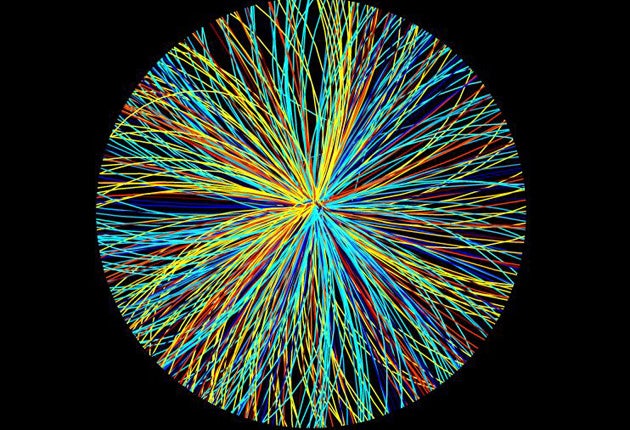
Miniature versions of the Big Bang which gave birth to the universe almost 14 billion years ago have been created within the Large Hadron Collider (LHC), the giant machine probing the nature of matter near Geneva.
British scientists working on the LHC's "Alice" (a large ion collider experiment) detector were celebrating the achievement, which opens up a new era in particle physics research.
The "mini bangs" were produced by smashing together lead ions – atoms of lead which have been stripped of their electrons – at enormous speeds. The collisions generated temperatures a million times hotter than the centre of the Sun, reproducing conditions not seen since just after the Big Bang.
Dr David Evans, a member of the UK team from the University of Birmingham, said: "We are thrilled with the achievement. The collisions generated mini Big Bangs and the highest temperatures and densities ever achieved in an experiment.
"This process took place in a safe, controlled environment generating incredibly hot and dense sub-atomic fireballs with temperatures of over 10 trillion degrees, a million times hotter than the centre of the Sun.
"At these temperatures even protons and neutrons – which make up the nuclei of atoms – melt, resulting in a hot dense soup of quarks and gluons known as a quark-gluon plasma."
Powerful magnets spun the lead ions round miles of underground tunnels at near the speed of light. Flying in opposite directions, the particles were focused into a narrow beam and forced to collide inside the massive Alice detector.
Scientists hope the quark-gluon plasma will allow them to learn more about the strong force, one of the four fundamental forces of nature.
"The strong force not only binds the nuclei of atoms together but is responsible for 98 per cent of their mass," said Dr Evans. "I now look forward to studying a tiny piece of what the universe was made of just a millionth of a second after the Big Bang."
The Alice experiment is just one part of the LHC, whose circular beam tunnel runs for 16.7 miles 328ft below the border of France and Switzerland, at Cern (the European Organisation for Nuclear Research).
Four detectors sit in huge chambers at various points in the tunnel. Alice is 16 metres high, 26 metres across and weighs around 10,000 tonnes. The Alice experiment involves around 1,000 physicists and engineers from 100 institutes in 30 countries.
Britain's contribution includes eight physicists and engineers and seven PhD students from the University of Birmingham. During the lead nuclei collisions, Alice will download data at a rate of 1.2 gigabytes per second, producing the equivalent of more than three million CDs-worth of information.
Join our commenting forum
Join thought-provoking conversations, follow other Independent readers and see their replies
Comments
Bookmark popover
Removed from bookmarks