Bad moon rising?
Tomorrow, the Earth's satellite will be as close to us as it has been in 20 years, and some say disaster will trail in its wake. Are they right? Jerome Taylor looks to the sky for answers
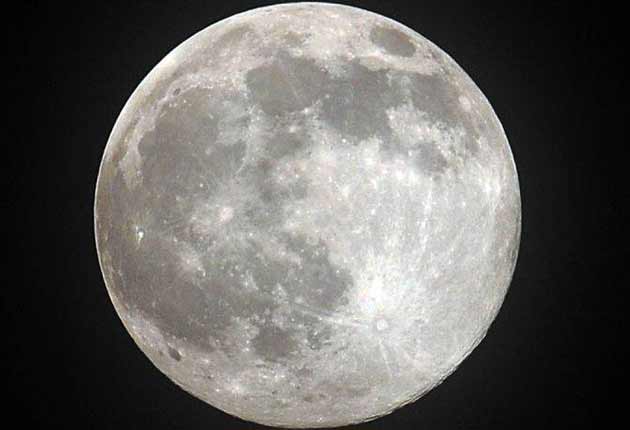
What's that in the sky? Is it a bird, is it a plane? No, it's Super-Moon. Tomorrow evening, the world will be treated to a lunar phenomenon. Those who rarely look upwards will probably not notice anything particularly different about the night sky. But regular star-gazers will see that the Earth's ghostly neighbour appears slightly larger and brighter than it usually does.
That is because the moon is going to be closer to Earth tomorrow night than at any other time during the past 18 years. The more excitable of astrologers describe such an event as a "Super-Moon" and, because the moon is at the fullest part of its cycle, tomorrow's phenomenon has even been upgraded to an "extreme Super-Moon".
For amateur and professional astronomers, a lunar perigee, which describes when the moon is closest to us, offers an opportunity to get up close and personal with our nearest extraterrestrial body. But for the more conspiracy-minded, a super moon is a far from welcome sight.
Even before Japan's devastating earthquake struck Honshu, certain sections of the global blogosphere were already warning in breathless tones about an upcoming Moon armageddon caused by the extra gravitational pull of the moon's proximity. Richard Nolle, an American astrologer who claims to have coined the phrase "super moon" and – according to his own website – foresaw the 1993 World Trade Centre bombings, has predicted a whole host of global meteorological nightmares this weekend, including a surge in extreme tides, magnitude 5+ earthquakes and a slew of powerful storms.
"Being planetary in scale," he added ominously, "there's no place on our home planet that's beyond the range of a super moon, so it wouldn't hurt to make ready wherever you are or plan to be during the March 16-22 super moon risk window."
After the Japanese earthquake struck, what further proof was needed, especially once fellow bloggers claimed that the 2004 Asian tsunami and a large Australian flood in the mid-1950s also occurred close to a lunar perigee? Fortunately, seismologists, astronomers and most scientific consensus demand a lot more evidence before we blame the moon for natural disasters.
At its perigee, the moon is about 220,000 miles from Earth; at its furthest point, 254,000 miles. Although the moon's gravitational pull is a factor in oceanic tides, there is little evidence to suggest that its pull is great enough to have any substantial effect the Earth's tectonic activity or lead to freak weather patterns.
"Don't get me started on the blogosphere," says a rather weary Kevin Horsburgh, from the National Oceanography Centre in Liverpool which monitors Britain's tidal pattern. "I don't know where they get their ideas. But the great thing about astronomy-driven tidal measurements is that they are completely predictable."
Tidal forces from the moon, Dr Horsburgh says, are roughly 10 to 15 per cent stronger during a lunar perigee which coincides with the spring tides once every four and a half years. "But that doesn't mean we'd expect the tides to be 10 to 15 per cent higher," he adds. At most, scientists say, we might expect to see tides rise by about an inch during a Super-Moon phase, hardly a figure that should create panic.
The Super-Moon scare stories have flourished unchecked on the Web among a long list of conspiracy theories. Phil Plait, writer of the Bad Astronomy blog (subtitle: "The universe is cool enough without making up crap about it"), aimed at debunking scientific myths, says attributing such powers to the moon makes no scientific sense. "Think about it," he says. "If there were some connection, and it were this obvious, geologists and seismologists would be issuing warnings every perigee and every full moon. These are people who have devoted their lives to understanding how the earth shakes, and would be screaming their heads off if it were something as easy and obvious as the moon. They don't because there's no connection."
The Japan earthquake and the Boxing Day tsunami struck during the lunar apogee, when the moon is furthest from us. In a phone call from Nevada, Mr Nolle said he had never blamed those events on Super-Moon theory. "But there are plenty of others," he said. "Christchurch, SuperMoon; Hurricane Katrina, SuperMoon. The scientific critics are not even attempting to look at super moon theory, they just go for the knee-jerk reaction."
Ironically, there is scientific evidence to suggest that the earth's gravitational pull causes earthquakes on the moon.
Thinking Big
The "Moon illusion" is what makes the Moon look enormous when it is close to the Earth's horizon. It is thought that the Moon is larger because our brains perceive it to be so. Why our brains make this mistake is a matter of debate. Some have argued that when the Moon is low on the horizon there are lots of objects such as hills, houses, trees against which you can compare its size. When it's high in the sky it sits in isolation and therefore looks smaller. But pilots flying at very high altitudes sometimes experience the Moon illusion too, without any objects in the foreground. In this case it is thought that the Moon appears larger because of the way we perceive the sky rather than the Moon itself.
The moon in numbers
220,000 Closest the Moon gets to Earth, in miles, during its perigee.
254,000 The maximum distance, in miles, between earth and moon.
12-13 Number of lunar perigees in an average year.
10-15% Increase in the Moon's gravitational pull during the Super-Moon phase.
5.5 Magnitude of the strongest quake ever measured on the Moon.
Join our commenting forum
Join thought-provoking conversations, follow other Independent readers and see their replies
Comments
Bookmark popover
Removed from bookmarks