Bio warfare scientists help solve mystery of dying bees
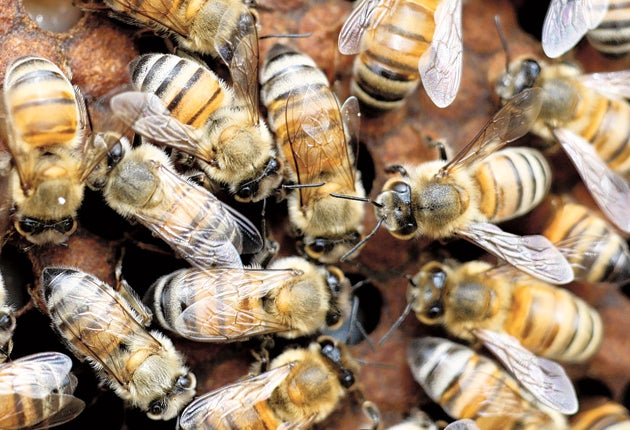
The cause of the mysterious decline of the honey bee in the United States – and elsewhere in the world – may have been found in the form of a "double whammy" infection with both a virus and a fungus.
A unique collaboration between university researchers and military scientists in the US has found that a combination of a virus and a fungus in the gut of honey bees may result in the phenomenon known as colony-collapse disorder.
Over the past four years, bee keepers in the United States, Europe and Asia have reported dramatic declines of the key insect that is critical to the pollination of many valuable crops. Between 40 and 60 per cent of honeybee colonies have suffered a complete collapse in the US alone.
One of the difficulties of finding a cause is that the affected bees often fly off in different directions leaving behind, at most, a single queen and a few workers. This has made it almost impossible for entomologists to carry out post mortems on corpses of the missing bees.
Now a team of researchers led by Jerry Bromenshenk of the University of Montana in Missoula has completed an exhaustive survey of bees that bee keepers have managed to collect from collapsed colonies to see whether they are suffering from any unusual infections. Working with scientists at the US Army Edgewood Chemical Biological Centre in Maryland, who have developed expertise in detecting and analysing biological molecules, Professor Bromenshenk and his colleagues found that many of the bees were infected with both a virus, called invertebrate iridescent virus (IIV), and a fungus known as Nosema apis.
"These findings implicate co-infection by IIV and Nosema with honey bee colony decline, giving credence to older research pointing to IIV, interacting with Nosema and mites, as probable cause of bee losses in the USA, Europe and Asia," the researchers write in their study published in the journal PLoSOne. The scientists do not know how the combination of the two infections could be causing the disorder, but they point to the fact that both virus and fungus proliferate in cool, damp weather as well as infecting bees through the gut, indicating that insect nutrition may be involved.
"Colony collapse disorder continues to impact bee colonies in the US in 2010 at levels seemingly equal to, or exceeding that of 2007, when this unusual syndrome first received worldwide press coverage," the scientists said.
"The disorder is characterised by sudden losses of bees. This results in nearly empty beehives that, at best, may harbour a queen and a small worker bee population. A vexing aspect of the disorder is that there are ample resources left in the hive, and few or no dead bees in or near the hive. Bees seem to disappear without a trace," they said.
Many potential causes of the phenomenon have been suggested, ranging from pesticides to mobile phone radiation. However, several studies have pointed to viruses and other infectious agents that could somehow disorientate the bees by interfering with the complex navigation system they use to find their way to their colonies.
The scientists have yet to work out how the virus and fungus can interact, as neither seems to be particularly lethal on their own. However, together they seem to be 100 per cent fatal, the study suggests.
"It's a chicken and egg in a sense. We don't know which came first... They are co-factors, that's all we can say at the moment. They're both present in all these collapsed colonies," Dr Bromenshenk told The New York Times.
Earlier research by scientists at the University of California, San Francisco, identified the fungus as a possible cause of the problem.
The US Army and Montana team were able to analyse the biological molecules present in dead bees to point to the link with the IIV virus – a technique developed to analyse potential biological and chemical weapons.
Join our commenting forum
Join thought-provoking conversations, follow other Independent readers and see their replies
Comments
Bookmark popover
Removed from bookmarks