Birds hold key to secret of human speech
Way that zebra finches learn to sing could explain how children pick up first words
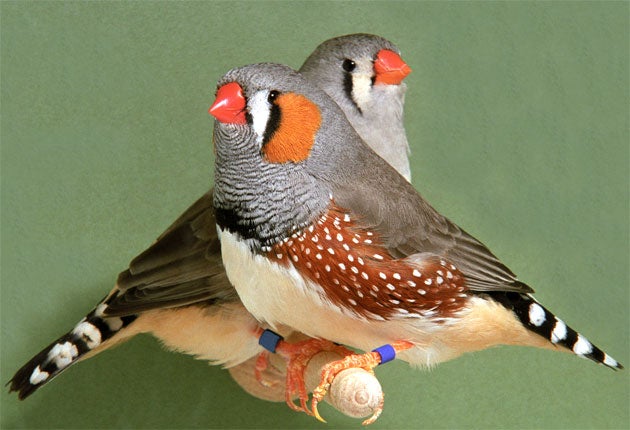
A tiny songbird that learns how to sing by listening to its parents could open the way to understanding how children start to talk and what goes wrong when speech defects occur, scientists said.
Scientists have deciphered the complete genetic code of the zebra finch and have found hundreds of genes involved in the task of allowing male zebra finches to learn the particular song sung by their fathers, which is passed on to subsequent generations in a similar way to a human language.
They believe that working out the genetic mechanism of how birds learn to sing a certain song they hear from birth will enable them to understand the same biological changes within the genes of the human brain that explain how children learn to talk by listening to their parents.
Zebra finches, which weigh less than an ounce and mate for life, have fascinated biologists because, like many songbirds, they learn their songs by listening to their elders. Parrots, hummingbirds, bats, whales and humans also communicate through learned vocalisations.
By deciphering the zebra finch's entire genome – its complete set of genes – the scientists hope to study the changes taking place within the cells of a bird's brain as it learns a song. The researchers have already identified 800 genes involved, said Professor Erich Jarvis of Duke University Medical Centre in North Carolina.
"The system for singing has much more complexity than we imagined. In the part of the brain that controls learning how to sing, about 5 per cent of the genes are regulated by the action of singing. I thought there might be 100 genes, but our laboratory found that there are at least 800 regulated genes turning off and on, and there may be more," Professor Jarvis said.
Many of these genes do not follow the convention of "coding" for proteins, but instead they help to produce smaller gene-like molecules called RNA, which, like its cousin DNA, codes for genetic information. These small RNAs regulate other genes in the brain involved in memorising and vocalising a song.
"By comparing the finch genome with the human genome, we should now be able to expand our understanding of learned vocalisation in humans. Such information may help researchers who are striving to develop new ways to diagnose and treat communication disorders, such as stuttering and autism," said Eric Green, director of the US National Human Genome Research Institute.
The zebra finch is only the second bird, after the chicken, to have its genome decoded, in an international effort involving scientists from the US, Britain and Europe. The study is published in the journal Nature.
Join our commenting forum
Join thought-provoking conversations, follow other Independent readers and see their replies
Comments
Bookmark popover
Removed from bookmarks