CSI Cairo: How science will solve the mystery of Tutankhamun
New technology is helping answer the riddles in the life, and death, of the boy pharaoh. And it's cracked other historical puzzles too
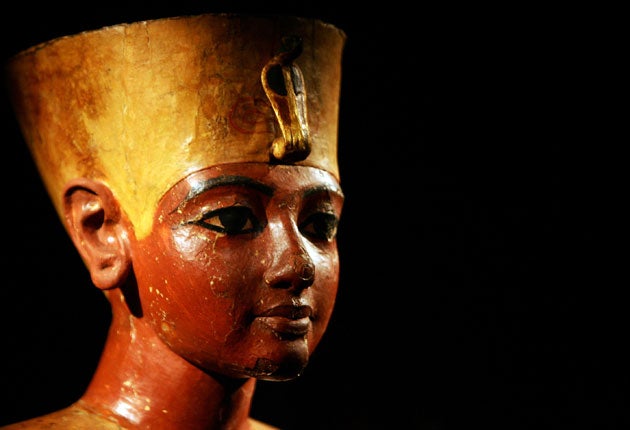
His golden funeral mask with its striped headdress has become the symbol of Egypt's ancient grandeur. Yet for all the fame that surrounds the boy King Tutankhamun, no one really knows who he was.
Now, the mystery of King Tut's lineage has finally been solved. It will be revealed to the world on Wednesday, more than 30 centuries after the pharaoh was sealed in a gold coffin.
Dr Zahi Hawass, secretary general of Egypt's Supreme Council of Antiquities, will reveal the results of extensive DNA testing carried out over the past 18 months on the pharaoh's mummy as well as two mummified foetuses found in his burial chamber.
The findings, Dr Hawass says, are the most exciting since the discovery of the tomb by the British archaeologist Howard Carter in 1922. They are also the latest in a stream of breakthroughs in our knowledge about art and the ancient world that have been made possible by new technology.
Among the outstanding riddles, for example, is whether Tutankhamun's mother was Queen Nefertiti – whose mummy has yet to be discovered – and whether the two foetuses found with him were his children.
"We don't know how King Tut died," Dr Hawass said yesterday. "We have begun DNA testing and we have made some wonderful discoveries. The results have been confirmed by the Journal of the American Medical Association and they will be publishing all the findings. It is very exciting. We will know who King Tut was."
Master of the scrolls
When Vesuvius erupted in AD79 it covered a villa in Herculaneum in feet of ash and carbon. In the 1750s tunnellers found the villa along with carbonised papyrus scrolls which disintegrated if they were opened. Now X-rays and CT (Computerised Tomography) scans of the scrolls reveal they are predominantly the work of the Epicurean philosopher and poet Philodemus of Gadara.
A genetic time machine
DNA samples have been taken from Tutankhamun and other mummies from the 18th dynasty of rulers in an attempt to establish his family lineage. While the results are being kept under wraps, the level of detail is illustrated by a 4,000-year-old clump of black hair discovered in Greenland. Analysis found that the hair belonged to a short man with brown eyes, non-white skin and "shovel-shaped" front teeth, who had an A+ blood type and probably originated in Siberia.
The X-ray that takes the lid off Vincent Van Gogh
The fluorescence synchrotron is a powerful X-ray technique that picks up the the glow from chemicals in various layers of paint. In addition to revealing an image beneath a canvas – many painters would paint over earlier works to save money – scientists can link each signal to a paint pigment and reveal hidden paintings in full colour rather than black and white. It was used on Van Gogh's Patch of Grass to discover the face of a woman, providing better understanding of his development.
Thank heavens for Fourier and infrared spectroscopy
The Fourier transform infrared spectroscope was used to identify pigments left on ancient statues. It helped in restoring Picasso's Les Demoiselles d'Avignon in 2004 by picking up organic matter in the paint, such as wax, varnish and glue.
Lasers shed light on the inner Sphinx
The ancient Egyptian Sphinx has been laser scanned from nose to tail to create an accurate 3D computer rendering of the statue. This model is used to measure the effects of humans and nature on the Sphinx. The technique has also been used by Southampton University to create an exact model of the head of an Amazon warrior discovered at Herculaneum. The model revealed the underlying geometry and tiniest detail. New digitisation techniques helped researchers to recreate the statue's colouring.
Every shroud...
Debate has raged for centuries over the Turin Shroud, said to be the cloth used to wrap the body of Christ, and imprinted with his image. Tests in 1980 using an electron microscope found red ochre which was said to be blood. An electron microprobe analyser proved that the image was painted. Carbon dating placed it between 1260 and 1390.
A victory for good old Raman
Essentially a laser microscope that can zoom down to 1,000th of a millimetre. The topsail from Nelson's flagship HMS Victory is the only extant early 19th-century sail in the world. It was analysed using Raman spectroscopy in 2005, allowing conservators to re-create the sail. The technique also helped to establish that 19 Jackson Pollock drip paintings discovered in 2005 by the film-maker Alex Matter were fakes. Matter found the paintings among his deceased parent's belongings. Pollock scholar Ellen G Landau had said they were genuine, but the Raman microscope picked up five pigments that weren't invented until after the artist's death.
Join our commenting forum
Join thought-provoking conversations, follow other Independent readers and see their replies
Comments
Bookmark popover
Removed from bookmarks