Did leak from a laboratory cause swine flu pandemic?
Same strain of influenza was released by accident three decades ago
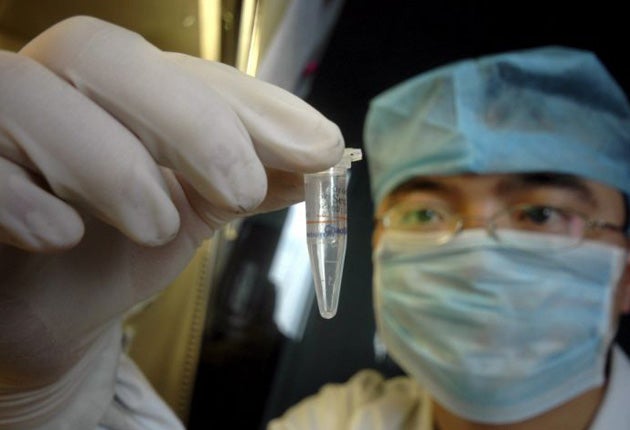
It has swept across the world killing at least 300 people and infecting thousands more. Yet the swine flu pandemic might not have happened had it not been for the accidental release of the same strain of influenza virus from a research laboratory in the late 1970s, according to a new study.
Scientists investigating the genetic make-up of flu viruses have concluded there is a high probability that the H1N1 strain of influenza "A" behind the current pandemic might never have been re-introduced into the human population were it not for an accidental leak from a laboratory working on the same strain in 1977.
Yesterday, the Department of Health announced a further surge in the number of cases in Britain with another 1,604 confirmed over the weekend, and the death of a girl in Birmingham with underlying medical complications; the third death in Britain from swine flu-related problems.
Almost 6,000 Britons have now been infected with the influenza "A" (H1N1) strain of swine flu. But two medical researchers believe that this strain of the virus had been extinct in the human population for more than 20 years until it was unwittingly reintroduced by scientists working in a research lab somewhere in the world, leading to a pandemic in 1977 that began in Russia and China.
"Careful study of the genetic origin of the [1977] virus showed that it was closely related to a 1950 strain, but dissimilar to influenza 'A' (H1N1) strains from both 1947 and 1957. This finding suggested that the 1977 outbreak strain had been preserved since 1950. The re-emergence was probably an accidental release from a laboratory source," according to the study published in The New England Journal of Medicine.
Shanta Zimmer and Donald Burke from the University of Pittsburgh in Pennsylvania said that influenza "A" (H1N1) disappeared completely from humans after a pandemic of another strain of flu in 1957. H1N1 was not detected in annual surveillance until an outbreak of H1N1 swine flu in January 1976 at a US Army base in Fort Dix, New Jersey.
This outbreak affected 230 military personnel, killing one person, but it was successfully contained and was almost certainly caused by the direct transmission of swine flu from pigs. Nevertheless, the global anxiety caused by the Fort Dix outbreak led to a surge in research into H1N1 around the world, with experiments on frozen samples of the virus stored in labs since the 1950s, Dr Zimmer said.
"I would imagine that most labs researching into influenza would have had the 1950s strain. We cannot actually pinpoint which lab had it or accidentally released it, but the re-emergence of H1N1 in 1977 made it potentially a man-made pandemic," she said.
"It's a reminder that we need to be continually vigilant in terms of laboratory procedures. The identical virus in the current pandemic would not have occurred because a component of it comes from the H1N1 strain of 1977 – but it doesn't mean to say that we wouldn't have had another one causing a pandemic," she added.
One of the most likely routes for the release of the 1950s virus is that laboratory workers became infected accidentally and then infected families and friends, Dr Zimmer explained. After the 1977 pandemic, the H1N1 strain of flu re-appeared annually as seasonal flu but this year it underwent a radical genetic change to become another pandemic strain.
Professor John Oxford of the Royal London Hospital said that the accidental release of the 1950s strain of H1N1 in 1977 is entirely plausible, but it may have been a good thing as it would have given many older people alive today some measure of immunity to the current pandemic. "We can look upon it now as a stroke of good luck," he said.
Join our commenting forum
Join thought-provoking conversations, follow other Independent readers and see their replies
Comments
Bookmark popover
Removed from bookmarks