Discovered in a tender embrace, the first known nuclear family
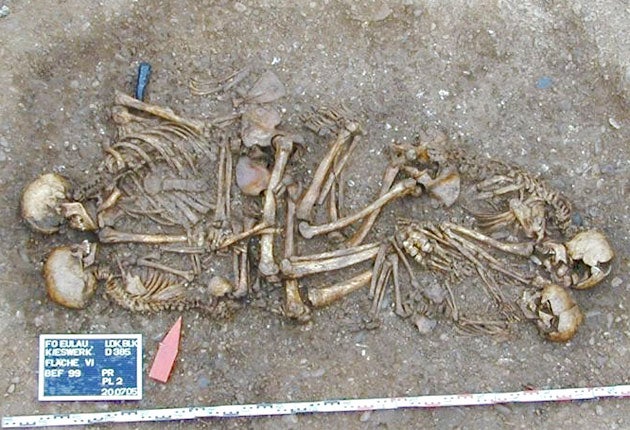
A Stone Age burial ground, where the bodies of adults and children lay together for thousands of years entwined in tender embraces, has provided the earliest evidence for the existence of the nuclear family.
DNA tests on four skeletons from one of the graves have shown that the family unit of mother, father and their biological children goes back at least 4,600 years, when these bodies were carefully interred after a violent death.
The Stone Age site near Eulau in Germany contains the skeletons of several groups of adults and children buried facing one another in an arrangement that may mirror their relationships in life, scientists said yesterday.
In one grave, a mother is embracing her son, while crouching next to her in the same grave is the father with his arms around their elder son. "A direct child-parent relationship was detected in one burial, providing the oldest molecular genetic evidence of a nuclear family," the scientists said in the study published in the journal Proceedings of the National Academy of Sciences.
The skeletons are one of four multiple burials at Eulau dating to the time when a Neolithic people, who decorated their pottery with the impressions of twisted cord, inhabited a vast area of land in central Europe. The Corded Ware Culture existed from 2700BC to about 2000BC and, apart from their pottery, they are mostly known for their relatively large number of graves and burial grounds, which indicate a high population density.
Scientists studying the Eulau site found that multiple burials are not the result of secondary interments at later dates but took place at the same time, probably due to a violent attack. Some of the bodies display signs of violent blows, and a female skeleton has a flint arrowhead embedded in its spine.
Wolfgang Haak, of the University of Adelaide in Australia, said that the information gathered on the burials at the site had provided firm evidence about the nature of the social interactions at this early point in human history – no bodies of adolescents and very young adults have been found.
"By establishing genetic links between the adults and children buried together, we have established the presence of the classic nuclear family in a prehistoric context in central Europe," Dr Haak said. "Their unity in death suggests a unity in life. But this does not establish the elemental family to be a universal model or the most ancient institution of communities."
The scientists also carried out tests on the teeth of the skeletons, revealing where they had grown up. This established that the females had "married in" from another community.
Join our commenting forum
Join thought-provoking conversations, follow other Independent readers and see their replies
Comments
Bookmark popover
Removed from bookmarks