Discovery of 'killer' shrimp alarms experts
For the first time the vicious shrimp Dikerogammarus villosus has been found in Britain, causing consternation among scientists charged with keeping the country's waterways stocked with native wildlife.
Visually, the brown crustacean may not inspire in the public the terror generated by more fearsome monsters of the deep, but a hint of the menace scientists say it is capable of can be gleaned from its nickname: the killer shrimp.
A particularly voracious and aggressive predator, Dikerogammarus villosus preys on a range of invertebrates, particularly native shrimps and young fish, sometimes causing their extinction. It tends to dominate its habitat, killing and maiming unselectively.
Its aggression – it bites and shreds its prey to death but often leaves it uneaten – is matched by its versatility, and it can survive fluctuations in temperature, salinity and oxygen levels. As a result its numbers have grown rapidly in the long rivers of western Europe in the past 20 years, damaging smaller species and ruining ecological chains.
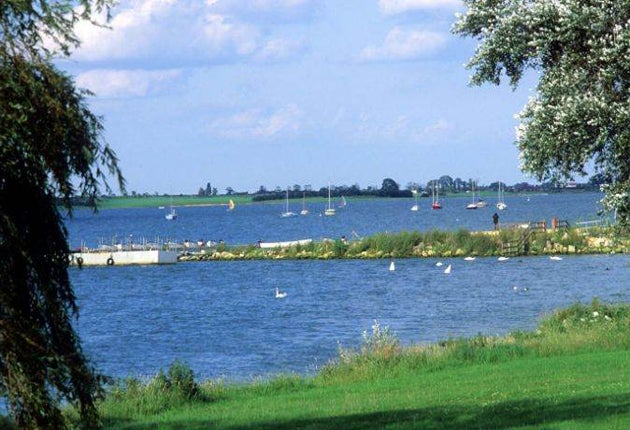
On Friday two anglers spotted unusual-looking shrimps scuttling along Grafham Water reservoir in Cambridgeshire, captured some specimens and sent them to the Environment Agency.
A preliminary identification of Dikerogammarus villosus was made – later confirmed by a Dutch scientist – prompting a full-scale alert. The agency contacted Anglian Water, the owner of Grafham, and began measures to survey and halt the shrimp's presence.
Expert biologists have begun testing the water flowing into and out of Grafham, which will indicate the severity of the problem and what measures need to be taken. Signs have also been erected asking anglers, boaters and other water users to look out for the shrimp and to scrub their rods, boats and other apparatus to ensure they do not carry it unwittingly into other water.
Dr Paul Leinster, the Environment Agency's chief executive, said: "We are devastated that this shrimp has been found in Britain, and very grateful to the keen-eyed anglers who found it.
"We are currently establishing the degree of the problem, and whether the shrimp is only in Grafham Water or if it is in nearby lakes and the Great Ouse as well."
Scientists will have to look closely because the shrimp is small, ranging from 3mm to 30mm. Despite its small size, if the shrimp becomes established in Britain, the Environment Agency fears it could soon start swallowing natives species common on lakes and rivers, such as native damselflies and water boatmen, with knock-on effects on the species which feed on them – birds, spiders and frogs.
Ciaran Nelson, from Anglian Water, said: "We have put precautionary biosecurity measures in place around Grafham Water as containing the shrimp is of paramount importance. We are also assisting with investigations to establish if it is already more widespread. The presence of this species poses no risk to the quality of drinking water supplies.
"We are asking all water users at Grafham to take the actions asked of them on-site. This includes checking equipment for shrimp when they leave the water and removing any they find. They should also ensure equipment is thoroughly cleaned and dried before it is put into any other water. Subject to these controls, recreational activities on the reservoir can continue."
The Environment Agency said the shrimp could have arrived at Grafham in various ways, for example through boating, angling, fish-stocking – or naturally, via birds. Its progress through western Europe has been rapid. Populations in the Black Sea rivers had spread northwards and westwards into the German Danube by 1992, since when it has spread into other German rivers such as the Rhine and Elbe, and the Rhone in France.
Alarm about its arrival has reached the upper echelons of Whitehall. The Environment Minister, Richard Benyon, said he was "extremely concerned" it had been found. "Anglian Water has acted quickly to put biosecurity measures in place and the Environment Agency is working hard to establish the extent of the problem and what action may need to be taken," he said.
"We need to do everything we can to protect our native wildlife and young fish from the potential damage the killer shrimp can cause."
Water users at Grafham who want information on the measures they can take to combat the spread of the shrimp can contact Anglian Water on 08457 919155.
Anyone who has seen "an unusual shrimp" is asked to email a photograph to the Centre for Ecology & Hydrology for identification. The address is: alert_nonnative@ceh.ac.uk
Invasive species...
American signal crayfish
Native to North America, signals carry a disease, crayfish plague, that is deadly to our threatened native white-claw crayfish. Since their introduction to Britain in the Seventies, they are now widespread throughout Europe.
Non-native American mink
Brought to the UK in the 1920s for fur farms. After several escapes it quickly established itself in the English countryside, becoming the main predator of the native water vole (Ratty in The Wind in the Willows), whose numbers have fallen by more than 90 per cent in 50 years, partly because of predation by mink.
Floating pennywort
After being introduced as an aquatic garden plant in the Eighties, this 'water triffid' soon went wild. It grows in huge, dense mattresses that choke waterways, starving the water of light, oxygen and nutrients.
Topmouth gudgeon
It may be less than three inches long, but this invader from Asia preys on the eggs of native fish, breeds fast and spreads disease.
Chinese mitten crabs
This Asian species has made its home in some UK fresh waters, including the Thames. It damages riverbanks by burrowing into them, and out-competes native species.
Join our commenting forum
Join thought-provoking conversations, follow other Independent readers and see their replies
Comments