Do octopuses have a favourite tentacle?
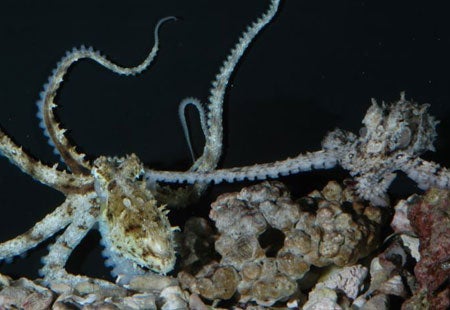
Twenty-five octopuses will today begin twiddling a Rubik's Cube in the name of scientific research.
Marine biologists concede they have little hope of the eight-limbed sea molluscs solving the fiendish plastic puzzle. Instead, the month-long project at 23 Sea Life Centres across Britain and Europe will examine octopus intelligence in an attempt to discover if they have a favourite tentacle for picking things up – much as humans are right or left-handed.
Octopuses belong to the same family as slugs and snails, but scientists believe they are far more intelligent than their relatives. The researchers will give the 25 assorted creatures food and toys to play with, and record which limbs the animals use.
Claire Little, a marine expert at the Weymouth Sea Life Centre, explained: "Uniquely, octopuses have more than half their nerves in their arms and have been shown to partially think with their arms.
"Many animals have been shown to favour a certain arm so we will see if octopuses can be added to that list."
If the experiment indicates a preference it could shed new light on the structure of octopus brains. What's more, octopuses are susceptible to stress, so finding if they have a favoured side on which to be fed could improve their well-being in captivity.
A diagram of an octopus will sit alongside the tanks with the tentacles on the right labelled R1, R2, R3 and R4 from front to back; the left tentacles labelled L1 and so on.
If the octopus uses a combination of arms, up to three will be recorded in sequence. A ball, a jam jar and Lego bricks will also be dropped in to the water for the octopuses' inspection. The giant Pacific octopus, the common octopus and the lesser octopus will all star in the research.
Previous work has shown them to have a capacity for learning and surprisingly complex memories. In 2003 an octopus in a German zoo wasrevealed to have learnt how to open jars of shrimps by copying staff. The five-month-old animal opened the jars by pressing its body on the lid and grasping the sides with its eight tentacles.
The results of the latest research will be analysed by Sea Life Centre biologists and the results announced in autumn. "We hope it will help towards solving the mystery of handedness in the animal kingdom," added Ms Little.
Join our commenting forum
Join thought-provoking conversations, follow other Independent readers and see their replies
Comments
Bookmark popover
Removed from bookmarks