Does Saturn moon hide watery caverns - and life?
News in pictures
News in pictures
On Facebook
From the blogs

Roy Hodgson for England: A club of one

To argue against Harry Redknapp for England is akin to arguing in favour of bankers bonuses. While s...

Time for a reality check on the Sri Lankan civil war

Sri Lanka, much like Britain, has side-lined accountability long enough.

Children Of Alcoholics week: One million children may just be the tip of the iceberg

Children Of Alcoholics week starts today. So, what are the aims for Nacoa during this important week...

Review of Being Human: ‘Being Human 1955’

Following on from an episode tinged with tragedy, this week lifted the mood with something lighter.

Suggested Topics

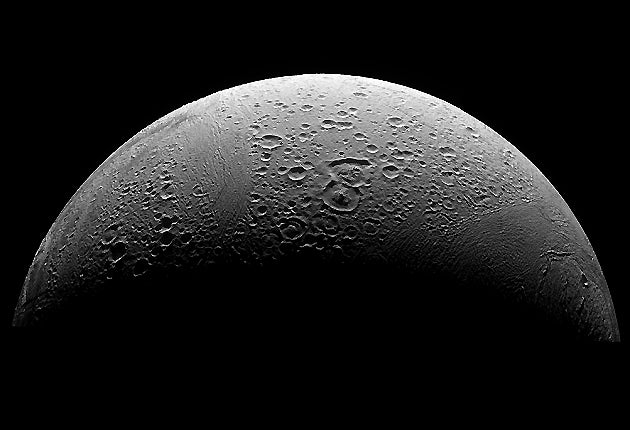
Saturn's icy moon Enceladus could contain watery underground caverns, forming a potential home for alien life, say scientists.

German researchers have found salt - a signature chemical for seawater - in ice grains from vapour jets streaming out of surface cracks, providing the strongest evidence yet of a liquid water reservoir beneath the moon's frozen crust.

A US team said the amount of salt they had detected using a different method suggested an earlier theory that water was boiling explosively into the vacuum of space via geysers was wrong, and evaporation was occurring quite slowly.

Both studies were published in the journal Nature.

One explanation for the slower evaporation may be that water is emerging from pressurised chambers below the so-called tiger stripe fractures in the moon's surface, said John Spencer of the Southwest Research Institute in Boulder, Colorado.

"Our picture of its sub-surface must now be expanded to include the possibility of misty ice caverns floored with pools and channels of salty water, lurking beneath the tiger stripes," he wrote in a commentary on the two scientific papers.

"What else may lurk in those salty pools, if they exist, remains to be seen."

The Cassini spacecraft first discovered huge plumes erupting from fissures near the south pole of Enceladus in 2005, sparking speculation of a vast underground ocean spewing vapour through giant Yellowstone-like geysers.

Since then, scientists have debated whether this meant that Enceladus (pronounced en-SELL-ah-dus), with a diameter of only 310 miles (500 km), was hiding a reservoir of liquid water. It is one of about 60 moons of the ringed planet Saturn.

Frank Postberg of the Max Planck Institute for Nuclear Physics in Heidelberg said the presence of sodium salts was compelling evidence, indicating salty minerals were washed out from rock on Enceladus in the same way oceans absorb salt on Earth.

He and colleagues reported they had found salty grains of ice after analysing data from Cassini's cosmic dust detector as it flew through Saturn's outermost ring, where Enceladus orbits.

Whether or not Enceladus harbours life remains a mystery. But the evidence of liquid water, coupled with heat near the moon's South Pole, suggests it is possible.

"If you have this large amount of water in contact with a rocky core and you have heat, then you have very good conditions," Postberg said in a telephone interview.

"On top of that we measured a slightly alkaline pH value, which is very good for the formation of complex organic molecules."

Scientists hope to find out more when Cassini makes two more close fly-bys of Enceladus in November.

www.nature.com/nature

Independent Comment
blog comments powered by Disqus

Day In a Page

Picture preview: Lucian Freud drawings

Lucian Freud drawings

Picture preview
Silent revolution at the Baftas as the French take top awards

Silent revolution at the Baftas

The Artist wins in seven categories, with Meryl Streep the other big success story
Whitney Houston: The diva who had – and lost – it all

The diva who had – and lost – it all

Nick Hasted charts the highs and lows of Whitney Houston's life
How Picasso won over (some of) the British

How Picasso won over (some of) the British

Winston Churchill and Evelyn Waugh hated his work, but Picasso provided inspiration for a whole generation of UK artists
Topshop: A Decade Of Design

Topshop: A Decade Of Design

When London Fashion Week starts on Friday, Topshop will celebrate 10 years backing its brightest young stars
John Prescott: 'My wife thought I'd just retire, but I'm not a slippers man'

'My wife thought I'd just retire, but I'm not a slippers man'

At 73, John Prescott isn't mellowing. In fact he's taking a shot at becoming a police commissioner
Jim Gamble: We are losing the race to protect our young

Jim Gamble: We are losing the race to protect our young

Technology and the children who use it won't wait for slow-moving child-protection services and police to catch up
Sarah Sands: A friend is not the one you turn to, but the person who turns to you

Sarah Sands on friendship

A friend is not the one you turn to, but the person who turns to you
Andy Burnham: 'It's a genie out of the bottle moment'

Andy Burnham interview

'It's a genie out of the bottle moment'
Leveson: What we've learnt so far

Leveson: What we've learnt so far

Ingenious hacks, shifty editors and attacks of Sudden Memory Loss Syndrome – Matthew Bell assesses the state of play at the Royal Courts of Justice
Modern lovers: The 'sexual body warriors' and pioneers transforming 21st-century relationships

Modern lovers: The 'sexual body warriors'

Sarah Morrison meets the people redefining love in the 21st century.
'I was angry, so angry': How heartbreak, betrayal and Su Pollard helped Estelle find pop success

Estelle: 'I was angry, so angry'

The singer talks about heartache, betrayal and bouncing back.
Choc tactics: Bill Granger's Valentine's recipes for chocoholics

Bill Granger's Valentine's recipes for chocoholics

Should it be white, milk or plain? Can you make a melt-in-the-mouth pudding without using any?
Male, pale & stale: Could more women on the board help Mothercare – and other ailing firms?

Male, pale & stale

Could more women on the board help Mothercare – and other ailing firms?
Upstairs, downstairs, 2012-style

Upstairs, downstairs, 2012-style

There are now more domestic workers in Britain than in Edwardian times