Einstein was right, you can be in two places at once
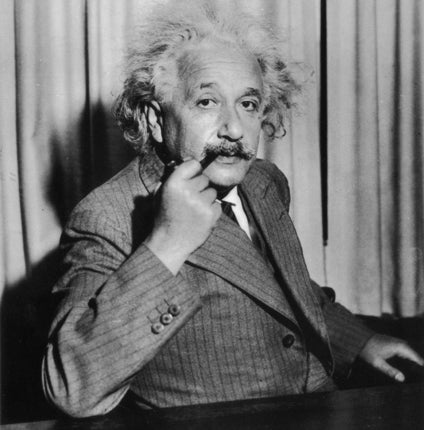
A device that exists in two different states at the same time, and coincidentally proves that Albert Einstein was right when he thought he was wrong, has been named as the scientific breakthrough of the year.
The machine, consisting of a sliver of wafer-thin metal, is the first man-made device to be governed by the mysterious quantum forces that operate at the level of atoms and sub-atomic particles.
Normal, everyday objects obey the laws of conventional Newtonian physics, named after Sir Isaac Newton, but these rules break down on the sub-atomic scale and a whole new branch of theoretical physics had to be invented to explain what happens on this sub-microscopic level.
Einstein was the first to embrace quantum physics but later rejected it on the grounds that it made everything unpredictable – "God does not play dice with the universe," he famously stated.
However, a range of effects has been recorded over the past few years that can only be explained by quantum mechanics and in March scientists were able to build the first device that seemed to follow the quantum rules that Einstein was the first to realise applied to light waves.
The breakthrough, recognised by the journal Science as the most significant this year, opens the way to a range of practical developments such as quantum computers that are far faster than conventional processors and which could never be hacked into because they handle and transmit data using an unbreakable form of encryption.
"Quantum theory dictates that a very tiny thing can absorb energy only in discrete amounts, can never sit perfectly still, and can literally be in two places at once," said Adrian Cho, a writer for Science. "This represents the first time that scientists have demonstrated quantum effects in the motion of a human-made object. It opens up a variety of possibilities ranging from new experiments that meld quantum control over light, electrical currents and motion to, perhaps someday, tests of the bounds of quantum mechanics and our sense of reality."
The breakthrough was achieved by physicists Andrew Cleland and John Martinis from the University of California at Santa Barbara. Their machine consisted of a tiny metal paddle made of semiconductor material just visible to the naked eye. By supercooling the device to just above absolute zero (minus 273C), then raising its energy by a "single quantum", they made it vibrate by getting thicker and thinner at a frequency of some 6 billion times a second, producing a detectable electric current. They even managed to get it to vibrate in two energy states at once, both a lot and a little – a phenomenon allowed only by the rules of quantum mechanics.
"Physicists still haven't achieved a two-places-at-once state with a tiny object like this one," Mr Cho said. "But now that they have reached this simplest state of quantum motion, it seems a whole lot more obtainable."
Join our commenting forum
Join thought-provoking conversations, follow other Independent readers and see their replies
Comments
Bookmark popover
Removed from bookmarks