Expert predicts 5.5 magnitude earthquake could hit London at any time
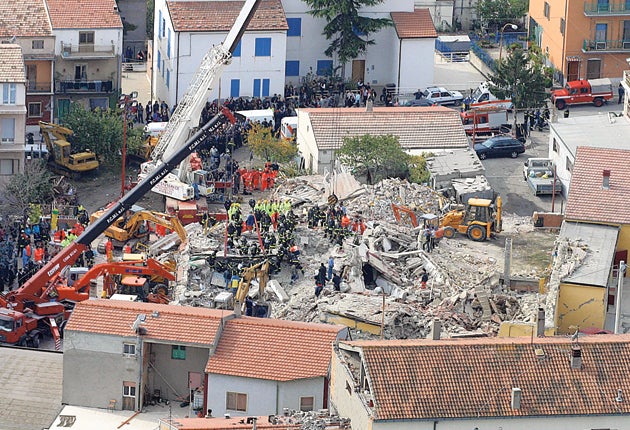
Britain is overdue a potentially devastating earthquake that could topple London's grandest landmarks, cause billions of pounds worth of damage and endanger scores of lives, a leading seismologist warned yesterday.
Dr Roger Musson of the British Geological Survey in Edinburgh said that a sub-sea fault under the Straits of Dover that has caused two large earthquakes in the past 700 years could strike again at any time, putting London in the firing line.
The geological fault has already generated relatively large earthquakes in 1382 and 1580 and there is a substantial risk that a similar-sized earthquake could occur again with severe consequences for the capital given that it rests on clay soil that is easily shaken, Dr Musson said.
"Something that has happened twice can and probably will happen three times. But whether it happens tomorrow, or in two years' time or in 20 years or 50 years, that is something we would love to know but we don't," he said.
"While the next earthquake would not be a disaster on an international scale, it will come as an unpleasant shock for a country that tends to think itself immune from earthquakes," Dr Musson told the British Science Festival at Aston University, Birmingham.
Although the British Isles does not lie on a major boundary of a tectonic plate, where most large earthquakes tend to occur, the country experiences regular small earthquakes due to a network of minor fault lines, including the one under the Straits of Dover. The number of quakes varies according to their size, with smaller quakes more frequent. Typically there is one earthquake of magnitude 3.5 each year, 10 earthquakes of magnitude 2.5 and one magnitude 4.5 every 10 years.
"There are a lot of little fault lines all over the place. It's like a dinner plate that has been broken, glued back together and squeezed," Dr Musson said.
The last large earthquake to affect London occurred on the 6 April 1580 and was estimated to have been a relatively large magnitude 5.5 based on an assessment of the area of land that was affected, Dr Musson said.
"Although [the epicentre] was some distance away, London was quite strongly affected, probably because the soft Thames clays are more susceptible to being shaken," he said.
It felled half a dozen chimney stacks and a pinnacle on Westminster Abbey. Two children were killed by falling stonework from Christ Church's hospital. The earthquake caused damage to the tower of St Peter's Church in Broadstairs, Kent, that can still be seen today, and was a virtual repeat of an earlier earthquake in 1382, caused by the same Dover Straits fault line. "Earthquakes can happen again. This is as true in Britain as anywhere else in the world," said Dr Musson.
London has about 40 times the population that it had in the 16th Century and the older infrastructure may be as vulnerable as it was four centuries ago. "The same earthquake tomorrow will impact far more people than in 1580. It would certainly be a nasty shock in terms of Britain's experience of earthquakes," he added.
Most modern buildings would be unaffected by such an earthquake but many of the older buildings, especially those in a bad state of repair, could suffer substantial damage, especially to their chimney stacks.
"It may not sound very dramatic compared to buildings collapsing, but if people are walking in the street and a chimney falls on them, that's bad news," he said.
Dr Musson added that as he works for a government-funded agency, the authorities are well aware of his assessment of the risk. "They know about it, but I'm not directly involved in formulating policy," he said.
Join our commenting forum
Join thought-provoking conversations, follow other Independent readers and see their replies
Comments
Bookmark popover
Removed from bookmarks