Feather fossils reveal dinosaur's colour
Thursday 28 January 2010
Latest in Science
On Facebook
From the blogs
Bahrain: One year on
I am used to endless lies and criticism from the BNP and its favourite blogster, as well as Islamist...
HIV orphans in Thailand prepare for the future
In Baan Gerda, a community for HIV infected or affected youngsters in Northern Thailand, a group of ...
Online House Hunter: England’s most romantic places
Our Online House Hunter goes in search of romance this Valentine's Day...
Roy Hodgson for England: A club of one
To argue against Harry Redknapp for England is akin to arguing in favour of bankers bonuses. While s...
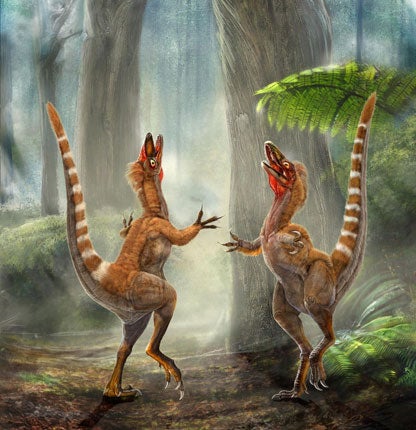
A meat-eating dinosaur that lived about 125 million years ago was adorned with orange and white rings running along the length of its tail, according to a study that has identified the colour of dinosaurs for the first time.
Fossilised bristles – primitive feathers – on the dinosaur's tail contain microscopic structures or "organelles" that would have contained the pigments which formed the coloured patterns on the tail, scientists have discovered.
The researchers also found evidence of coloration in the fossilised feathers of a bird that lived at about the same time as the dinosaur, which had the same kind of pigment-containing structures in its feathers. Both finds suggest that feathers could have arisen as a way of displaying colours rather than as a way of insulating the body against heat loss, or as an aid to the evolution of gliding and powered flight, the scientists said.
"It's the first time anyone has had evidence of original colour in a [fossilised] feather. We can't say what all the colours were because there are other colouring agents in feathers which may not be in the fossils," said Professor Mike Benton of Bristol University.
The study was carried out with Chinese scientists from the Institute of Vertebrate Palaeontology and Palaeoanthropology in Beijing on fossils of the carnivorous therapod dinosaur Sinosautropteryx, which had orange and white rings on its tail, and the ancient bird Confuciusornis, which was found to have patches of white, black and orange-brown colouring. The fossils were found in north-eastern China.
- 1 Apple admits it has a human rights problem
- 2 Caught in his own blast: an Iranian targeting Israel
- 3 No secularism please, we're British
- 4 Reinstate Knox's murder charge, Italian court told
- 5 Police confiscate passport from Brooks' assistant
- 6 Lightning kills an entire football team
- 7 'Drunk tanks' and minimum prices to help Britain sober up
- 1 How Koscielny became prince of the Emirates
- 2 Apple admits it has a human rights problem
- 3 Spotify: 1 million plays, £108 return
- 4 Six Grammys, five years off: Adele puts love before career
- 5 Lightning kills an entire football team
- 6 Police confiscate passport from Brooks' assistant
- 7 Nauru and Abkhazia: One is a destitute microstate marooned in the South Pacific, the other is a disputed former Soviet Republic 13,000km away, so why are they so keen to be friends?
- 8 I was born to be a killer. Every night I see the Devil in my dreams
- 9 Mark Steel: If religion is 'marginal', I'm the Pope
- 10 Rothschild loses libel case, and reveals secret world of money and politics
Free trial of new Independent iPad app
Get your daily dose of the best of British journalism, sponsored by American Airlines
Win a three-week coastal jaunt
Spend three weeks exploring every nook and cranny of gorgeous Atlantic Canada.
Amazing restaurant offers
Three glasses of free champagne and a special menu at 46 top London restaurants.
Latest Independent competitions
Win anything from gadgets to five-star holidays on our competitions and offers page.
Commercial thought leaders
Watch the best in the business world give their insights into the world of business.
Career Services
Day In a Page
No secularism please, we're British
Working as a jail torturer ruined my life
New Arsenal face an old question of credibility in San Siro


Comments