Fire holds no fears for chimps, says scientist
But did the early ancestor of Man learn how to control it?
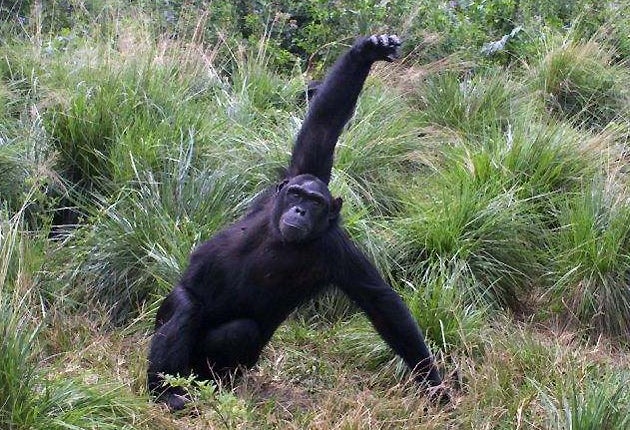
Wild chimpanzees have been observed carrying out a “fire dance” in front of grassland wildfires as part of a suite of unusual behaviours that could indicate an ability of man’s closet living relative to understand and even control fire.
Instead of fleeing the wildfires in panic, the chimps were seen to monitor them carefully, showing no signs of the fear that other animals normally exhibit. Their leader – the alpha male – was even observed performing a ritualistic display while facing the flames.
The observations could shed light on when our human ancestors first controlled fire – a key stage in human evolution. Scientists said that if chimps are able to understand the nature of fire then the same could have been true for the small-brained, ape-like ancestors of humans that lived millions of years ago.
Jill Pruetz, an anthropologist at Iowa State University in Ames, said that she observed the fire-dancing behaviour a couple of times in a group of chimps living in a savannah region at Fongoli in Senegal where wildfires often occur towards the end of the dry season.
“I saw it a couple of times in 2006 and I was really surprised at how good the chimps were at predicting the behaviour of fire. These were basically fires that occur at the end of the dry season and they can burn very hot and can move very fast,” Dr Pruetz said.
“They were much better than I was in predicting how the fire would move. In one case the fire was around us on three sides yet they were very calm and they minimised the distance and the amount of time they had to move.”
The “fire dance” of the alpha male was similar to the rain-dancing behaviour observed by primatologist Jane Goodall, when the dominant chimp would begin to sway in slow motion at the signs of an approaching storm, Dr Pruetz said.
“Chimps everywhere have what is called a rain dance and it’s just a big male display to show dominance,” she said. “Males display all the time for a number of different reasons, but when there’s a big thunderstorm approaching they do this exaggerated display, it’s almost like slow motion.
“When I was with this one party of chimps at Fongoli, the dominant male did the same sort of thing, but it was towards the fire, so I called it the fire dance.
“It wasn’t directed at other members of the group but at the fire itself. As the fire approached them, and the sound of cracking and popping was really deafening, the male started this exaggerated display.”
At one point, the leader of the group appeared to emit a barking noise unlike any other warning sound that the chimps use to communicate danger to one another. “This happened before the fire dance. I could hear it for literally hundreds of metres,” Dr Pruetz said.
“The chimps became more timid as the fire came closer, and the alpha male went out of sight and I heard him give this variation of a warning bark. I had never heard this particular vocalisation before. It seemed to me to be specific to the fire, but I don’t know what he was communicating,” she said.
Equally surprising was the general calmness of the group to an approaching fire, even when the smoke and flames were clearly visible. Dr Pruetz said that she was astonished at how calm the chimps were and this could be a key stage in the control of fire: “It’s important to conceptualise fire in order to overcome the fear of it. Some people think that for humans there is an innate fear of fire and to overcome it is the first step in ultimately controlling it and being able to make fire.
“I think that chimps are perfectly capable of controlling fire. We watch their behaviour in the face of fire and we think they can conceptualise fire, and we see that captive apes can control fire. But they we have to ask why would they do it [in the wild], what is the impetus?”
The study, to be published in the American Journal of Physical Anthropology, lends support to the idea that the control of fire occurred relatively early in human evolution. Although there is archaeological evidence from burnt remnants that human ancestors controlled fire more than a million years ago, some scientists believe this is contentious. The earliest hearths, which are indisputable evidence for the control of fire, date to less than 1 million years old.
Dr Pruetz said: “Our data contributes to the argument in that, if we have this animal that is small-brained but cognitively sophisticated, then maybe we should rethink those data from Australopithecines [early human ancestors] in how they may have reacted to fire and reconsider the data at some sites that indicate there was some kind of control of fire.”
* Additional research by Fergal MacErlean
Join our commenting forum
Join thought-provoking conversations, follow other Independent readers and see their replies
Comments
Bookmark popover
Removed from bookmarks