Forget the Large Hadron Collider. All hail Cern's new, straight-line atom smasher
Physicists are demanding a £4.4bn, 31-kilometre tunnel if they are to explain the mysteries of the universe
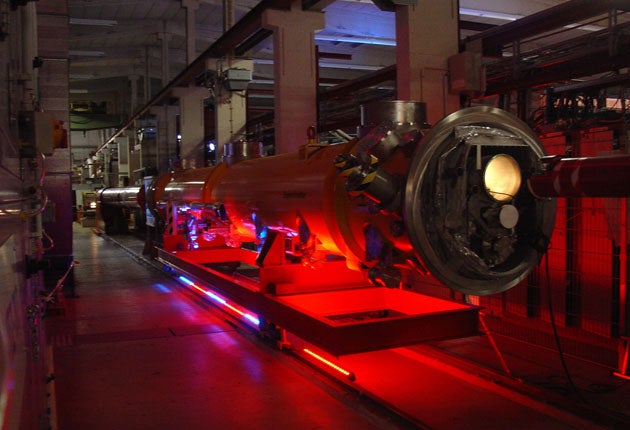
After decades of bending atoms around giant rings and smashing them apart in search of the secrets of the universe, scientists at Cern, the European particle physics laboratory outside Geneva, are reviving a 1960s technology and going straight.
Their latest ring, the 27km Large Hadron Collider (LHC), only got up to speed in March, yet physicists meet in Paris this week to discuss plans for a new $6.7bn (£4.4bn) experiment – the International Linear Collider (ILC), which they hope to start building in 2012.
The new machine will be a straight-line tunnel, 31km long, and will use super-conducting magnets to accelerate electrons and positrons, their antimatter equivalents, towards each other at close to the speed of light.
"To explore what the LHC discovers in more detail, you need an electron collider," says Professor Brian Foster, the European director of the ILC project. Part of the report to the Paris conference will be "a blueprint for how you would set up an ILC lab". More than 700 people at 300 laboratories and universities around the world are already working on the accelerator. The only other high-energy linear electron smasher is the Stanford Linear Accelerator in California, a 3.2km track built in 1962.
Both the existing LHC and the planned ILC are trying to solve fundamental physics questions, including – what happened in the Big Bang? Where did all the antimatter go? How many dimensions does space have? Why are there so many different sub-atomic particles? And, most famously, what does a Higgs particle look like?
While the 12 subatomic components of matter have all been found, including quarks and neutrinos, the Higgs has proved more elusive. The leading theory of how the universe works says that the Higgs gives matter mass, and therefore gravity. Its discovery could point the way to unifying the two great 20th-century theories of physics – quantum and general relativity.
It may also help solve the mystery of the missing 96 per cent of the universe. When astronomers estimate the mass of galaxies, including stars, planets, nebulas and black holes, they find that they are so light they should fly apart as they spin. The extra mass needed to keep them together is thought to be hidden in as yet undiscovered "dark matter".
Although a location for the new device has not been decided, Cern is a likely contender, if only because most of the physicists who might want to use it are already there, along with the infrastructure they need.
Cern's LHC uses protons made from atoms of the lightest element, hydrogen, by stripping off their electrons in a strong magnetic field, and accelerating them to 99.9999991 per cent of the speed of light.
By the time they enter the LHC, Einstein's equation, E=mc2, is in play. Since the protons can't be made to go any faster, pumping additional energy in makes them more massive. In the LHC, they can be pushed to 7 trillion electron volts. When two beams, rotating in opposite directions, cross, the energy released from a single pair could be as high as 14 TeV.
But proton crashes are "dirty". "It's like colliding two oranges together at 45mph," says Professor Foster. "Sometimes the pips hit each other, but usually it's just a spray of juice." The pips, in his analogy, are the trio of quarks that make up a proton and which cause the most interesting smashes. Typically, only one quark from each proton in a collision will hit head on, while the other four will miss each other.
Worse, although scientists know how much energy they've put into each proton, they don't know how it is distributed between the pips. One quark could have most of it, or all three could have roughly equal amounts. At best, researchers can tell the maximum amount of energy a collision might involve. Still, the LHC produces billions of bangs a second so they know roughly what energy levels give them interesting results.
But for a more precise exploration of the high-energy frontier, they will need the ILC. Electrons are 2,000 times smaller than protons, and do not have an internal structure. When two of them run into each other, the energy released is known exactly.
But electrons are not perfect. When particles are bent by magnetic fields, they emit X-rays. For relatively massive protons, this is not a problem, but for the lighter electrons it's a huge obstacle. Most of the energy pumped into an electron in the LHC would merely replace that lost to radiation.
And so, scientists are returning to the linear design of half a century ago. The exact specifications will have to wait until the LHC has identified which energy ranges are of interest, but the ILC as envisioned will have energy levels of around 0.5TeV.
Construction of the new accelerator is expected to take seven years. No one would be surprised if, during that time, plans emerge for an even more powerful, next-generation accelerator.
Join our commenting forum
Join thought-provoking conversations, follow other Independent readers and see their replies
Comments
Bookmark popover
Removed from bookmarks