Forty years since the first picture of earth from space
Earthrise, December 1968 – the first picture of our world taken from space was published 40 years ago this week and still retains its haunting power
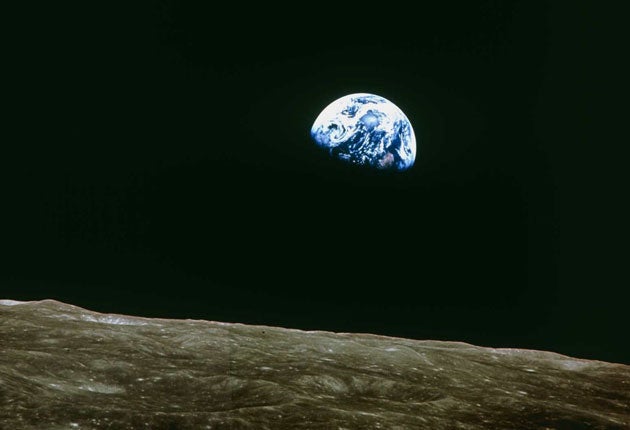
They went to the Moon, but ended up discovering the Earth. The crew of Apollo 8 were the first people to leave Earth's orbit and pass behind the far side of the Moon. They had been drilled and trained for just about every eventuality, save one – the awe-inspiring sight of seeing our own planet hanging over an empty lunar horizon.
It later became known as "Earthrise" and the image of the world rising in the dark vastness of space over a sun-lit lunar landscape became an iconic reminder of our lonely planet's splendid isolation and delicate fragility.
The image was captured during Christmas Eve 1968 but the photographs themselves appeared for the first time in print 40 years ago this week. It was an image that would eventually launch a thousand environmental movements, such was its impact on the public consciousness.
The three-man crew of Apollo 8 – Frank Borman, Jim Lovell and Bill Anders – were carrying out the necessary groundwork for the later manned landing on the Moon and were the first people to orbit the Moon, flying around the far side which is not visible from Earth.
They were also in effect the first people to lose complete contact with their own planet, not being able to see or radio Earth for the duration of their journey behind the Moon. It was only when they completed the orbit that they could regain contact.
Ironically, for the first three orbits, the crew had their backs to the Earth as it re-appeared over the lunar horizon and did not see the iconic view that would change their lives. It was only on the fourth orbit that one of the men turned round and saw the spectacle for the first time.
"Oh my God! Look at that picture over there! Isn't that something?" he said, his words captured for posterity on the on-board tape recorder. They quickly scrambled for a camera – the first couple of images of "Earthrise" were in black and white, subsequent photos were taken in colour. It is these colour photographs that became the iconic images of the environmental movement.
They showed the stark contrast between the grey, desolate landscape of the lifeless Moon and the vivid blue-and-white orb of the fertile Earth – a symbol of warmth and life in a bleak desert of deathly coldness.
Sir Fred Hoyle, the great British cosmologist, rightly predicted in 1948 that the first images of Earth from space would change forever our view of our own planet. "Earthrise" encapsulated the fragility of a place that seems so immense to the people who live there, but so tiny when viewed from the relatively short distance of its natural satellite.
Since then, hundreds of still images were taken of Earth during the nine Apollo flights to the Moon, but only 24 people have seen the whole of the Earth from space.
The American astronomer Carl Sagan captured the mood well when another picture of Earth was taken from space, this time in 1990 by the Voyager 1 spacecraft at a distance of 3.7 billion miles.
In this picture, the Earth appeared as a "pale blue dot" surrounded by the vastness of space, like a tiny mote of dust caught in a sunbeam.
"Look again at that dot. That's here. That's home. That's us. On it everyone you love, everyone you know, everyone you ever heard of, every human being who ever was, lived out their lives," Sagan said in 1996.
"Our posturing, our imagined self-importance, the delusion that we have some privileged position in the universe, are challenged by this point of light. Our planet is a lonely speck in the great enveloping cosmic dark. In our obscurity, in all this vastness, there is no hint that help will come from elsewhere to save us from ourselves."
And so it took catching sight of our own place in space to realise that the Earth is the only home we have, and we had better look after it.
'We gave that film tender love and care. There was no room for error'
By Ken MacTaggart
In the early days of 1969, Dick Underwood, Nasa's chief of photography, was working on seven rolls of Kodak film in his lab at the Houston headquarters of the US space agency Nasa.
The films had travelled with three men from the middle of the Pacific Ocean. Frank Borman, Jim Lovell and Bill Anders, the crew of Apollo 8, and had just brought back their record of mankind's first visit to another world.
The rolls, four in black-and-white and three in colour, contained a total of 865 frames. Unknown to those who received the films, among them were a handful of images that would become some of the most famous pictures in the history of photography.
The photos were carefully developed by Mr Underwood and his team. Speaking from his office in Houston, where he runs his Space Panoramas business, Mr Underwood recalled that day: "We had rehearsed the procedures hundreds of times with test films – checks on electrical systems including a back-up, purity and exact temperature of water, precise chemical mixtures, humidity of air to dry the film, and every other detail.
"I took them to my area of the photo lab where we had a special processor that I had built for Apollo space film. We gave that very thin film tender love and care. There was no room for error. Failure was not going to happen."
Many of the pictures were stunning – the last stage of the rocket surrounded by floating debris; a huge Earth seen for the first time as a complete globe hanging in a black void; and the scarred and cratered surface of the Moon at close quarters.
But one picture stood above all the rest in its unfailing ability to produce gasps. It showed the Earth from a distance of quarter of a million miles, a fragile blue and white sphere, hanging over a barren grey-brown lunar horizon.
Underwood watched the film emerge from his developing machine: "The processing of that first roll and seeing those Earthrise pictures while the film was still wet was one of the great moments in my life. Seeing the film come out of first wash was like being a witness to a great event in history."
Join our commenting forum
Join thought-provoking conversations, follow other Independent readers and see their replies
Comments
Bookmark popover
Removed from bookmarks