Genetic disorder turns risk-averse into gamblers
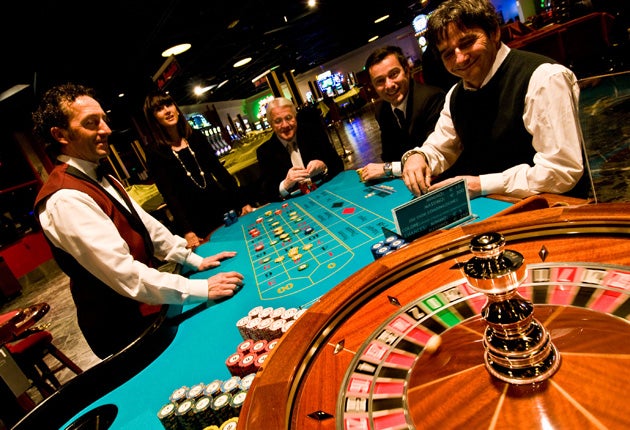
The brains of people who risk everything when gambling may be wired up differently to those of the naturally cautious, according to a study that appears to have discovered a neurological basis for reckless behaviour.
The research found that people were far more gullible to high-risk gambling when a small but distinct part of their brain had been damaged as a result of a rare genetic disorder. They showed little of the natural aversion to losing something of value that most people are born with.
Tests on two otherwise healthy women who had suffered damage to a part of the brain called the amygdala, which has already been implicated in the arousal of fear and anxiety, revealed that they were far more ready to lose money through risky gambling behaviour compared to healthy individuals with no such brain damage.
The amygdala is an almond-shaped structure deep inside the core of the brain and it is sometimes referred to as the "seat of fear" because of its important role in controlling this basic, primal emotion. It is an ancient part of the brain, existing long before the evolutionary development of the outer "higher cortex" which controls more sophisticated emotional states.
"A fully functioning amygdala appears to make us more cautious. We already know that the amygdala is involved in processing fear, and it also appears to make us afraid of losing money," said Professor Ralph Adolphs of University College London.
Scientists involved in the latest study tested the two American women, a 43-year-old who had left school at 18 and a 23-year-old who had gone to college, for their tendency to "loss aversion", in other words their inclination to risk losing money as a result of reckless gambling.
The scientists presented each woman with a gift of $50 (£32) and invited them to participate in a series of gambling choices based on a 50:50 chance of winning. They were offered bets such as risk winning $5 or losing $20, win $50 or lose $20 and win $20 or lose $15.
Most people would not take the risk on these sums based on just flipping a coin and healthy participants in the study showed normal loss-aversion behaviour seen in the population at large. The two women, however, gambled on almost any bet, no matter what the risks involved.
"Monetary loss aversion has been studied in behavioural economics for some time, but this is the first time that patients have been reported who lack it entirely," said Benedetto De Martino, a researcher at University College London who carried out the research published in the Proceedings of the National Academy of Sciences.
"It may be that the amygdala controls a very general biological mechanism for inhibiting risky behaviour when outcomes are potentially negative, such as the monetary loss aversion which shapes our everyday financial decisions," Dr De Martino said.
Loss aversion behaviour is seen to be important biologically because it is a way of weighing up the options of potentially life-threatening decisions during human evolution. However, it manifests itself in other decisions we take in a more modern setting.
"Imagine you're on Who Wants to Be a Millionaire? You've just answered the £500,000 question correctly and have moved on to the final question. You're down to your 50:50 lifeline but don't know the answer," Dr De Martino said.
"If you get it right, you'll win £1m; if you get it wrong, you'll drop back to £32,000. The vast majority of people would take the "loss-averse option" and walk away with £500,000," he said.
Join our commenting forum
Join thought-provoking conversations, follow other Independent readers and see their replies
Comments
Bookmark popover
Removed from bookmarks