Genome breakthrough heralds new dawn for agriculture
Decoding of genome hailed as most significant breakthrough in wheat production in 10,000 years
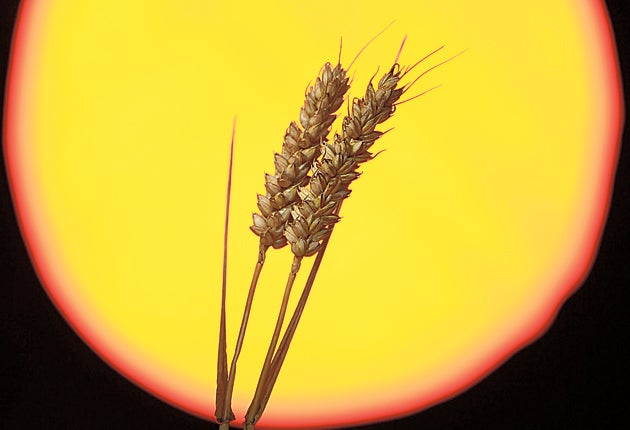
In a scientific tour-de-force that has been hailed as the most significant breakthrough in wheat production since the cereal crop was cultivated by the first farmers more than 10,000 years ago, scientists have decoded the genome of the wheat plant.
As a result, new breeds of disease-resistant crops could be producing higher wheat yields in as little as five years' time, raising the prospect of lower bread prices and greater food security in a more populated world. And rather than guard their knowledge, the British scientists responsible for the research will today place a draft version of the genome online, making it available for free to wheat breeders around the world, who will be able to use it to speed up the creation of the new disease-resistant varieties that are urgently needed. Most wheat breeders currently rely on traditional methods of mixing new crop varieties – techniques that have not changed substantially for hundreds of years.
Wheat production is under pressure, particularly this summer because of the failure of the Russian harvest. Yet world food production will have to increase by an estimated 50 per cent over the next 40 years if the growing global population is to be fed.
One leading scientist behind the British study said yesterday that knowing the wheat genome would revolutionise the conventional breeding of wheat. Breeders, he explained, will be able to take valuable shortcuts that reduce the amount of time it takes to breed essential new plant varieties resistant to disease and drought. This would not entail genetic modification, although the genome will also prove invaluable for scientists if they did want to directly change the DNA of the wheat plant.
Conventional breeding can exploit the information contained in the wheat genome to screen seeds for the genetic "markers" or signposts that indicate the presence of valuable genes, such as those for resistance to drought or disease.
"A process that now takes five or six years will take one or two years. It is quite possible in five years' time that a loaf of bread will be cheaper because of this," said Professor Neil Hall, a genome scientist at Liverpool University, one of the three research centres that carried out the study.
Professor Keith Edwards of the University of Bristol said the breakthrough was highly significant. "In a short space of time we have delivered most of the sequences necessary for plant breeders to identify genetic differences in wheat. The public release of the data will dramatically increase the efficiency of breeding new crop varieties," Professor Edwards said.
Wheat yields per hectare have increased threefold since Roman times, but over the past decade they have reached a plateau despite intensive efforts by the plant breeders who have struggled with the menace of constantly evolving wheat diseases. This is one reason why wheat production has failed to keep pace with increased demand.
"It has been estimated that in Europe, productivity needs to double to keep pace with demand and to maintain stable prices. We need to start breeding new varieties of wheat that will be important in five or 10 years' time," Professor Hall said.
"This means that we will be able to utilise the wheat genome to its full potential. It means that we can fully utilise what nature has given us." However Professor Hall added: "Unless global population is kept under control, nature may not be enough and we may have to use genetic modification because there is always going to be a limit to what you can get out of wheat."
Although wheat was one of the first domesticated crops, it has posed formidable problems for modern breeders, largely because of its complex genetics which are the result of the plant being a hybrid of three distinct species of wild grass. The 17 billion individual "letters" in the wheat genome – which is more than five times larger than the human genome – mean that it is one of the largest genomes to be sequenced. The draft sequence, covering 95 per cent of the wheat plant's DNA, was completed within a year of the start of the project, which cost £1.8m and was funded by the Biotechnology and Biological Sciences Research Council.
"Sequencing the human genome took 15 years to complete, but with huge advances in DNA technology, the wheat genome took only a year," Professor Hall said. "The information we have collected will be invaluable in tackling the problem of global food shortage."
He added: "The primary goal of this research was to help conventional plant breeders. But it may be that... genetic modification will also be necessary to boost yields."
Join our commenting forum
Join thought-provoking conversations, follow other Independent readers and see their replies
Comments
Bookmark popover
Removed from bookmarks