Giant iceberg breaks free from Antarctic in collision
Saturday 27 February 2010
Latest in Science
On Facebook
From the blogs
More than half of Afghanistan’s families live in extreme poverty
Leila is watching her baby intently, as his mouth moves trying to swallow the small blob of yellow p...
Time for a new approach to alcohol
Ambulances were called and three drunk teenagers were brought to my care. One was so drunk we had to...
Bahrain: One year on
I am used to endless lies and criticism from the BNP and its favourite blogster, as well as Islamist...
Paul Volcker stands tall against the banking lobby
Why is Europe, which likes to present itself as an opponent of speculative "Anglo-Saxon" finance, li...
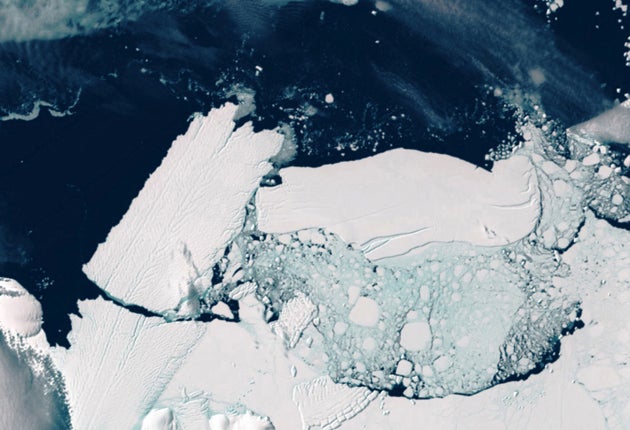
An iceberg the size of Luxembourg has broken away from the Antarctic continent and is drifting towards an area of the Southern Ocean that plays a critical role in driving the world's ocean circulation – the global "conveyor belt" of circulating sea water.
The floating iceberg, which contains enough fresh water to supply a third of the world's population for a year, is 48 miles long, 22 miles wide, has a surface area of 965 square miles and an average thickness of 1,300 feet. It is one of the largest icebergs to be monitored by scientists.
Researchers believe the iceberg may be big enough to interfere with the flow of extremely cold and salty water that naturally sinks to the seabed in this part of the southern hemisphere to form the deep current of water that is transported around the world along the sea floor.
This ocean circulation transports heat and nutrients and is vital for the marine food chain as well as maintaining important currents, such as the Gulf Stream
The giant iceberg broke away from the Mertz Glacier tongue in East Antarctica about three weeks ago. The "calving" occurred when another, equally large, iceberg rammed against the Mertz Glacier tongue. "The calving itself hasn't been directly linked to climate change but it is related to the natural processes occurring on the ice sheet," Rob Massom, a scientist at the Australian Antarctic Climate and Ecosystems Co-operative Research Centre in Hobart, Tasmania, told the news agency Reuters.
Mike Meredith, of the British Antarctic Survey, said the drifting iceberg is unlikely to completely interrupt the global ocean circulation. "This bottom water formation occurs in several places... It is unlikely that we'll see any impact on the global climate," he said.
- 1 No secularism please, we're British
- 2 Apple admits it has a human rights problem
- 3 'Drunk tanks' and minimum prices to help Britain sober up
- 4 Working as a jail torturer ruined my life
- 5 Lightning kills an entire football team
- 6 Reinstate Knox's murder charge, Italian court told
- 7 Caught in his own blast: an Iranian targeting Israel
- 1 Spotify: 1 million plays, £108 return
- 2 How Koscielny became prince of the Emirates
- 3 Apple admits it has a human rights problem
- 4 Mark Steel: If religion is 'marginal', I'm the Pope
- 5 No secularism please, we're British
- 6 Lightning kills an entire football team
- 7 Matthew Norman: There's always the Human Rights Act, Trevor
- 8 Special report: The hungry generation
- 9 I was born to be a killer. Every night I see the Devil in my dreams
- 10 Six Grammys, five years off: Adele puts love before career
Free trial of new Independent iPad app
Get your daily dose of the best of British journalism, sponsored by American Airlines
Win a three-week coastal jaunt
Spend three weeks exploring every nook and cranny of gorgeous Atlantic Canada.
Amazing restaurant offers
Three glasses of free champagne and a special menu at 46 top London restaurants.
Latest Independent competitions
Win anything from gadgets to five-star holidays on our competitions and offers page.
Commercial thought leaders
Watch the best in the business world give their insights into the world of business.
Career Services
Day In a Page
No secularism please, we're British


Comments