GM mosquitoes deployed to control Asia's dengue fever
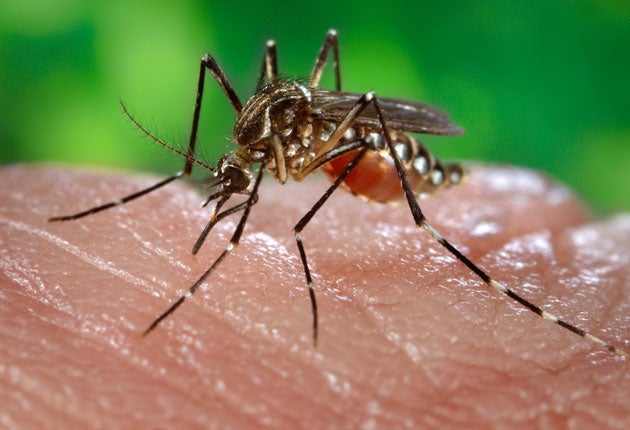
A genetically modified mosquito carrying an artificial fragment of DNA designed to curb the insect's fertility has been released for the first time in south-east Asia as part of an ambitious attempt to combat deadly dengue fever that affects up to 100 million people worldwide.
The GM mosquito has been developed by scientists at Oxford biotechnology company Oxitec to pass on a gene that kills the insect at the larval stage of its lifecycle. Officials in Malaysia said that the field experiment involved the release of about 6,000 male GM mosquitoes into an area of uninhabited forest to monitor their dispersal.
If successful, scientists hope to conduct bigger trials to test the idea that the GM males will mate with wild female mosquitoes that will produce unviable larvae that die before adulthood. On a big enough scale this should significantly reduce mosquito numbers and limit the spread of the dengue virus, which is transmitted in the bite of females.
Last year Oxitec carried out a much larger field trial in the Cayman Islands involving the release of about 3 million GM male mosquitoes – the first release of a GM mosquito into the wild. The company said that the local population of the Aedes aegypti mosquito, the species that carries the Dengue virus, fell by 80 per cent.
The researchers believe that releasing GM male mosquitoes into the wild should be safe because, unlike females that need to feed on blood to produce their eggs, males cannot spread dengue or other mosquito-borne diseases such as yellow fever and malaria as they lack the piercing mouth parts necessary to enable them to consume blood from a human victim.
The self-destruct nature of the gene passed on by the GM male mosquitoes when they mate with wild females also ensures that the genetic modification is not passed on to other organisms in the wild, said Hayden Parry, chief executive of Oxitec, which developed the GM mosquito.
"These mosquitoes are 'sterile'. We only release the males and when they mate with females their offspring die. So there are only two options, either they mate and their offspring die, or the males don't find a female and they die anyway," Mr Parry said.
"This is a very limited trial in an uninhabited area near the town of Bentong [Malaysia]. We are basically looking at how the GM mosquitoes disperse in the wild and how long they live for, but it is the first trial of a GM mosquito in this part of the world," he said.
The Malaysian Institute for Medical Research, which is in charge of the latest release experiment, said that the field trial began on 21 December and was successfully completed on 5 January. In addition to the 6,000 GM male mosquitoes, scientists also released 6,000 non-GM males for comparison.
There is no vaccine or effective drug to treat dengue fever, which is a growing problem. Malaysia has reported a 52 per cent increase in dengue-related deaths over the past 20 years and total infections rose 11 per cent from 2009 to more than 46,000 cases last year, including 134 deaths.
Controlling the insect that transmits the dengue virus is seen as critical in fighting the disease. Releasing GM males carrying a self-destruct gene comes out of the "sterile insect technique", when sterile males are released to compete with fertile wild males.
A deadly disease
Dengue causes a severe flu-like illness, and sometimes a potentially lethal complication called dengue haemorrhagic fever. Its incidence has grown dramatically in recent decades, probably linked with the spread of the aedes aegypti mosquito.
About 2.5 billion people are now at risk of dengue, which is found in mostly urban and semi-urban areas in tropical and subtropical climates. The aedes mosquito is known to favour urban habitats.
The WHO says that dengue haemorrhagic fever is a leading cause of serious illness and death among children in some Asian countries. Appropriate medical care frequently saves the lives of patients with dengue haemorrhagic fever.
Join our commenting forum
Join thought-provoking conversations, follow other Independent readers and see their replies
Comments
Bookmark popover
Removed from bookmarks