Has the mystery of Easter Island finally been solved?
New book challenges accepted wisdom about demise of the indigenous civilisation
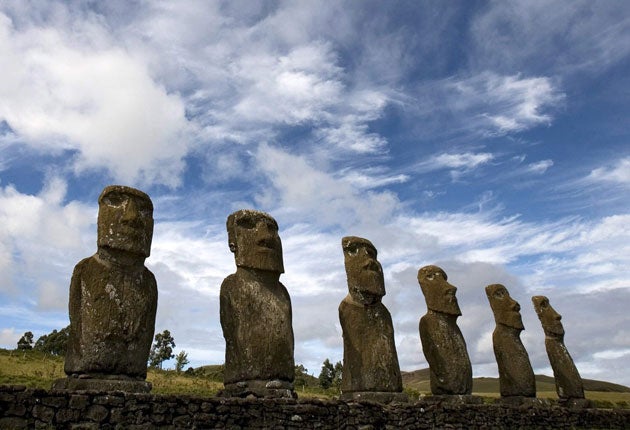
A scientific battle over the fate of Easter Island's natives is ready to erupt this summer with the publication of a book challenging the notion that their Neolithic society committed ecological suicide.
The debate has a modern political dimension. At stake is the central example, cited by Jared Diamond in his 2005 book Collapse: How Societies Choose to Fail or Survive, of the dire consequences that threaten if humans don't take care of the planet.
The archaeological argument revolves around the moai, hundreds of stone statues that line the coast of the now treeless South Pacific island, known to its inhabitants as Rapa Nui.
The almost-naked natives discovered by a Dutch expedition on Easter Sunday 1722 were considered too impoverished to have carved and moved the statues themselves.
The accepted theory is that a more advanced civilisation, numbering some 15,000 people, must have erected the statues, with hundreds of men hauling them to the shore and whole industries devoted to making ropes, rollers and sledges while the rest struggled to feed the workers.
After the last of the island's giant palm trees was felled, the theory suggests, its ecology collapsed, food production crashed, and civil war ensued, leading eventually to cannibalism, with the remnants of the population left to eke out an existence until the Dutch arrived.
But the revisionists, led by archaeologists Carl Lipo of California State University and Terry Hunt of the University of Hawaii, argue that this superior society never existed.
The Rapa Nui culture, Dr Lipo says, was wiped out after Europeans arrived, bringing epidemics of sexually transmitted diseases, TB, dysentery and leprosy. Illness, enslavement and land theft reduced the population from an estimated 3,000 to just 111 by 1877.
In their new book, The Statues that Walked: Unravelling the Mystery of Easter Island, to be published in June, Dr Lipo and Professor Hunt present their evidence that Polynesian colonists arrived in 1200, up to 800 years later than the conventional theory claims, and immediately modified the environment with slash-and-burn agriculture.
The effect this had on the giant palm forest was magnified by the rats that arrived with them. The rodent population, feeding extensively on palm seeds, exploded.
Dr Lipo argues that deforestation didn't make things much worse for humans. Rapa Nui was no tropical paradise. It's an old volcanic island and many of the nutrients in the soil had already been washed away. Burning the giant palms actually helped, but the settlers soon turned to a technique called stone mulching, in which freshly broken volcanic rocks are planted in the poor soil to add nutrients and cut down on erosion.
The same people who used rock mulching and greeted the Dutch could have moved the moai from Rano Raraku, the quarry where they were carved, to the shore, he says. The statues seem designed to allow small groups of men to move them by rocking them, as you would a refrigerator.
Similar suggestions have been made in the past, but experiments indicated that the moai would have been worn away by the time they got to the coast. Dr Lipo, aided by anthropologist Sergio Rapu, the island's first native governor under Chilean rule, thinks he has found a way around this, with more rocking and less shuffling.
Defenders of the old theory are not taking this lying down. The British archaeologist Paul Bahn and his co-author John Flenley are bringing out a third edition of The Enigmas of Easter Island with a response to the upstarts. "They're ignoring the oral tradition and just cherry-picking the data they like," he said at the weekend, adding that he has no doubt that the islanders suffered a prehistoric collapse. "They were cutting off their nose to spite their face," he said.
Join our commenting forum
Join thought-provoking conversations, follow other Independent readers and see their replies
Comments
Bookmark popover
Removed from bookmarks