Have they found the Higgs boson at last? Cern physicists say they're confident of breakthrough
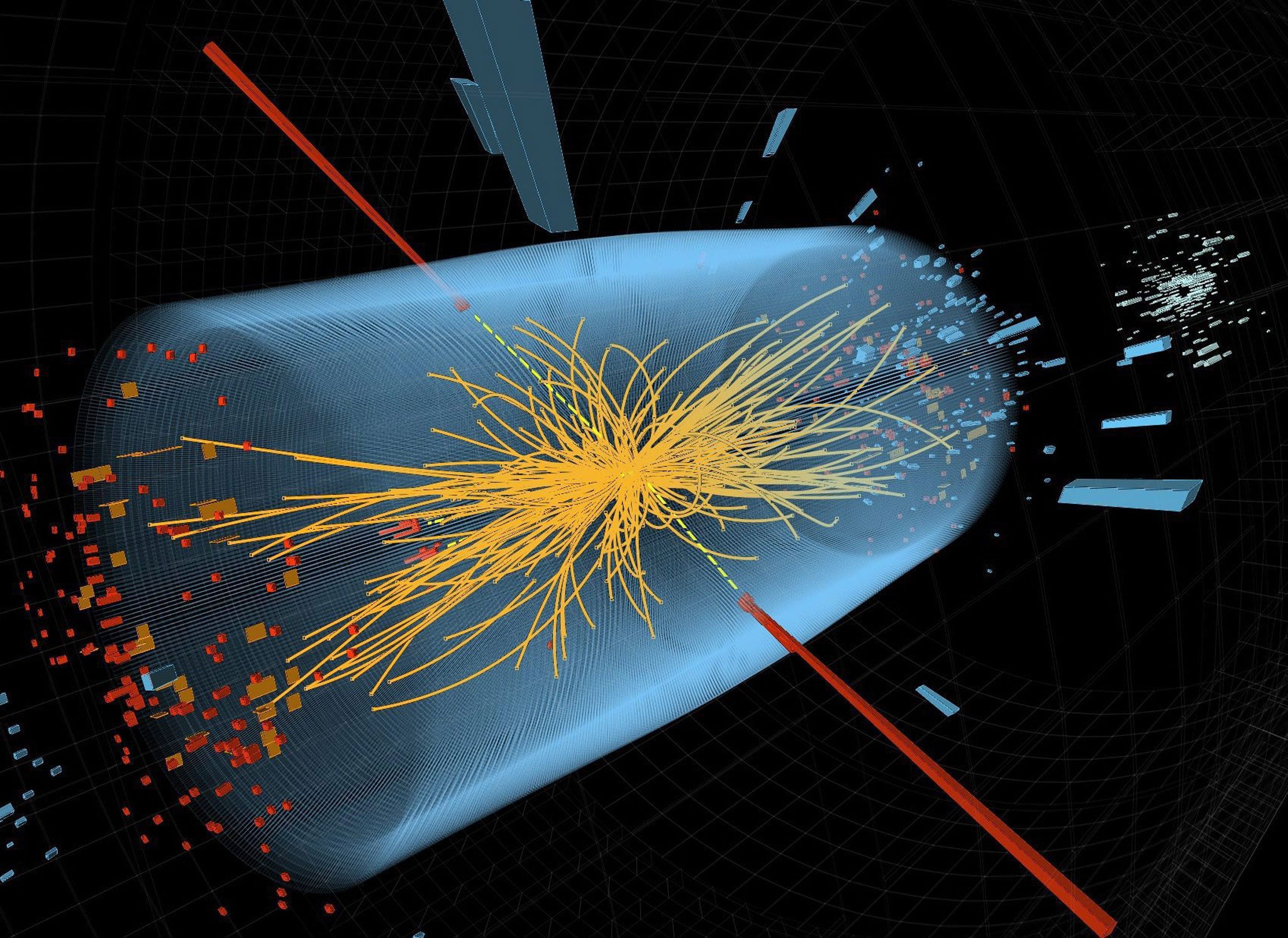
A new sub-atomic particle that could explain one of the great mysteries of the Universe – why matter has mass – has almost certainly been found according to further evidence supporting the discovery of the elusive Higgs boson.
Scientists at the European Organisation for Nuclear Research (Cern) in Geneva said yesterday they are increasingly confident that they have finally found the Higgs particle nearly 50 years after it was first proposed by Professor Peter Higgs of Edinburgh University.
Further analysis of data gathered by Cern’s Large Hadron Collider (LHC) show that the new sub-atomic particle announced last summer bears one of the classic signatures of the proposed Higgs boson – it does not spin or rotate like all other known sub-atomic particles.
The fact that this new particle is “spin zero”, combined with further evidence based on the way it decays into other known sub-atomic particles, is a convincing indication that it is indeed the Higgs boson, said Professor Dave Charlton of Birmingham University, a spokesman for the LHC’s Atlas experiment.
“It looks more and more likely that we really have found the Higgs particle, although it’s always difficult to say this with absolute certainty. Most physicists would now agree that this is probably the Higgs,” Professor Charlton said.
Professor Higgs, along with other colleagues, first suggested in the 1960s that a sub-atomic particle must pervade the Universe and create an invisible field on which matter interacts to give it mass, whether it is people or planets.
It has only been in recent years that particle physicists have been able to build a particle accelerator big enough to produce the energies needed to create the sort of sub-atomic collisions that would shake out the Higgs particle to reveal its identity.
The LHC produced enough high-energy collisions for physicists to begin to see tantalising hints of the Higgs last summer. Since then, that have trawled through the data to produce further evidence, released today at the Moriond Conference in La Thuile, Italy.
“The preliminary results with the full 2012 data set are magnificent and to me it is clear that we are dealing with a Higgs boson though we still have a long way to go to know what kind of Higgs boson it is,” said Joe Incandela, a spokesman for the CMS experiment on the LHC.
The Standard Model of physics, which attempts to unify many of the disparate forces of nature, from weak electrostatic interactions to the strong nuclear forces at the heart of the atom, suggests that the Higgs will have certain properties. But further work is needed to see whether the new particle conforms to this prediction, Professor Charlton said.
“The spin-zero finding tells us it is a Higgs particle but the question of whether it is the Standard Model Higgs or a more exotic particle remains open. We’ve only just started down that road, although at the moment it is consistent with the Standard Model,” Professor Charlton said.
Geoff Hall, professor of physics at Imperial College in London said: “The results are an indication of further excellent progress with the analysis of the data taken last year and the superb performance of the LHC accelerator and experiments. Nothing has emerged which conflicts with the assignment of the new particle as a Higgs boson.”
Join our commenting forum
Join thought-provoking conversations, follow other Independent readers and see their replies
Comments