How the elephant got its trunk (and other wonders of nature)
Nobel laureate to reveal secrets of evolution via massive gene-mapping project
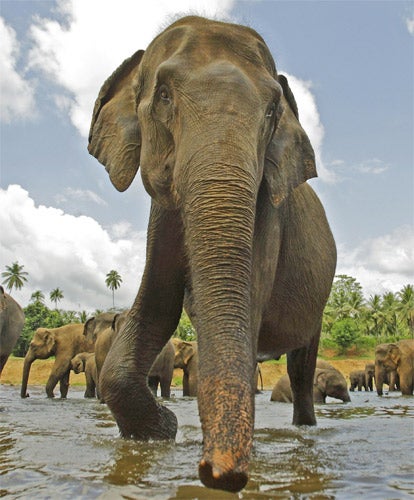
AP
'No one has ever really known how the elephant got its trunk, or how the leopard got its spots. This project will lay the foundation for work that will answer those questions and many others,' says Dr David Haussler
An ambitious plan to map the genomes of 10,000 species of vertebrates – animals with backbones – has been announced by scientists.
Unravelling the DNA sequences of the many species of vertebrates will help science to explain how the leopard got its spots, how the elephant came by its trunk and how the bat learned to fly, the researchers said.
A group of eminent biologists have proposed that the "Genome 10K" project to decode 10,000 genomes – from frogs, fish and snakes, to birds, whales and monkeys – would enable scientists to tell the 600-million-year story of how vertebrates evolved from a single marine organism with the first prototype backbone into the plethora of lifeforms in the land, sea and air.
Sydney Brenner, a Nobel laureate and a senior distinguished fellow at the Salk Institute in California, said the project would help evolutionists write the missing chapters in the story of life. "The most challenging intellectual problem in biology for this century will be the reconstruction of our biological past so we can understand how complex organisms such as ourselves evolved," Dr Brenner said.
"Genomes contain information from the past. They are molecular fossils, and having sequences from vertebrates will be an essential source of rich information," he said.
The aim of Genome 10K is to collect and sequence the DNA of each vertebrate genus – the collective grouping above a species – from a database of more than 16,000 named species of vertebrate animals compiled by more than 50 institutions from around the world.
"Understanding the evolution of the vertebrates is one of the greatest detective stories in science," said David Haussler of the University of California, Santa Cruz, one of the project's architects.
"No one has ever really known how the elephant got its trunk, or how the leopard got its spots. This project will lay the foundation for work that will answer those questions and many others," Dr Haussler said. "Differences in the DNA that makes up the genomes of the animals we find today hold the key to the great biological events of the past, such as the development of the four-chambered heart and the magnificent architecture of the wings, fins and arms, each adapted to its special purpose," he said.
Each genome is likely to consist of about 3 billion DNA "bases", or chemical letters in the DNA code, which will be assigned in their correct sequence. The project has become possible because the cost of DNA sequencing has fallen greatly since the human genome was fully decoded nearly 10 years ago.
Vertebrates are one of the most "malleable" branches of life, Dr Haussler said. They evolved in the ocean but quickly spread to every habitat on land, as well as to the air in the form of birds and bats, and the sea in the shape of whales, dolphins and porpoises.
During this expansion, they produced innovative structures, such as multi-chambered hearts, bones, teeth and an articulated internal skeleton. They have also become the most intelligent of lifeforms, symbolised by the large brain and sophisticated language and culture of humans, the scientists said.
By comparing the genomes of the 10,000 vertebrates with that of humans, the scientists hope to gain insight into how man descended from his distant animal ancestors. "We can understand the function of elements in the human genome by seeing what parts of the genome have changed and what parts have not changed in humans and other animals," Dr Haussler said.
View all comments that have been posted about this article.
Offensive or abusive comments will be removed and your IP logged and may be used to prevent further submission. In submitting a comment to the site, you agree to be bound by the Independent Minds Terms of Service.
- Print Article
- Email Article
-
Click here for copyright permissions
Copyright 2009 Independent News and Media Limited


Comments
The 10 Dirtiest Foods You're Eating and Their Nutrition Facts
No.1. Chicken
No.2. Ground Beef
No.3. Ground Turkey
No.4.Oysters
No.5. Eggs
No.6. Cantaloupe
No.10. Scallions
Eating for Stress Reduction --Top 7 Foods For Stress Release
Many foods are healing foods. Many people are full of stress.
There are various foods that help to relieve stress. Instead of taking some perscription pill for stress, you should try these types of foods, many of which are even good for you.
Check These Top 7 Foods For Stress Release
Would it be possible for you to find a way to remove spam, such as the message to which I am replying? I have seen this bit of rubbish appear several times recently and there is no reporting mechanism on the site to alert the moderators.
Thank you.
Good point. DNA lineage of all ethnic people has shown we all come from one ancient mother. Religion calls this mother "Eve" and science calls this mother "Eve" too or mother zero...
Only God knows. We just believe.
There is no methodology given. How are we going to interpret the results when scientists tell statistics.
Are the scientists going to put all 10k results of 3,000,000k into a database and then use statistics to find common ancestry. And are they then going to cross genomes to test their theories of common ancestry, creating mutants along the way.
How do you know which differences are more important than others.
What is the difference between
10001000010020003 v 10001000010010003
and
10001000010020003 v 10001000010020001
yes, I have only changed one number in each chain, with original comparator the same. Meaningless here, but in a genome chain not so meaningless.
Or am I mis-interpreting the significance of a genome?
I dont get it?
Is this supposed to be meaningful to the layperson or am I being thick ;-) ?
I am a lay-person, with an almost non-existant understanding of dna, genetics, genomes etc... (yes, I know it is evident in my post).
However, I can imagine a genome as a lengthy string of digits of GACT put into a computer and statistics used to determine how much one string differs from another.
What I don't understand is how to determine what a difference it makes if 2 genome strings of length 17 (random and grossly understated and assuming that you only compare genomes of similar length) have a single difference at the 10th place or a single difference at the 15th place. How do you start mapping genome changes from one animal to another.
Do the placings of differences show greater family ties or not. How does all this genome mapping actually show the course of evolution.
For instance, using the idea of the evolutionary family tree of branches on branches etc..., how do you place the animals at the bottom (since all of the genomes will come from animals that are currently existing).
I suppose that this is my main question - How do the genomes signify places on the branches. Or will the scientists simply slot the genome readouts onto existing understanding of descent of organisms.
What happens if statistically a pig shows greater similarity to a bumble bee than to a goat?
How will the genomes show how the elephant got its trunk?
Fast forward to 2009: Show me one programmer who doesn't start a program using a template that he has used in the past or that was written by someone else.
Think about it.....
That would be because as far as science is concerned evolution is a fact.
A: How else would it be able to clean its wedding tackle.
B: The trunk helps with its weight distribution when it walks.
C: God thought that the elephant didn't look quite right without a trunk.
D: For telling lies about the size of its penis, we all know that blue whales have bigger ones.