How the human skin is a des res for bacteria
Study reveals astonishing number and range of microbes on our bodies
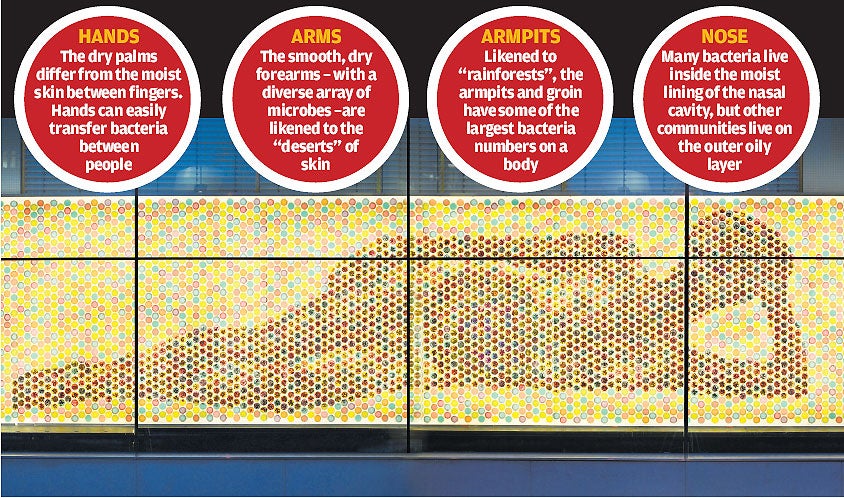
The skin of the human body is home to a far more numerous and diverse community of bacteria than previously thought. There are 100 times more bacterial species living on the skin than estimated, a study has found.
Some parts of the body such as the moist armpits were akin to tropical rainforests in terms of the type of ecosystem the bacteria inhabit, whilst other areas of skin were like dry deserts, scientists said.
The study also found that the same regions of skin on different people tended to house similar communities of bacteria and that these variations in bacterial habitats may explain why some skin complaints tend to affect certain areas of the body.
The findings emerged from a new method for studying bacterial communities living on the body using a genetic analysis of the DNA found on the skin rather than the older technique of taking skin swabs and trying to grow the microbes in the laboratory.
“What I found most surprising was the great diversity of bacteria living on the skin,” said Julia Segre of the US National Human Genome Research Institute in Bethesda, Maryland, whose study is published in the journal Science.
“The second most surprising finding was that the skin was like a desert with moist areas like streams such as the armpits, and isolated oases of life where there are rich reservoirs of deep diversity, such as the navel,” Dr Segre said.
The researchers took swabs from 20 sites around the bodies of 10 healthy people and ran them through a DNA screening process that identified bacteria belonging to 19 different phyla - one of the largest classifications of life.
Most skin bacteria do no harm and are likely to keep the skin healthy by preventing infections with more harmful microbes. "We need to stop thinking that all bacteria are bad. Personal hygiene is good, but to be cleaner is not necessarily to be healthier," she said.
Although the greatest overall number of bacteria were often found in the moist, hairy parts of the body like the armpits, they found the greatest diversity of microbes on the dry, smooth forearm, where on average they found 44 species of bacteria. The least diverse habitat was behind the ear, they said.
"Hairy, moist underarms lie a short distance from smooth, dry forearms, but these two niches are likely as ecologically dissimilar as rainforests are to deserts," the scientists said.
They found that the skin can be divided into three broad ecological habitats - moist, oily and dry. The oily sites contained the most uniform mix of microbes and included the eyebrows and sides of the nose.
The moist areas were inside the nose, the webbed areas between the fingers and inside the groin. The dry areas included the palm of the hand and the buttock, they said.
Bacterial cells are about a thousand times smaller than human cells but they are far more numerous. Even though only about 1 per cent of body weight is due to the bacteria living on or inside the body, there are about 10 times as many bacterial cells living on the skin as there are human cells in the body.
Dr Segre said that the study of bacterial communities on the skin will aid the understanding of certain skin conditions, and help to answer questions such as why psoriasis tends to affect the outer elbow whilst eczema often affects the inner bend of the elbow.
"The data generated by our study are freely available to scientists around the world. We hope this will speed efforts to understand the complex genetic and environmental factors involved in eczema, psoriasis, acne, antibiotic-resistant infections and many other disorders affecting the skin," Dr Segre said.
Bacteria communities...
Hands
The dry palms differ from the moist skin between fingers. Hands can easily transfer bacteria between people.
Arms
The smooth, dry forearms – with a diverse array of microbes –are likened to the "deserts" of skin.
Armpits
Likened to "rainforests", the armpits and groin have some of the largest bacteria numbers on a body.
Nose
Many bacteria live inside the moist lining of the nasal cavity, but other communities live on the outer oily layer.
Join our commenting forum
Join thought-provoking conversations, follow other Independent readers and see their replies
Comments
Bookmark popover
Removed from bookmarks