Humans <u>cannot</u> multitask (even women)
Study finds the structure of the brain means we struggle to do more than two jobs at once
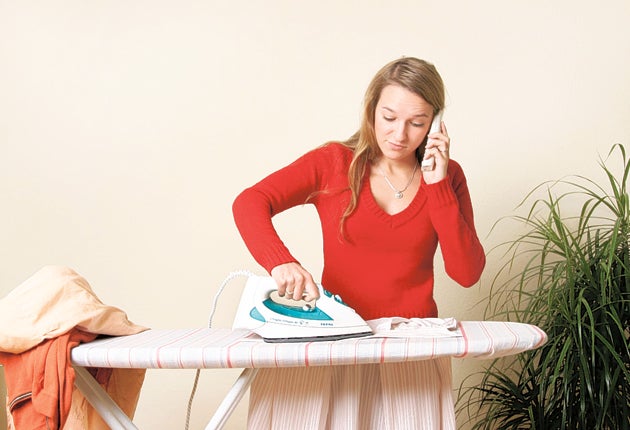
The human mind may be inherently incapable of dealing with more than two tasks at a time according to a study showing that "multi-tasking" skills are limited by the physical division of the brain into two hemispheres.
Scientists have found that when people have to carry out two tasks simultaneously their brains divide each job up so that one is performed largely by the left side of the brain and the other is carried out mainly on the right.
The study suggests that this basic division of the brain into two halves may explain why human beings tend to prefer a simple choice between two options rather than three or more. It might even explain why the Liberal Democrats, as the third political party, find it hard to get a look in at general elections.
Sylvain Charron and Etienne Koechlin of France's National Institute of Health and Medical Research in Paris, discovered the way the brain divides up two simultaneous tasks. They asked 32 volunteers to carry out two different mental puzzles while their brains were being scanned by an MRI machine.
"Each subject was performing two tasks concurrently. One task was to pair upper case letters and the other task was to pair lower case letters together. It was a very simple task and the subjects had to switch back and forth between them," Dr Koechlin said.
"We motivated them with a reward if they made no errors between trials. It was a monetary reward actually, so when the subject made an error on one of the tasks, their reward was less. We rewarded brain activity and at the same time we monitored the subjects' errors, reaction time and so on. So we could measure performance and we found that a larger reward was associated with a better performance," he said.
The study, published in the journal Science, focused on the medial frontal cortex, which lies at the front of the brain above the eyes. It is this part of the brain that is thought to drive the pursuit of rewards associated with carrying out a task. The medial frontal cortex is divided into two halves, one for each side of the brain, and the scientists found when they monitored a subject's brain activity in the MRI scanner that the right side of the frontal cortex tended to be active when the subject was carrying out one task, and the left side was more active when carrying out the other.
All volunteers were right-handed so there was no confusion about which part of the brain was controlling each task – the right hand is controlled by the left side of the brain and vice versa.
"We found that brain activity increased with rewards and expectations in the medial frontal cortex. We found in the left hemisphere that the activity increased as the reward value of one task increased, but not the other task, whereas in the right hemisphere the brain activation was related to the reward value of the other task," Professor Koechlin said.
"The two hemispheres co-operated when there was only one task. But in two tasks, one hemisphere covers the reward of one task and the other hemisphere covers the reward of the other."
"The human prefrontal function seems to be built to control two tasks simultaneously. It means in everyday behaviour we can readily switch between two tasks but not between three. With three tasks the division is limited to only two hemispheres, so there is a problem," he said.
This physical restraint on doing three things at once may have wider implications for human reasoning. "We know that subjects have difficulty deciding between more than two options and our study provides a possible explanation for why we like such binary decisions – because the brain's frontal lobe function is fundamentally binary in nature," Professor Koechlin said.
And, contrary to popular belief, they found no differences in multi-tasking skills between the sexes, meaning no excuses for men from now on.
Join our commenting forum
Join thought-provoking conversations, follow other Independent readers and see their replies
Comments
Bookmark popover
Removed from bookmarks