Lasers used to make female flies act like males
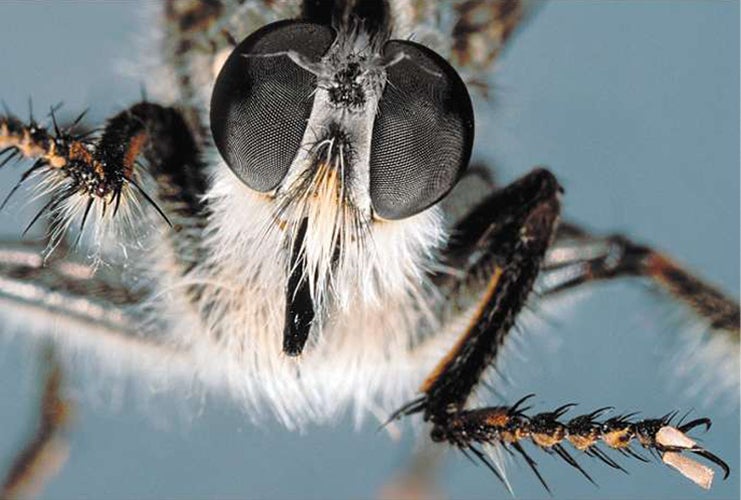
Scientists have used a laser to control a female fly's mind and make it sing "love songs" which are only ever sung by males. The ground-breaking research, which suggests the difference between the sexes may be much subtler than thought, was conducted using radical new technology which allows scientists to turn individual brain cells on and off by shining a light on them.
The research is predominantly the work of Gero Miesenböck, an Austrian scientist formerly of Yale University who has recently moved to Oxford. Nicknamed "Lord of the Flies" by contemporaries, Professor Miesenböck specialises in controlling fly movements by genetically modifying certain brain cells to make them sensitive to light.
This is the first time an animal's sexual behaviour has been modified by such "mind control" techniques.
When trying to attract a mate, male fruit flies "sing" to females by rapidly vibrating one wing. Professor Miesenböck's team genetically modified specific neurons in a fly's brain that are thought to control such behaviour using a protein that would make them light sensitive. By using a laser they were then able to trigger the vibrations at will, even in females which do not naturally emit such a love song.
Although the song was a slightly different pitch to the male version, the scientists were astonished to discover that the circuitry for male behaviour appeared to exist in female brains but simply lay dormant.
"You might expect that the brains of the sexes would be built differently, but that does not seem to be the case," Prof Miesenböck said yesterday. "Instead, it appears there is a largely bisexual or unisex brain with a few critical switches that make the difference between male and female behaviour."
In a similar experiment conducted three years ago at Harvard, scientists were able to unmask male-like traits in female mice by manipulating the pheromones which govern their sexual behaviour. Professor Miesenböck believes both experiments show how the brains of male and female species are more similar than previously thought.
"In flies, you don't see a spontaneous emergence of male behaviour when you block pheromonal cues," he said. "It needs an artificial trigger. Females have the program but seem to lack the activating command. The principle is the same [in flies and mice]: males and females are not as different as you might think."
Such research may explain how some species of fish can change their sex in days and why other species, over thousands of years, have been able to adapt their sexuality in times of demographic hardship.
But the technique of controlling individual brain cells using light may also one day help scientists treat neurological diseases. Brain scientists and psychiatrists still use electrotherapy in treating psychiatric conditions such as depression and also use electrode implants in the brain to treat diseases like Parkinson's.
Such approaches often produce unpleasant side-effects because they are inexact. Electrotherapy and electrodes target cells in a wide area, not just cells that need to be stimulated to treat an ailment. Scientists hope this new laser technique may one day allow neurologists to only target the required brain cells.
Join our commenting forum
Join thought-provoking conversations, follow other Independent readers and see their replies
Comments
Bookmark popover
Removed from bookmarks