Life and afterlife of a woman who will live for ever
Her cells have been used in genetics for 50 years. Now her story is a publishing triumph
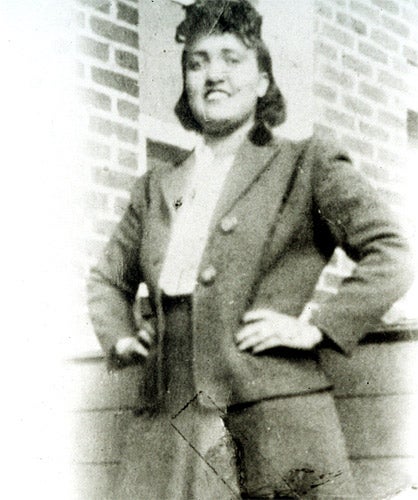
Henrietta Lacks, the poor black tobacco worker who died in 1951 without knowing that her cells would be used to treat millions of patients through vaccines and research, could be the most important woman in modern medicine. Last night, she extended her dominance to the publishing industry.
The Immortal Life of Henrietta Lacks, the story of Lacks’ remarkable life and death written by the US science writer Rebecca Skloot, won the Wellcome Trust Book Prize, a £25,000 award celebrating medicine in literature. Skloot’s work has also been named Amazon’s Best Book of 2010, beating Jonathan Franzen’s Freedom and Stieg Larsson’s The Girl Who Kicked the Hornet’s Nest. Henrietta Lacks entered the New York Times bestseller list at number five when it was released in the US in February, and stayed there for months; it was released in Britain in June to widespread acclaim.
"It's wonderful that the prize has been awarded to a book that was such a labour of love for its author,” said Clare Matterson, director of edical hmanities and engagement at the Wellcome Trust Book Prize. “Rebecca Skloot's work absolutely meets the objective of this prize. It has something of everything - a compelling science story, an emotional personal story and intriguing ethical dilemmas - and all woven together and written with style.”
Henrietta Lacks has been described as a “biomedical thriller” and chronicles the tale of how the 31-year-old’s dead cancer cells were removed from her body without her family’s permission when she died at a Baltimore hospital from cervical cancer.
After her death, scientists grew Lacks’s tumour cells in a laboratory, the first time a human cell line had survived outside the body. Since then HeLa cells (an abbreviated version of Lacks’s name) have been used to develop polio vaccines, in vitro fertilisation techniques and in genetics research, to understand cancers and to manufacture drugs for herpes and influenza.
More than 50 million tonnes of her cells have been grown since she died, and their use has been acknowledged in more than 60,000 scientific papers with 10 new studies added to the list every day.
Skloot charts the tribulations of her impoverished relatives, and the author’s obsession with the “Henrietta mystery”, namely how such an influential figure ended up being buried in an unmarked grave in a clearing just outside Roanoke, the small town in rural Virgina where she grew up.
Lacks was only confirmed as the source of the cancer cells in 1973, to the surprise of her relations. In 2001 HeLa cells were trading at $167 (£107) a vial. Her descendants have never received a penny from their ancestor’s gift to science.
“This cell line is used all around the world and revolutionised cell biology because they grew so well in culture,” said Professor William Earnshaw, principal research fellow of the University of Edinburgh’s Centre for Cell Biology. “They are used to answer a wide variety of questions and yielded a huge amount of information. We use them to study how cells grow and divide.”
The story’s relevance to black society has made the book particularly appealing to parts of the US public. The treatment of Lacks has been portrayed as another example of the mistreatment of black Americans in the pursuit of medical science. The Tuskegee Syphilis Study, carried out between 1932 and 1972, saw scientists observe how untreated syphilis slowly and painfully killed African American men. Penicillin, which could treat the affliction, was developed in the 1940s.
Skloot’s book has now sold 400,000 hardbacks in the US and Oprah Winfrey and Alan Ball, creator of Six Feet Under and True Blood, are producing an HBO film based on the tale.
Join our commenting forum
Join thought-provoking conversations, follow other Independent readers and see their replies
Comments