Mankind leaves mark on the planet with the end of the 12,000-year Holocene age
Landmark in the Earth's 4.7bn-year history as geologists hail dawn of the 'human epoch'
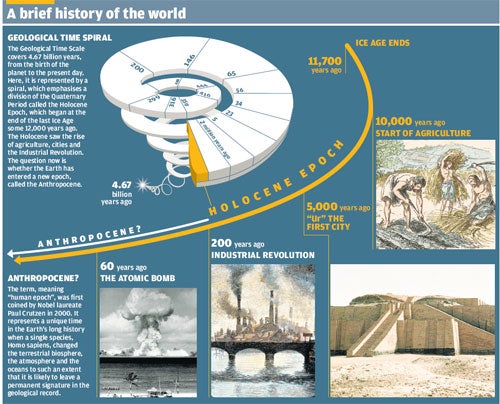
Biologists have their principles of evolution, physicists have their laws of thermodynamics and chemists have their periodic table. For geologists, perhaps the most hallowed reference source is the Geological Time Scale, a complex timeline depicting the entire history of the Earth as a series of distinct periods, epochs and ages, from the birth of the planet 4.7 billion years ago to the present day.
The Geological Time Scale is quite literally set in stone. As geologists dig down through the different sedimentary layers of rock, they go back in time to periods when prehistoric humans with stone tools hunted mammoths, to an earlier time 100 million years ago when dinosaurs roamed the land, and even to a distant era 3.8 billion years ago when life first arose in the ancient oceans of a more primitive world.
Changes to the Geological Time Scale resulted from natural events, whether it was the mass extinction of life from a giant asteroid impact, or an ice age resulting from changes to the orbit of the Earth around the Sun. Now, however, geologists are about to consider whether humans themselves have started to influence the geological history of the world.
They cite human-induced changes to the geology of the Earth in support of such an almost heretical position, pointing to alterations in the landscape caused by the growth of global agriculture, the mass extinction of animals and plants caused by hunting and habitat loss, differences in the composition of the atmosphere resulting from the burning of fossil fuels, and to a corresponding change to the global climate, including rising sea levels and increasing ocean acidity.
On the immense scales of geology, time is measured in tens of thousands, and indeed hundreds of millions of years. By comparison, human life and history are imperceptibly short.
So it is almost inconceivable that the Geological Time Scale should be changed to accommodate the effect that such short-lived human activity has had on the long history of the planet. Yet a significant number of scientists believes there is now a strong case to justify the modification of the Geological Time Scale to take into account the impact of humans on the Earth.
They believe that the current geological epoch, called the Holocene, which has existed since the end of the last ice age some 12,000 years ago, should now be amended. They suggest that the Geological Time Scale should be formally changed to include the start of a new phase called the Anthropocene, meaning the "human epoch".
Next month the International Commission on Stratigraphy (ICS), the body responsible for guarding the integrity of the Geological Time Scale, will meet in Prague where it will receive a preliminary report from its Anthropocene Working Group, a collection of experts charged with the task of considering the case of introducing the new, man-made sub-division. It will be the start of a long process that began in 2008 when the Stratigraphy Commission of the Geological Society of London decided that there "was merit" to the idea of formalising the term. But, ultimately, it will be for the distinguished members of the ICS to decide on the matter, possibly after years of intense discussion.
To gauge opinion among the 50 or so members of ICS, The Independent conducted a straw poll by email asking whether or not these experts believed there was a strong case for making the Anthropocene into a new formal division of the Geological Time Scale – and why. We received just over 20 replies and nearly half of them – nine – agreed that the case was already strong enough to consider the Anthropocene as a new division. Most of them believed it should be classified as a new "epoch", the same classification as the Holocene, which is a subdivision of the Quaternary Period, the most recent of the three periods of the Cenozoic Era.
"There is no doubt the fingerprints of the Industrial Revolution will be clearly marked by distinctive changes in the planet's biotas and environments in the geological record," said David Harper, professor of palaetontology at the University of Copenhagen in Denmark.
Mark Hounslow of Lancaster University, and member of the ICS, agreed: "Wherever future generations look back, be it in climate change, in ice-sediment, or changes to the character of sediments... it will appear to be a dramatic juncture of earth history."
Jan Zalasiewicz, a geologist at Leicester University and chairman of the Anthropocene Working Group, said the case for considering the Anthropocene rests on the changes to biodiveristy, caused by habitat loss and the introduction of invasive species, which is amplified by global warming and ocean acidification. "Such changes leave permanent markers, in the future fossil record in this case," he explained.
Barry Richards of the Geological Survey of Canada agreed: "Human activities, particularly since the onset of the industrial revolution, are clearly having a major impact on the Earth. We are leaving a clear and unique record... in the stratigraphic record."
A small majority of ICS members disagreed, arguing it is far too early to decide whether humans will leave a permanent, geological legacy. Possibly, in some tens of thousand of years from now such a division will be justified, said Professor Jozsef Palfy, head of palaeontology and geology at the Hungarian Natural History Museum in Budapest. "Its signature stratrigraphic record is such a thin veneer just now, that it is not justifiable to distinguish it as a time-rock unit. The Anthropocene is a nice and useful informal term, but I see no need for its formalisation," he said.
Professor Jim Gehling, a senior palaeontologist at the South Australia Museum in Adelaide and another member of the ICS, said the present epoch, the Holocene, began 11,700 years ago and coincided with agriculture, the domestication of animals and crop plants, and the rise of urban settlements. "This is effectively what I understand as the concept of the 'Anthropocene', when humans began the processes that, more recently, seem to be affecting climate change. The onset of the industrial revolution is not particularly significant compared with the shift from nomadic to agricultural lifestyles, and the consequent clearing of woodlands, draining of swamps and burning of fuel."
But this is not what an increasing number of geologists believe. Professor Sha Jingeng of the Chinese Academy of Sciences said the appearance of humans on Earth was the greatest "bioevent" in geological history: "That is why the Anthropocene must be used in the Geological Time Scale."
Join our commenting forum
Join thought-provoking conversations, follow other Independent readers and see their replies
Comments