Mars rover Curiosity safely lands on the red planet
A £1.6 billion one-ton robot rover the size of a small car landed safely on Mars today after one of the most daring and difficult interplanetary operations attempted
The six-wheeled rover Curiosity was lowered to the Martian surface on three nylon tethers suspended from a hovering "sky crane" kept airborne with retro rockets.
An expected signal confirming that the robot had landed was received on Earth at 6.31am UK time.
There were scenes of wild jubilation at Nasa's Jet Propulsion Laboratory in California when the message came through to mission control: "Touchdown confirmed."
Curiosity can now start its 98 week mission - the length of one Martian year - exploring a Martian crater that billions of years ago may have been filled with water.
The nuclear powered rover is bristling with sophisticated technology designed to discover if Mars may have supported life.
Roughly the size of a Mini Cooper, Curiosity is twice as long and five times as heavy as the twin rovers Spirit and Opportunity which landed on Mars in 2004.
The robot was just too heavy to have its landing cushioned by bouncing air bags - the method used for the previous rovers.
Instead scientists came up with the dramatic "sky crane" solution.
After entering the Martian atmosphere at 13,200mph, the capsule containing the rover was first slowed by friction and then a supersonic parachute.
Closer to the ground, the descent stage carrying Curiosity was released, firing retro rockets positioned around its rim. Above the landing site in Gale Crater, near the Martian equator, the rover was dropped to the surface on 25ft tethers.
The purpose of this was to prevent damage from sand and debris kicked up by the retro rockets.
Finally, the descent stage broke away to crash at a safe distance.
Curiosity's target was Gale Crater, near the Martian equator, where there is geological evidence of past water.
The rover landed close to Mount Sharp, a 3.4-mile (5.5km) high peak in the centre of the crater with clay deposits around its base.
Proof that Curiosity was on Mars came in the form of thumbnail images showing the planet's rock-strewn surface and one of the rover's wheels.
The images were relayed to Earth by the orbiting Nasa spacecraft Mars Odyssey.
Dr John Bridges, from the University of Leicester, one of two British scientists leading teams on the mission, wrote in a live blog from mission control: "It's down - landed!
"The first images are already being sent back via Odyssey. They are Hazcam images, showing a shadow cast by Curiosity on the Gale surface.
"Lots of very happy and excited people in this room! What an opportunity we have now to explore this fascinating planet."
The landing marks the start of the Mars Science Laboratory (MSL) mission during which Curiosity will act as a mobile geologist, gathering and analysing samples from the Martian surface.
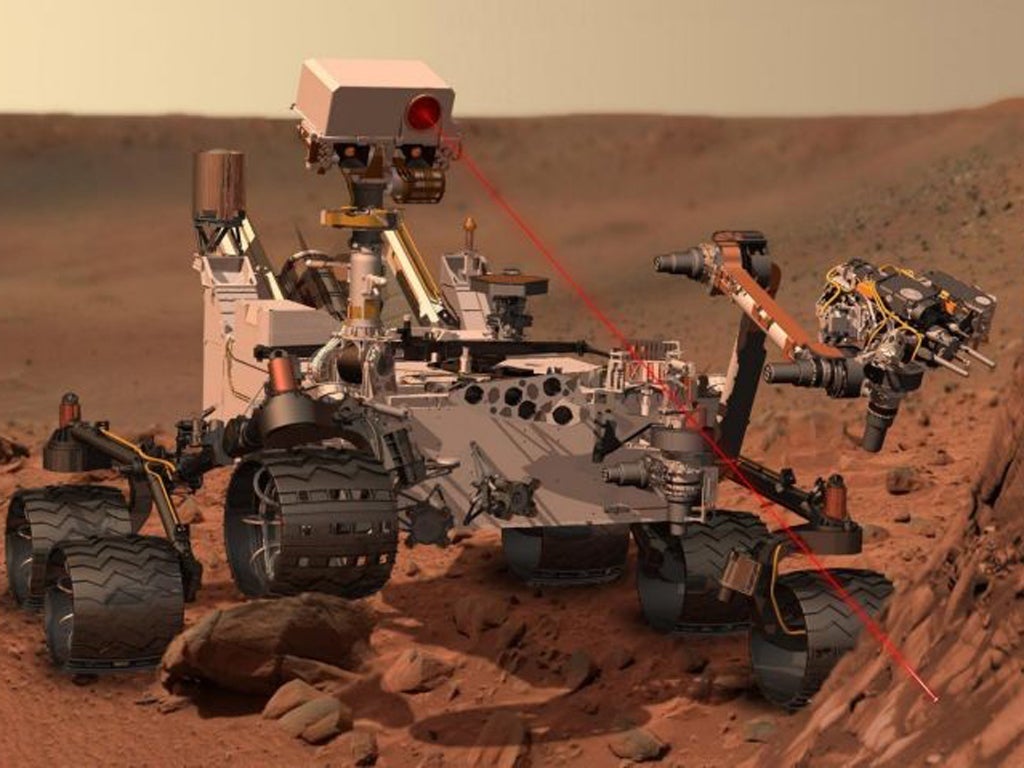
The rover has a robot arm fitted with a multi-tool “hand” for scooping up soil and drilling into rock.
It also carries its own laser gun which can be used to “zap” rocks more than 20ft (6m) away. The laser will vaporise tiny amounts of material in a flash of light that can be analysed to reveal chemical data.
As well as a stereo camera fitted to a mast for panoramic shots, Curiosity has a magnifying imager that can reveal details smaller than the width of a human hair.
Samples will be analysed using a state-of-the-art on-board laboratory.
Speaking after the landing, Dr Bridges said: “The science community has been given a very valuable chance to move forward our understanding of how Mars has evolved. How long did wet conditions last and were there standing bodies of water on Mars?
“I hope the effective combination in MSL of science objectives and space engineering will point the way towards more exploration of the solar system and technological innovations.”
Professor Sanjeev Gupta, from Imperial College London, who is also in the US leading a rover team, said: “Now that the MSL has landed we can get to grips with some remarkable science.
“The area the rover will be exploring, with its large areas of exposed rock and variety of landforms, will take us on a journey through geological time.
“With the extraordinary volume of data MSL can produce, we will be able to reconstruct how the rocks and climate of this region have changed through time.”
A live video link showed tension mounting in the mission control room in Pasadena during the final minutes before the landing.
Nasa described the period between entering the Martian atmosphere and touch-down as "seven minutes of terror".
When confirmation of the landing arrived, controllers leaped from their desks, cheering, clapping, punching the air and hugging each other. Some were in tears. One voice was heard to shout: "We did it, man."
Dr Susanne Schwenzer, from the Open University, who will be working with Dr Bridges, said: "The landing was a very exciting moment - waiting for parachute deploy; taking a deep breath after that had happened. This was the moment I for the first time thought there might be success today. And it was.. we are on Mars again. For me this is the first time I have been involved in a mission, as a member of the participating scientist team of Dr John Bridges.
"This is a very exciting moment, because we can now start to explore Gale Crater, to make our way to the clay minerals detected from orbit.
"As a mineralogist, I am especially interested in the conditions under which these minerals formed. They are witness of water activity, but exactly how they were formed will be the task of this mission to find out. The next days will bring more and more firsts, such as the first panorama image of the landing site. For the moment: we are on Mars. Looking forward to the science to come."
Scientists agree that Mars had water on its surface in ancient times, possibly as long as four billion years ago. But precisely where, when and for how long there were lakes or oceans on Mars remains a mystery. Scientists are also unsure whether, despite the presence of water, conditions were favourable or toxic to life.
Nothing could live on the radiation-cooked surface of Mars today, it is believed. But some experts do not rule out the possibility of microbial bugs still living below the Martian surface.
An Atlas V rocket carrying Curiosity blasted off from Cape Canaveral, Florida, last November. The journey to Mars crossed 352 million miles of space and took nine months.
PA
Join our commenting forum
Join thought-provoking conversations, follow other Independent readers and see their replies
Comments
Bookmark popover
Removed from bookmarks