Methane: the find that may mean life on Mars
Scientists say massive gas plumes are difficult to explain without biological source
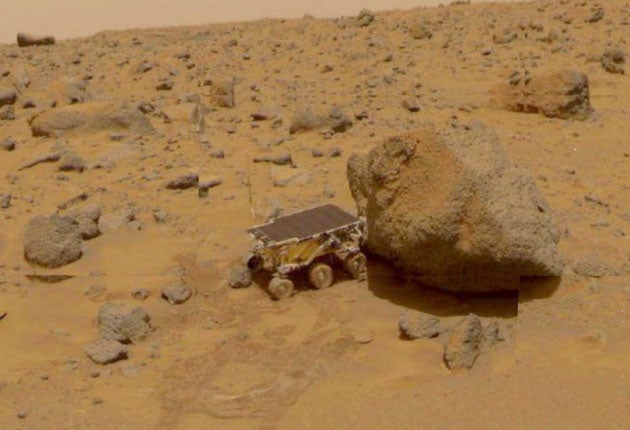
Nasa scientists confirmed last night that they have detected vast plumes of methane gas in the atmosphere of Mars, which they said could be a sign that extraterrestrial microbes are living deep beneath the surface of the Red Planet.
A detailed analysis of the Martian atmosphere using telescopes on Earth has detected three "active hotspots" in the northern hemisphere producing about 19,000 tons of methane – equivalent to some of the larger underground methane seeps on Earth.
Four years ago, scientists analysing data from the European Space Agency's Mars Express spacecraft announced that they had detected possible signs of methane, but the latest Nasa announcement has placed the detection of methane beyond doubt, raising the prospect that this could turn out to be the first unequivocal sign of life beyond Earth.
"Mars is active. It has natural gas – methane – and more importantly it varies in time and space," Michael Meyer, a Mars programme scientist at Nasa headquarters in Washington, said last night.
Methane is quickly broken down chemically in the radiation-soaked environment of Mars and does not last for more than a few hundred years, so scientists believe that it is probably being continually released from the ground by one of two sources – either as a result of geological activity or as a by-product of life.
Although the gas can be produced by geological processes, there are no known active volcanoes on Mars. This raises the tantalising possibility that it is being produced biologically by microbes living beneath the surface.
A team led by Michael Mumma of Nasa Goddard Space Flight Centre in Greenbelt, Maryland, found particularly "strong releases" of methane mixed with water vapour in the northern hemisphere in 2003. "This is the first definitive release of methane on Mars and the first definitive maps of where it is released," Dr Mumma said.
During a survey that covered 90 per cent of the Martian surface spanning a period of three Mars years, the scientists also detected a strong release of methane in 2006 at the time of the year when the Martian day is the same length as the Martian night. "Before 2003, all searches for methane were negative. Since then, three groups have reported detections of methane," the scientists say in their study published today in the journal Science.
"The most compelling question relates to the origin of the methane. The methane we detected is of unknown age – its origin could be ancient or perhaps recent. Both geochemical and biological origins have been explored, but no consensus has emerged," the scientists say in Science.
One possibility is that the methane is produced by Martian microbes living deep enough for underground water to be in liquid form. At this depth they could be living off hydrogen formed when water molecules split apart, along with carbon dioxide which could act as a source of carbon, producing methane as a waste product.
Lisa Pratt, a geobiologist at Indiana University, said the latest findings are extremely exciting. "It's time, it's prudent we explore Mars looking for a lifeform that exhales methane," she said.
Professor Fred Taylor, head of atmospheric, oceanic and planetary science at Oxford University, said it is difficult to explain how plumes could appear at specific locations at certain times without a biological source.
Join our commenting forum
Join thought-provoking conversations, follow other Independent readers and see their replies
Comments
Bookmark popover
Removed from bookmarks