Microbes that 'breathe iron' are found in Antarctic
Unique organisms have developed from more than a million years in isolation
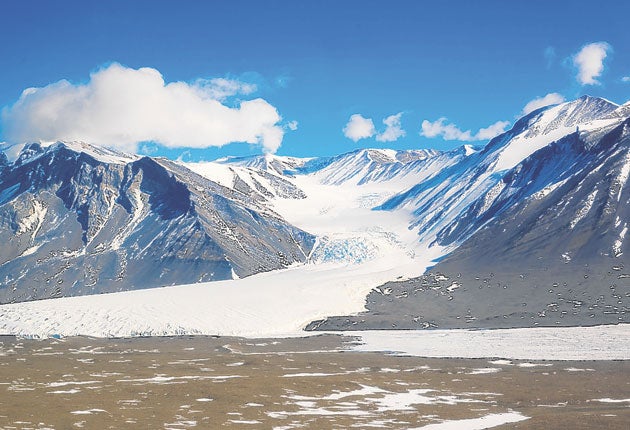
A community of microbes that have lived cut off from the rest of the world for more than 1.5 million years has been discovered beneath a vast glacier in the Antarctic.
The organisms have survived in total darkness on nothing but the minerals and long-decayed organic matter that were also trapped at the base of the glacier. Instead of breathing oxygen, they have learnt to "breathe" iron to produce energy.
The discovery of the microbes demonstrates the tenacious capacity of life to survive in the most extreme environments, and raises the prospect that it may one day be possible to find life in equally extreme environments both on Earth and on other planets.
"It's a bit like finding a forest that nobody has seen for 1.5 million years," said Professor Ann Pearson of Harvard University, one of the scientists who made the discovery. "Intriguingly, the species living there are similar to contemporary organisms, and yet quite different – a result, no doubt, of having lived in such an inhospitable environment for so long."
The scientists discovered the microbes by analysing the very salty water flowing out of a crack in the wall of the Taylor Glacier in the McMurdo Dry Valleys of East Antarctica. The glacier is famous for its "Blood Falls", an outflow of rusty-red mineral deposits first discovered in 1911.
The brine seeping from the glacier contained no oxygen, indicating that it had been isolated from the atmosphere, but it did include the telltale genetic signatures of living organisms living beneath the mass of ice.
The scientists believe that the microbes are descended from a population of marine organisms that once lived in an ancient ocean that had become a landlocked briny pond before being covered in the glacier between 1.5m and 2m years ago. The exact size of the pond is not known but it lies more than 1,300 feet below ice, about 2.5 miles from Blood Falls.
"This briny pond is a unique sort of time capsule from a period in Earth's history," said Jill Mikucki of Dartmouth College, New Hampshire, the lead author of the study, published today in the journal Science.
The scientists obtained a cold, clear sample of the brine as it flowed from a crack in the glacier. "When I started running the chemical analysis on it, there was no oxygen. That was when this got really interesting. It was a real Eureka moment," Dr Mikucki said.
"The brine is about four times more salty than seawater and so it does not freeze, despite being at a temperature of about -10C. The chemical analysis showed that the genes of the microbes found in the brine were closely related to the genes of modern-day marine microbes even though they have been cut off from the ocean for more than a million years. The salts associated with these features are marine salts, and given the history of marine water in the dry valleys, it made sense that subglacial microbial communities might retain some of their marine heritage," Dr Mikucki said.
Scientists at the site are using the same sort of analytical techniques to search for extreme terrestrial life forms that they hope to use in the search for life on Mars and Europa, the frozen moon of Jupiter.
Join our commenting forum
Join thought-provoking conversations, follow other Independent readers and see their replies
Comments
Bookmark popover
Removed from bookmarks