Mind over matter: How Stephen Hawking defied Motor Neurone Disease for 50 years
His work spans the whole of time, but our greatest theoretical physicist is as remarkable for reaching his 70th birthday, writes Jeremy Laurance
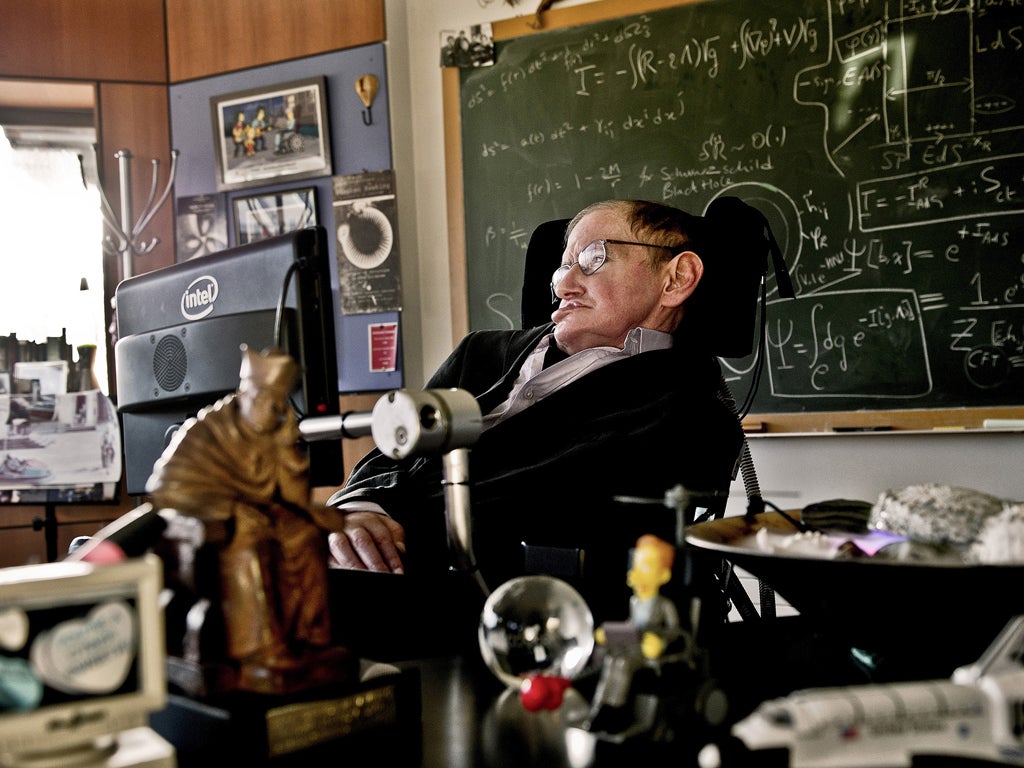
The cream of Britain's scientific establishment will gather in Cambridge tomorrow to celebrate the 70th birthday of the world's best known theoretical physicist. Lord Rees, the Astronomer Royal, will lead the tributes to Stephen Hawking, who for nearly four decades has dominated a field of research that extends from the beginnings of the universe to the end of time.
But some think Professor Hawking should be celebrated as much for surviving almost 50 years, a brilliant mind trapped in a crushed body, with a disease that kills most sufferers in less than three years. Diagnosed with motor neurone disease at 21, he was given two years to live.
He has not merely survived but prospered, in a way few could match. Married twice, the father of three children and the author of A Brief History of Time, which has sold 10 million copies since its publication in 1988, he has also somehow found time to extend and deepen our understanding of the cosmos. At 70 he still leads a jetset lifestyle, crossing continents and giving lectures to promote his enthusiasms.
At a lunch just before Christmas a guest asked what he was currently working on. There was a long pause while he activated the voice synthesiser through which he communicates, before it sputtered into life. "The origins of the universe", came the disembodied monotone, confirming no diminution in the professor's giant ambitions.
Has his brain helped his survival? Probably not. There is no evidence that higher IQ extends the life of people with extreme disabilities. But his positive outlook almost certainly has made a difference. He has written about the shock his diagnosis caused him, as a bored and unpromising PhD student at Cambridge in 1963. But while he was having tests in hospital, he watched a boy die of leukaemia in the bed opposite.
"Whenever I feel inclined to be sorry for myself I remember that boy," he said.
With his engagement to his first wife Jane Wilde he began to make progress. "That changed my life. It gave me something to live for," he wrote.
Most cases of MND progress quickly with swift loss of function. The term covers a group of neurological disorders that affect the motor neurones, the nerves that control the voluntary muscles. First to go are the legs and walking, then the muscles that control the upper body. Speaking becomes more difficult, then swallowing and finally breathing.
More than once he has paid tribute to the NHS, saying he would "not be here without it" having had a "large amount of high-quality treatment". He spoke out most recently in 2009, after the NHS was described as "evil" and "Orwellian" by US Republicans campaigning to stop President Barack Obama's reforms of US healthcare.
Today he has 24-hour care from three nurses who work in shifts. They feed him – a surprisingly violent manoeuvre involving pushing the food down his throat because of his impaired swallowing reflex – and bathe him and attend to all his needs.
The level of care is critical to the survival of people in his condition who are prey to pneumonia and pressure sores unless extensive measures are taken to keep them well. Successful treatment requires extraordinary commitment, attention to detail and a refusal to accept second best.
Some neurologists have questioned his diagnosis, suggesting he may have adult onset spinal muscular atrophy, a disorder similar to MND but which has a much better prognosis and potential for a normal life expectancy.
Most experts however believe his symptoms match classic amyotrophic lateral sclerosis (ALS), the commonest form of MND. Although the normal prognosis is two to five years, one in 20 patients survives 10 years or more.
Brian Dickie, the research director at the MND Association, said he believed there could be something in Professor Hawking's genetic make-up that might explain his survival.
"Just as we know there are a lot of genes that pre-dispose individuals to the disease it is likely there are other disease-modifying genes that cause it to progress much more slowly," he said.
Long survivors, at the extreme end of the statistical tail, are found for many diseases including cancer. Walter Bradley, emeritus professor of neurology at the University of Miami, says he has known five patients with ALS in whom the disease remained stable for years. His longest survivor lived for more than 40 years, continuing to work into his mid-70s.
But he wondered how a world-leading scientist with so brilliant, fertile and quick a mind could have the patience to communicate at the maximum six words a minute to which he is restricted.
"Perhaps only a man who thinks in terms of tens of billions of years of astronomical time and whose mind is adept at contemplating complex equations would have the perseverance to do what he has done. In my opinion Professor Hawking's victory over his disease is no less deserving [than his scientific research] of the award of a Nobel Prize."
Join our commenting forum
Join thought-provoking conversations, follow other Independent readers and see their replies
Comments
Bookmark popover
Removed from bookmarks