Mystery solved – by Ministry of Silly Walks
Scientists' experiments with volunteers help prove why we swing our arms
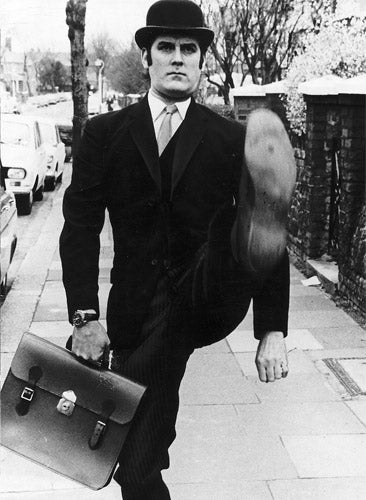
The mystery of why people swing their arms while walking rather than holding them still and rigid like the famous silly walk of John Cleese in his Monty Python sketch appears to have been solved. An experiment involving making a group of volunteers take equally silly walks in a laboratory setting has confirmed that arm swinging makes walking more efficient and easier.
Although it may seem obvious why people swing each of their arms in opposition to their legs, scientists have puzzled over the practice for many decades because it seemed to serve no mechanical function given that the arms do not touch the ground.
One extreme theory even proposed that arm swinging while walking was hard-wired into the human nervous system and served no modern purpose because it was a vestigial relic left over from when our animal ancestors walked on all fours.
However, a study based on the movements of 10 volunteers who were asked to perform a series of unnatural walks under experimental conditions has shown that swinging the arms in opposition to the legs significantly increases the efficiency of walking.
Steven Collins, a biomechanical engineer at Delft University of Technology in The Netherlands, said normal arm swinging while walking requires little effort and makes it easier than keeping the arms still. "This puts to rest the theory that arm swinging is a vestigial relic from our quadrupedal ancestors."
In order to answer the question of why humans swing their arms while walking, Dr Collins and his colleagues set up an experiment where people were studied as they walked in a variety of poses – normally with the arms swinging in opposition to each leg, with their arms at their sides either tied or held there voluntarily, or with each arm unnaturally forced to move in synchrony with each leg.
First, the scientists found that arm swinging – either normally or abnormally – actually required very little effort from the shoulder muscles because the movements tended to arise naturally from the twisting movement of the body as it walked. "Further, our results showed that normal arm swinging made walking much easier. Holding the arms at one's sides increased the effort of walking – measured by metabolic rate – by 12 per cent, which is quite a lot of walking, about the same as walking 20 per cent faster or carrying a 10 kg backpack," Dr Collins said.
The study, published in the journal Proceedings of the Royal Society B, also found that the natural swinging motion of the arms tended to counteract the twisting motion or "torque" of the body, created by the movement of the two legs along a straight path.
Join our commenting forum
Join thought-provoking conversations, follow other Independent readers and see their replies
Comments
Bookmark popover
Removed from bookmarks