Now Atlantic is found to have huge 'garbage patch'
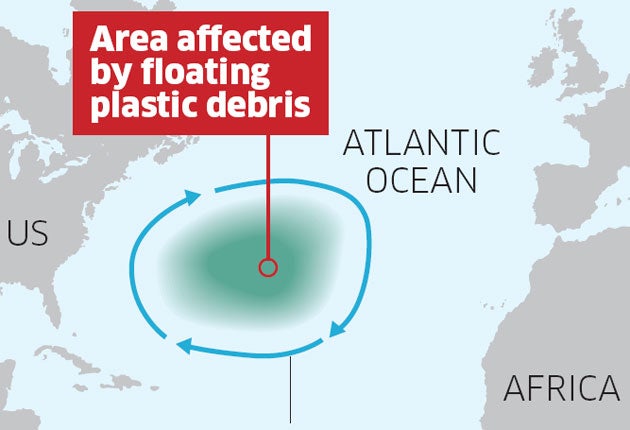
A huge expanse of floating plastic debris has been documented for the first time in the North Atlantic Ocean. The size of the affected area rivals the "great Pacific garbage patch" in the world's other great ocean basin, which generated an outcry over the effects of plastic waste on marine wildlife.
The new plastic waste, which was discovered in an area of the Atlantic to the east of Bermuda, consists mostly of fragments no bigger than a few millimetres wide. But their concentrations and the area of the sea that is covered have caused consternation among marine biologists studying the phenomenon.
Using fine-mesh nets towed from a research ship, the scientists collected more than 64,000 individual plastic pieces at 6,100 locations out at sea over the 22-year period of the survey. The highest concentrations were centred at approximately the same latitude as Atlanta, Georgia (32 degrees North) but extended about 500 miles north and south of this line.
Kara Lavender Law from the Sea Education Association in Woods Hole, Massachusetts, said the size of the Atlantic "garbage patch" was roughly equal to the one in the Pacific, where circulating currents of the North Pacific Gyre have trapped it over a wide area to the north of the equator.
"The Pacific has received more attention in terms of plastic accumulation but we know less about the Pacific so it's very difficult to compare the Atlantic patch in terms of size. We had a cruise this summer to try to find the eastern extent and in fact we failed to find it," Dr Lavender Law said.
"East of Bermuda we had no evidence of a decrease in concentration so we still haven't answered the question. All we can say is the highest concentrations between the two oceans are comparable. My guess is they are similar-sized problems," she said.
"For the first time we've been able to put north-south bounds on the region of plastic accumulation. We've presented the most extensive dataset on plastic marine debris on any ocean basin," she added. The nets have a mesh size of 0.3mm, so the survey has only collected fragments bigger than this size. "Most pieces are smaller than the eraser on the top of your pencil. These are fragments from larger objects but we cannot say which objects they are from or where they originated," Dr Lavender Law said.
Most of the plastic appears to be polyethylene or polypropylene, which are less dense than seawater and float near to the surface. However, other kinds of denser plastic debris may have sunk to the bottom of the ocean where it has disappeared from view.
The study, published in the journal Science, found that the concentration of plastic particles caught in the nets since the survey began in 1986 has remained remarkably constant – but Dr Lavender Law emphasised that this did not mean the problem was manageable. "It does seem constant but we have to be careful about the interpretation that it is not getting worse, because what we are measuring is plastic larger than a third of a millimetre in size floating at the surface," she said.
"One explanation is that the pieces are becoming small enough to pass straight through the net. The plastic may still be floating at the ocean surface – it's just that we are not collecting it once it's smaller than a particular size.
"Another explanation is that we've found evidence that biological growth on pieces of plastic actually makes them denser and it's possible that, over time, if there is enough biological growth they may become dense enough to sink from the surface, where we wouldn't collect it," she explained.
Small fragments of plastic could pose an even greater menace to marine life than the larger fragments that become entangled with animals such as albatrosses and turtles, she said. "We know that smaller pieces of plastic are eaten and it's unclear what happens to that plastic then. But clearly biological organisms were not designed to eat plastic," she said.
Join our commenting forum
Join thought-provoking conversations, follow other Independent readers and see their replies
Comments
Bookmark popover
Removed from bookmarks