Out of Africa: stone tools rewrite history of man as a global species
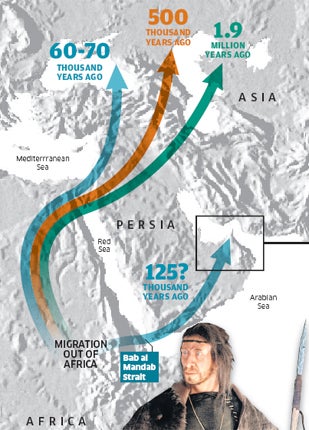
A stone-age archaeological site in the Arabian peninsula has become the focus of a radical theory of how early humans made the long walk from their evolutionary homeland of Africa to become a globally-dispersed species.
Scientists have found a set of stone tools buried beneath a collapsed rock shelter in the barren hills of the United Arab Emirates that they believe were made about 125,000 years ago by people who had migrated out of eastern African by crossing the Red Sea when sea levels were at a record low.
The age of the stone tools and the fact they they appear similar to those made by anatomically-modern humans living in eastern Africa suggests that our species, Homo sapiens, left Africa between 30,000 and 55,000 years earlier than previously believed. This casts new light on how modern humans eventually inhabited lands as far apart as Europe and Australia.
Genetic evidence had suggested that modern humans made the main migration from Africa between 60,000 and 70,000 years ago, although there was always a possibility of earlier migrations that had not got much further than the Middle East. However, all these movements were believed to have been made into the Middle East by people walking along the Nile valley and over the Sinai Peninsula.
The stone tools unearthed at the Jebel Faya site about 50km from the Persian Gulf suggests another possible migratory route across the Bab al-Mandab strait, a tract of open water which separates the Red Sea from the Arabian Ocean and the Horn of Africa from the Arabian Peninsula.
The scientists behind the study said that at the time of the migration, about 125,000 years ago, sea levels would have been low enough for people to make the crossing by foot or with simple rafts or boats. They also suggest that the waterless Nejd plateau of southern Arabia, which would have posed another barrier to migration, was in fact at that time covered in lakes and lush, game-filled vegetation.
"By 130,000 years ago, sea level was still about 100 metres lower than at present while the Nejd plateau was already passable. There was a brief period where modern humans may have been able to use the direct route from East Africa to Jebel Faya," said Professor Adrian Parker of Oxford Brookes University, who was part of the research team.
Once humans had crossed into southern Arabia, they would have enjoyed the benefits of a land rich in gazelle and, with little competition, the migrant community could have quickly expanded to become an important secondary centre for population growth, which later migrated across the Persian Gulf to India and the rest of Asia, the scientists suggest.
Simon Armitage of Royal Holloway, University of London, the lead author of the study published in the journal Science, said that discovering the dates of the stone tools was the key piece of evidence suggesting there was a much earlier migration out of Africa than previously supposed. "Archaeology without ages is like a jigsaw with the interlocking edges removed – you have lots of individual pieces of information but you can't fit them together to produce the big picture," Dr Armitage said.
"At Jebel Faya, the ages reveal a fascinating picture in which modern humans migrated out of Africa much earlier than previously thought, helped by global fluctuations in sea level and the climate change in the Arabian Peninsula."
The stone "tool kit" found at Jebel Faya includes relatively primitive hand axes and a collection of stone scrapers and perforators. The scientists said the tools resemble artifacts found in eastern Africa and their primitive nature suggests that migration did not depend on the invention of more complex tools.
"These anatomically modern humans, like you and me, had evolved in Africa about 200,000 years ago and subsequently populated the rest of the world. Our findings should stimulate a re-evaluation of the means by which we modern humans became a global species," Dr Armitage said.
However, not all scientist are convinced. Paul Mellars of Cambridge University told Science: "I'm totally unpersuaded. There's not a scrap of evidence here that these were made by modern humans, nor that they came from Africa."
Join our commenting forum
Join thought-provoking conversations, follow other Independent readers and see their replies
Comments