Population explosion scrutinised as scientists urge politicians to act
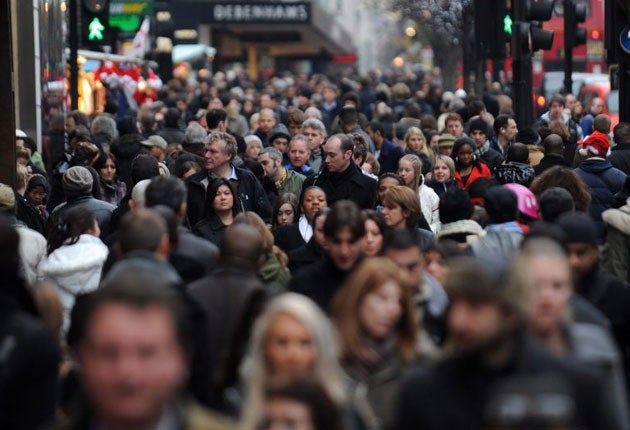
Britain's premier scientific organisation has launched a two-year study into global population levels. A growing body of scientists believe the time has come for politicians to confront the problems posed by the future increase in human numbers.
The Royal Society has established a working group of leading experts to draw up a comprehensive set of recommendations on human population that could set the agenda for tackling the environmental stress caused by billions of extra people on the planet.
Sir John Sulston, the Nobel laureate who took a leading role in decoding the human genome, will lead the study. A failure to be open about the problems caused by the global population explosion would set back human development, he warned.
"We really do have to look at where we are going in relation to population. If we don't do it, we may survive but we won't flourish," Sir John said. "We will be examining the extent to which population is a significant factor in the momentous international challenge of securing global sustainable development, considering not just the scientific elements but encompassing the wider issues including culture, gender, economics and law."
The working group includes the naturalist Sir David Attenborough, the environmentalist Sir Jonathon Porritt, who co-founded Forum for the Future, the Cambridge economist Sir Partha Dasgupta and the president of the Ethiopian Academy of Sciences, Professor Demissie Habte.
The announcement of the study comes on World Population Day, which will be marked by a meeting of science experts at the London School of Hygiene and Tropical Medicine.
They include Sir John Beddington, the Government's chief scientist, who has warned that population is one of several environmental issues that could produce a "perfect storm" of global events in the coming decades.
The planet's population stands at 6.8 billion and although fertility rates in most countries are falling, the number of young people alive now who are destined to become parents in the future suggests that this figure could rise to 8.3 billion by 2030 and 9.2 billion by 2050 – equivalent to adding nearly two more Chinas or eight more Americas.
Human numbers have shot up since the Industrial Revolution. In 1800, there were about a billion people and by 1900 the figure was 1.7 billion. It then multiplied four-fold to six billion within a century, powered by advances in medicine and public health, cheap fossil fuels and a technical revolution in food production.
Much of the coming increase in human numbers will be in the poorest developing countries, notably in sub-Saharan Africa, where the population is set to rise by about 50 per cent over the coming decades. Some of the poorest nations in Africa could see their populations triple.
Scientists estimate that food and energy production will have to increase by 50 per cent and water availability by 30 per cent to meet the demand caused by the extra 1.5 billion people living on Earth in the next two decades – an increase of nearly 10,000 people per hour.
Many countries have already significantly exceeded their capacity to be self-sustainable in providing their people with food, water and land without having to import resources. According to a research charity, the Optimum Population Trust (OPT), 77 out of 130 countries that have been studied can be classified as "overpopulated" based on the fact they are consuming more natural resources than they are producing and depend on other countries for the difference.
Britain's "ecological footprint" shows that it comes 17th in the league table of overpopulated nations, which are dominated by the high-consuming countries of the Middle East and Europe.
Roger Martin, of the OPT, said that if Britain had to rely on its biological resources, its sustainable population would be about 15 million rather than the present 60 million.
"Some people may argue that in a world of international trade, national self-sufficiency doesn't matter," Mr Martin said. "We think that's a very short-sighted view. You don't have to be a little Englander or an eco-survivalist to conclude that in an era of growing shortages – food, energy, water – being so dependent on the outside world puts us in a very vulnerable position.
"Overpopulation is a much used and abuse word, but we believe the index helps to anchor it firmly in the realm of sustainability; of people living within the limits of the place they inhabit.
"I think the index also clarifies what we really mean by sustainability and how important human numbers are to the concept."
Our ecological footprint
*One measure of the environmental impact of human population is called the "ecological footprint". It was developed more than 15 years ago by Mathis Wackernagel and William Rees, at the University of British Columbia in Canada. It is a measure of the demand placed on the biosphere by human activity, calculating the amount of biologically productive land and water area required to produce all the resources that an individual, population or activity consumes, and also to absorb the waste they generate, given prevailing technology and resource management. The "footprint" is measured in global hectares, or average world productivity, allowing one area or population to be compared with another.
Join our commenting forum
Join thought-provoking conversations, follow other Independent readers and see their replies
Comments
Bookmark popover
Removed from bookmarks