The Independent's journalism is supported by our readers. When you purchase through links on our site, we may earn commission.
Quasars: One hell of a blast
Quasars are the most destructive forces in the universe – and a newly discovered one could be the most powerful of all. David Whitehouse unravels its mysteries
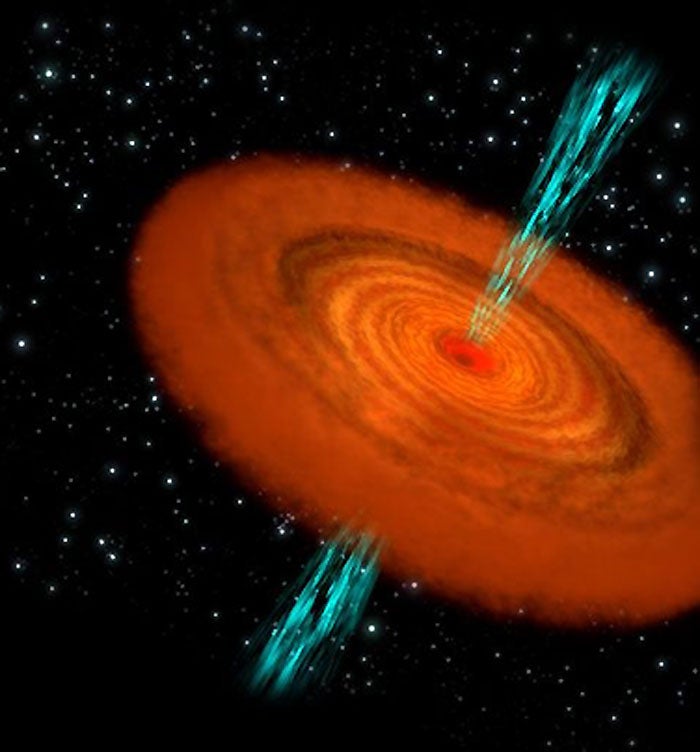
It looks like an image from a Star Wars film – the destruction of the Death Star, perhaps. But in fact this is real. Published yesterday by the European Space Agency, it shows a vast quasar destroying a galaxy far, far away. It's certainly among the most powerful quasars ever discovered, and if, as thought, it proves to be the mightiest of all, then this image will represent the most awesome force ever witnessed in the universe.
Of all the strange objects in the heavens, quasars are among the most fascinating. Thought to number about 100,000 in total, they are among the most mysterious, distant and significant objects in the universe. First discovered in the 1950s, they are scenes of cataclysmic violence. They are also the most distant objects we have ever seen. When the universe was young, quasars were common, but due to the extraordinary distances involved, and the time their light takes to reach us, we can still see them, burning bright. Thankfully, quasars do not occur today. If they did, we wouldn't be here.
A quasar consists of a black hole surrounded by super-heated gas that gives off prodigious amounts of radiation. Just to hint at the scales involved, the black hole at the centre of the quasar pictured here is a billion times the mass of our own Sun. Quasars begin life as distant galaxies, and eventually they collapse, and the galaxy and gas is swallowed by the black hole.
For astronomers, the new observations of quasars allow them to explore not only extremes of matter but also the evolution of the universe as it made the transition from its violent youth.
The orbiting observatory used to capture this latest image is called XMM-Newton. It was launched in 1999 and it detects X-rays, which are high-energy radiation waves that come from the hot and violent parts of the cosmos – from such things as exploding stars that tear themselves asunder, when for a few days a single star can outshine a hundred billion of its companions, and also from quasars, where the radiation is emitted by matter as it is drawn into a giant black hole.
Quasars were first glimpsed in the 1950s, when radio astronomers were carrying out the first surveys of the sky using radio telescopes. They noticed that there were many points emitting radiation, and were keen to see whether they could see the sources with conventional optical telescopes. Some of the radio waves seemed to be coming from ordinary stars, which in itself was a puzzle, but it was nothing to what would later be found out. A closer look at these "stars" changed the course of astronomy and our understanding of the universe.
The story is part of astronomical folklore. Two astronomers, Jesse Greenstein and Maarten Schmidt of the California Institute of Technology, had been using the largest telescope in the world at the time (the 200-inch reflector on Palomar Mountain in California) to peer at the object glowing in the exact position of 3C48 – the 48th object catalogued in the third Cambridge radio survey of the sky. It seemed to be a star and was called a "quasi-stellar object" or quasar.
Greenstein looked at the photograph that contained the image of the object and noticed that it appeared to be at an incredible distance. "Four billion light-years," he said (the nearest star, for comparison, is only four light-years away). Schmidt did not believe him. Could this object be the most distant object ever seen? He redid the calculations. Greenstein was right. This was no star at all! What had at first seemed to be a star and therefore thought to be very close by in cosmic terms, turned out in reality to be on the other side of the universe. This meant that they had to be pouring out so much light that they challenged what was then understood about energy and matter.
The race was then on to find more quasars, and they came, further and further away, radiating seemingly impossible energies. One or two of them were so bright that they could even be detected with an amateur astronomer's backyard telescope. Since then, astronomers have found many quasars and they are recognised as being a vital probe into the evolution of the cosmos. They are part of the early universe, a passing phase when the cosmos was young.
That is why they are so far away – when we look at the farthest reaches of space we are seeing back into earlier epochs because of the time it takes the light to reach us.
Today they are believed to be a feast happening at the edge of the universe when an enormous black hole devours vast clouds of gas, stars and even entire galaxies.
The idea is that when the universe was young and the first galaxies were being born, black holes formed at their cores. A black hole is an object from which nothing can escape and which will get larger as it swallows more matter, so being positioned at the centre of a galaxy is good, for there is a plentiful supply of matter.
As matter – represented by the green streaks in the picture on the right – falls into the black hole, it collects in a swirling reservoir called the accretion disc – the orange belt in the picture – which heats up to many millions of degrees. There is no place in nature as violent or extreme as matter swirling around a black hole and it is a prodigious source of X-rays. Most of the material spirals down into the black hole and when it passes the so-called event horizon it disappears from our universe, for what enters a black hole is lost for ever. However, computer simulations suggest that powerful radiation and magnetic fields present in the region can eject some of the gas from the gravitational clutches of the black hole, throwing it back into space along jets of matter and radiation that fly away from the black hole's spin axis.
It is this outflow that XMM-Newton has seen, and its profound effect on its surrounding galaxy. It can create turbulence in the gas throughout the galaxy, destroying star fields. Thus, understanding quasars is an important step to understanding the early history of galaxies. The latest observations used XMM-Newton to target four such powerful quasars, looking at the way the X-rays from the superhot accretion disc could be affected by the galaxy around the black hole. Two of them emitted more X-rays than anticipated, indicating that there is no veil of absorbing gas surrounding these particular quasars allowing a rare peek into the inner recess of the galaxy and the workings of the black hole.
It is thought that when a galaxy such as ours was young, a quasar could have been alight at its core and the harsh radiation it sent out would have prevented any life as we know it from developing. Only now, billions of years later, when the quasar has turned off, can we possibly exist here.
Today, astronomers can peer at the heart of our galaxy and see evidence for a super-massive black hole. These days it is quiescent, slumbering because it is no longer being fed with a steady diet of gas and stars. But should that ever change, a quasar could once more blaze forth, with jets of intense radiation rendering our galaxy uninhabitable. This is why we need to study quasars: they are wonderful and horrible.
Join our commenting forum
Join thought-provoking conversations, follow other Independent readers and see their replies
Comments
Bookmark popover
Removed from bookmarks