Radical plan to combat global warming 'may raise temperatures'
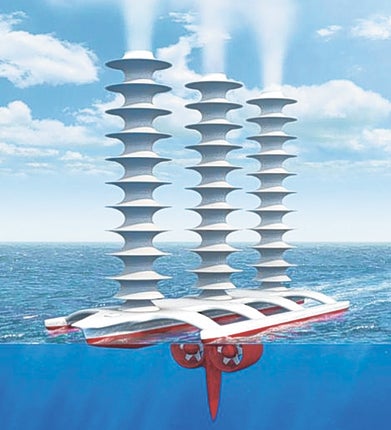
A controversial proposal to create artificial white clouds over the ocean in order to reflect sunlight and counter global warming could make matters worse, scientists have warned.
The proposed scheme to create whiter clouds over the oceans by injecting salt spray into the air from a flotilla of sailing ships is one of the more serious proposals of researchers investigating the possibility of "geoengineering" the climate in order to combat global warming.
Geoengineering – deliberately altering the global climate – was dismissed as outlandish fantasy a decade ago but has recently been seen as a serious topic of study, given the international failure to curb global emissions of carbon dioxide and the possibility of extreme climate change.
However, a study into the effects of creating man-made clouds which reflect sunlight and heat back into space has found that the strategy could end up having the opposite effect by interfering with the natural processes that lead to the formation of reflective white clouds over the ocean.
A team of scientists from Britain and Finland found that spraying salt water into the air to encourage the formation of clouds may actually hinder natural cloud formation over the coastal regions of the continents because of other pollutants from industrial activities.
"Our research suggests that attempts to generate brighter clouds via sea spray geoengineering would at best have only a tiny effect and could actually cause some clouds to become less bright," said Professor Ken Carslaw of the University of Leeds.
White clouds form naturally over the ocean as a result of saltwater spray being blown high into the air. The salt crystals form tiny particles on which cloud droplets form and the denser the droplets, the whiter the cloud and the more reflective it is towards incoming sunlight.
Twenty years ago, scientists proposed that it might be possible to augment this process with a fleet of ships designed to spray saltwater into the air. Calculations suggested that this could cool the planet if carried out on a large enough scale.
However, a computer model used by Professor Carslaw and his colleagues suggested that it would be difficult to create a uniform layer of saltwater spray and that natural particles in the air, called aerosols, could interfere with the process. "The formation of clouds from artificial sea spray is particularly sensitive to background levels of aerosol. This means that injecting spray around coastal areas where there is a lot of air pollution from land may not produce enough extra cloud drops to stave off global warming," Professor Carslaw said.
"In some locations, the artificial spray particles may hinder natural drop formation and could have an opposite effect on climate to that intended. In practice, generating a uniform covering of reflective clouds over large regions of the world's oceans would be extremely challenging," he said.
Geoengineering
Artificial clouds
This notion involves augmenting the natural process of white-cloud formation over the oceans to reduce levels of incoming sunlight and heat. But it would not help the increasing acidity of the seas because it fails to address rising levels of carbon dioxide in the atmosphere.
Artificial volcanoes
Another idea is to emit sulphate particles high into the atmosphere to reflect sunlight back into space. These would simulate what happens in a volcanic eruption when the aerosol particles from the eruption cut out sunlight and cause limited global cooling. The sulphates would wash out within a couple of years but again this "solution" does not address ocean acidity, or the potential acidity of the sulphate aerosols.
Artificial trees
Being able to emulate the way trees convert carbon dioxide gas into solid carbon-containing substances is seen as the best geoengineering idea. But nobody has been able to do it better than trees – so why not simply plant more forests? This proposal reduces carbon dioxide concentrations and so helps ocean acidity.
Mirrors in space
The idea is to create a huge reflective surface between earth and the sun that could be adjusted to interfere with incoming solar radiation. Apart from the immense technical difficulties, the political implications of who controls this technology are problematic to say the least.
Join our commenting forum
Join thought-provoking conversations, follow other Independent readers and see their replies
Comments
Bookmark popover
Removed from bookmarks