Science

Mostly Cloudy with Showers 13° London Hi 14°C / Lo 8°C

Recording tracks Russia's Moon gatecrash attempt
By Jonathan Brown

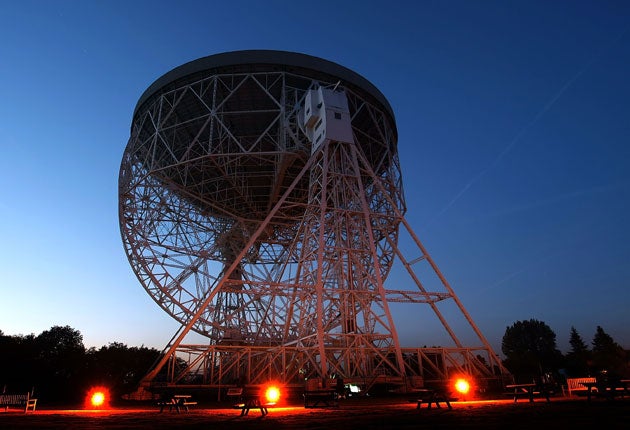
Jodrell Bank in Macclesfield

Getty Images

Jodrell Bank in Macclesfield

A never-before-heard recording of the dramatic moment in which British boffins observed a Soviet attempt to scupper American victory in the race to the Moon has been made available to the public for the first time.

With characteristic understatement, scientists at Jodrell Bank, led by its founder Sir Bernard Lovell can be heard as they track the Russian’s Luna 15 probe as it crashes into the surface of the moon just hours after the American Eagle Lander was due to begin its return journey in July 1969.

In stark contrast to the whoops of jubilation from Nasa’s highly-charged mission control at Cape Canaveral in Florida, a cool calm Sir Bernard can be heard describing the unfolding events in measured tones.

As they reach their denouement one voice from the University of Manchester observatory in Cheshire can be heard to exclaim: “I say, this has really been drama of the highest order” having presumably momentarily stopped puffing on his pipe to interject. Others describe the final moments before the Russian probe is lost. One says “it’s landing” and “it’s going down much too fast” at 15.50 on 21 July while another appears to gasp with excitement.

Listen to the recording

Jodrell played a vital role during the space race of the late 1950s and 1960s. Data captured from the Lovell radio telescope, named after its creator, was used to assist the Americans not only with Apollo 11 but from the very earliest stages of man’s quest into space.

It was also pressed into service to monitor Communist progress after Moscow had stolen a march on the Americans with the successful launch of the Sputnik satellite. Sir Bernard, 96, who recently revealed how he survived an assassination attempt using a lethal radiation dose during a visit to a Soviet space facility in 1963, can also be heard during the recording to cite a “well-informed source in Moscow” who revealed a change in orbit of the Luna 15.

The probe had been launched three days ahead of Apollo. Even though it was unmanned and its exact mission unknown, great excitement surrounded the technological head to head between the world’s superpowers. Experts at Jodrell calculated that the Luna probe was on a slower trajectory than its predecessors and it entered the moons orbit four days before touchdown. The signals given of by the probe were new to observers who immediately reported their discoveries back to the Americans who feared the Russians were trying to sabotage their mission, as well as explaining events to the British public through a series of media releases.

It is calculated now however that even if it had landed safely rather than careering out of control into the lunar surface and completed its objectives of recovering soil and rock samples from the Moon, its trajectory meant it would still have been too slow to beat Neil Armstrong and his crew back to Earth and whatever limited propaganda value Moscow may have squeezed out of the situation would have been lost. During an earlier Soviet moon probe, Luna 9, the Jodrell team captured images from the craft and used a primitive fax from the offices of the Daily Express in Manchester to print the pictures being sent down from space.

Post a Comment

View all comments that have been posted about this article.

Offensive or abusive comments will be removed and your IP logged and may be used to prevent further submission. In submitting a comment to the site, you agree to be bound by the Independent Minds Terms of Service.

Comments

Best regards from Russia
[info]rex123 wrote:
Friday, 3 July 2009 at 05:23 pm (UTC)
Well, naturally here in Russia we admire US expedition to the Moon back in 1969, but why do you need to try to humiliate our Moon programme? - why to make boasting out of US achievements (especially that you are UK, not US). I have never read in Russian press anything with the same tint of gloating delight towards US problems with Shuttles tragedies etc. as you here try to "celebrate" our failure with Luna-15 - it is a matter of being a jentlemen not to show it even if you are delighted that Russia failed here or there ...Soviet Moon programm started in 1959 and in October 1959 the first ever manmade space vechikle reached the surfice of the Moon - it was Soviet Luna-2. As for the probe of Moon soil - the first sample was delivered back to Russia only in 1970 by Luna-16- a year after USA managed to do it with mr.Armstrong's help.My best regards to our american partners these days while we all celebrate 40th anniversary of their acievement!
Re: Best regards from Russia
[info]ancientoneuk wrote:
Friday, 3 July 2009 at 11:36 pm (UTC)
Its all about being the biggest, the best, the first etc etc with the Americans, to put it bluntly, all they see is as long as they got the biggest "weapon" then it makes them feel good.

But you will notice if you peer in depth into any thing like this that its not as cut and dried as it looks, the Americans are very good at buying in technology or in the case of this, stealing it from the wreckage of Nazi Germany or stealing it from their allies too come to think of it.
Re: Best regards from Russia
[info]paddleman12 wrote:
Monday, 6 July 2009 at 06:29 pm (UTC)
As you said it is not as cut and dried as it looks and russians ran over the Peenemunde V2 base to steal all the plans, documents, pieces of V2 and bring them back to Russia either with german scientists left behind. So basically the russian space program was also based on Nazi german V2 rockets program.
Re: Best regards from Russia
[info]ancientoneuk wrote:
Monday, 6 July 2009 at 06:42 pm (UTC)
Totally agree and as Russia were more fortunate in gaining first dibs at these Nazi scientists, this is reflected in Russia's considerable lead in missile and rocket technology that they enjoy over America.

But if Eisenhower had listened to Churchill and Montgomery, the American's would have had more and it took a mutinous move by Montgomery to get the allies moving in the direction of Berlin but even after that, the thousands of ex SS and Gestapo officers spirited away by Dulles's Operation Paperclip would yield great dividends for all involved including at the time of the first mission, a rising star who ended up as Deputy Director of NASA but once was a highly placed SS scientist and Nazi party member...
Re: Best regards from Russia
[info]reiksares wrote:
Friday, 3 July 2009 at 11:50 pm (UTC)
In fact it was exactly like the British "Beagle-2" which set off for Mars...
Re: Best regards from Russia
[info]il_767 wrote:
Saturday, 4 July 2009 at 03:52 pm (UTC)
Rex, I don't think anyone is belittling the Russians' pioneering efforts, rather the article celebrates the accomplishments of the British Joddrell Bank team and university associates.

ancientoneuk, it's worth noting the Soviet Union also made use of captured German specialists. Despite your name your comments are puerile.
Re: Best regards from Russia
[info]ancientoneuk wrote:
Monday, 6 July 2009 at 07:06 pm (UTC)
Why are they puerile? And pray tell me what my name has to do with anything.

I don't see anywhere in my posts that deny the Russians did this, both America and Russia captured swathes of Nazi scientists and officers, as did Britain too, Russia dealt with the differently though, executing most when they had yielded their secrets, whereas America regardless of what the "paperclips" had done during the war and despite the State Department telling Dulles that Paperclip was highly illegal, gave them new identities, new jobs etc.

However Paperclip didn't just pull in missile and rocket scientists, it pulled in a lot of former Gestapo/Gefepo, Abwehr officers as well as non scientific SS members.

Britain's trawl was different, Britain was after the Nazi loot and money networks but managed to bag one or two top scientists amongst the mass of captured Nazi people.

History is silent on what their fate was although there is still strong rumour that Britain did evacuate Bormann by a team led by Creighton.
Recording tracks Russia's Moon gatecrash attempt
[info]mightyindian wrote:
Sunday, 5 July 2009 at 04:06 am (UTC)
IT IS MEDIA HYPE WHICH HAS POPULARISED APOLLO MOON LANDING. AMERICANS ARE VERY GOOD IN GATHERING MEDIA ATTENTION.MOST OF THE PEOPLE AROUND THE WORLD NEVER KNEW THAT RUSSIANS HAVE MADE ATTEMPTS THROUGH ROBOTS TO STUDY MOON SURFACE.RUSSIAN FILMMAKERS,RUSSIAN MEDIA NEVER REALISED HOW IMPORTANT ACHIEVEMENT RUSSIANS HAVE MADE.
WHATEVER HAPPENED IN PAST IS OF LITTLE IMPORTANCE IT IS HIGH TIME THAT INDIAN SPACE RESEARCH ORGANIZATION, ROSKOSMOS,NASA,ESA, JOIN HANDS IN ESTABLISHING HUMAN COLONIES ON OTHER PLANETS.

Bad Taste
[info]robert_hardy wrote:
Thursday, 9 July 2009 at 11:39 am (UTC)
Ah, but with British assistance did the Americans sabotage Luna 15, cracking the control codes and sending disruptive information, probably not, but the articles revelation that the Americans reacted with whoops of joy to the Russian's misfortune says a lot about the sick psyche of that nation. If Apollo had failed I very much doubt that the Russian mission control staff would have reacted with such craven and indecent bad taste.
Re: Bad Taste
[info]manelvagorio wrote:
Friday, 31 July 2009 at 07:59 pm (UTC)
Robert hardy - what as silly analogy! Being that the Luna 15 was UNMANNED, cheering over its failure required not nearly the same amount of craven and indecent bad taste to which you falsely ascribe it.

Little doubt, the sick psyche you speak of is your own.
What you're hearing
[info]ka9q wrote:
Wednesday, 15 July 2009 at 04:00 am (UTC)
This article doesn't really explain what you're hearing. The audio tone that's slowly dropping in pitch is the radio carrier wave of the Luna 15 spacecraft, shifted down to an audible frequency by the radio receiver at Jodrell bank. The pitch changes due to Doppler shift as the spacecraft moves around the moon, the moon moves around the earth, and the earth rotates on its axis. This is the same effect that causes the pitch of a train whistle to drop as it passes you. The tone suddenly stops when the spacecraft impacts the moon, and then the people in the control room can be heard fixing the time of that event.

Most popular