Research into mutant flu 'must go on'
Scientist dismisses US group's fear that creation of airborne H5N1 virus could inspire bio-terrorism
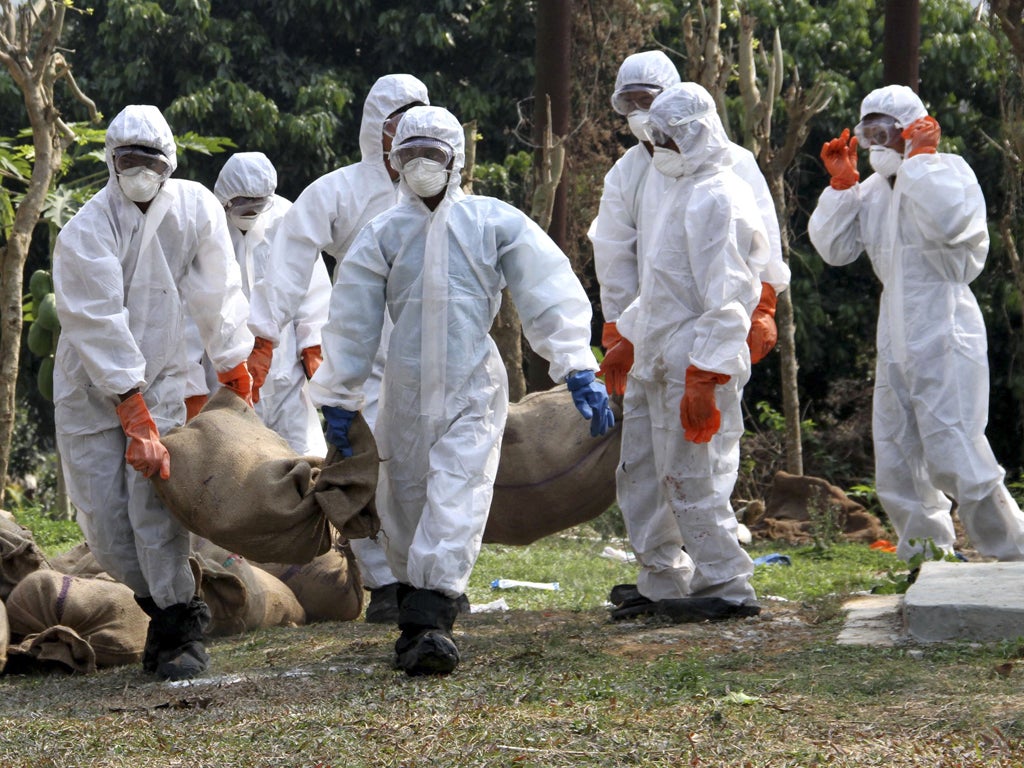
One of the scientists at the centre of the controversy over the creation a highly dangerous form of bird flu which could cause a devastating human pandemic has denounced attempts by the US Government to censor the research over fears that the findings might be misused by bioterrorists.
Yoshihiro Kawaoka, virologist at the universities of Tokyo and Wisconsin Madison, said that the recommendations of the US National Science Advisory Board for Biosecurity are unworkable and would make it harder for legitimate scientists to develop vaccines and drugs against new strains of pandemic flu.
Professor Kawaoka leads one of the two teams of scientists that have created “airborne” strains of the H5N1 bird flu virus that can be transmitted in coughs and sneezes between laboratory ferrets, the standard animal “model” of human influenza.
The second team, led by Ron Fouchier of the Erasmus Medical Centre in Rotterdam, has achieved similar results using a different technique, and has also criticised the biosecurity board’s recommendations.
The board, composed of leading US scientists, fears that details of the two studies, which have been both accepted for publication, one by the journal Nature and the other by Science, could be used by bioterrorists or a rogue state to develop “weaponised” versions of the H5N1 bird flu virus to cause a highly lethal pandemic.
In the limited number of cases where H5N1 has already passed by direct contact from poultry to humans, it has killed about 60 per cent of the people it has infected. If it mutated into a highly transmissible virus, it easily could become one the most dangerous viruses in history.
Some scientists have even questioned the need to conduct the experiments, which involved the deliberate mutation of the H5N1 bird flu in order to make it airborne transmissible between the laboratory ferrets.
However, Professor Kawaoka has now broken his long silence over the affair in a commentary article in the journal Nature where he strongly justifies the need for such research, while at the same time condemning the recommendation of the US biosecurity board to censor key details of the research.
“To date, H5N1 viruses have not been transmitted between humans. Some experts have argued that it is impossible. But given the potential consequences of a global outbreak, it is crucial to know whether these viruses can ever become transmissible,” Professor Kawaoka says.
“Some people have argued that the risks of such studies – misuse and accidental release for example – outweigh the benefits. I counter that H5N1 viruses circulating in nature already pose a threat, because influenza viruses mutate constantly and can cause pandemics with great loss of life,” he says.
The US biosecurity board argues that partial redaction of key details of the research would make it harder for bioterrorists to misuse the information, but Professor Kawaoka insists that there is already enough information within the pubic domain to allow knowledgeable people to make a transmissible form of the bird flu virus if they want to.
He also says that the mechanism suggested by the biosecurity board to allow vetted scientists to have access to the data is unwieldy and unworkable because it would require security background checks on thousands of researchers from around the world.
“The redaction of our manuscript, intended to contain risk, will make it harder for legitimate scientists to get this information while failing to provide a barrier to those who would do harm,” Professor Kawaoka says.
All scientists involved in H5N1 research have agreed to voluntary 60-day moratorium until an international meeting is convened to discuss ways around the problem. Professor Kawaoka says that this could lead to a solution to the problem of “duel use” biotechnology.
Professor Kawaoka, who did not reply to requests from The Independent, has told the journal Science that he was prohibited from discussing questions with the general media by Nature, which has accepted his scientific paper for publication.
“The journal advised me to avoid talking to the media until the paper was published. Without being ale to describe our findings, I cannot address fully the issues the media want to discuss,” Professor Kawaoka told Science.
Professor Fouchier, meanwhile, said that he could not respond to questions from The Independent until he was cleared to do so from the journal Science, which has accepted his scientific paper for publication.
Join our commenting forum
Join thought-provoking conversations, follow other Independent readers and see their replies
Comments
Bookmark popover
Removed from bookmarks