Running barefoot may be healthier, say scientists
Runners without shoes land more gently on the ground, avoiding impact injuries
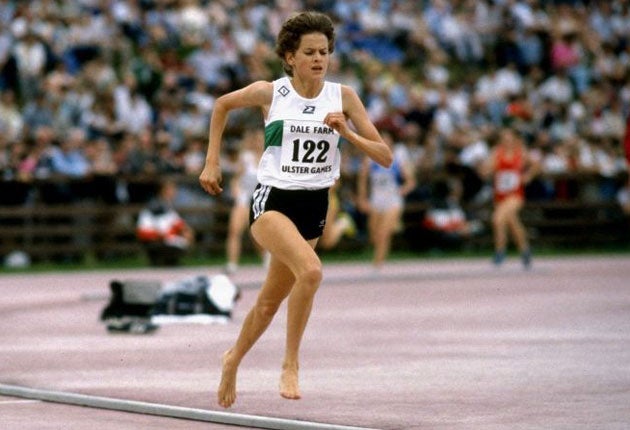
During her colourful career as a track and field athlete, Zola Budd was as famous for her eccentric habit of running barefoot as she was for turning her back on apartheid South Africa.
Now, scientists have found that running without any footwear could in fact be better for your legs than jogging in trainers, because it encourages the use of a different set of muscles as well as a different gait that avoids repeated heavy impacts between the feet and the ground.
Wearing modern trainers encourages heavy "heel-striking" between the back of the foot and the ground, whereas barefoot running makes people more "springy" and less likely to hit the ground hard with their feet, it is believed.
The researchers found that running in bare feet – which was until relatively recently in human evolution, the natural way to run – may give better protection against the sort of repetitive-impact injuries caused by striking the ground with a force equivalent to several times a person's body weight.
A study which compared barefoot runners with those who ran in modern trainers found that heel strike was less likely in those who did not wear running shoes. Barefoot runners were more likely to land on the front part or ball of the foot, and they adjusted their leg and foot movements so that they landed more gently on the ground, the scientists found.
"People who don't wear shoes when they run have an astonishingly different strike. By landing on the middle or front of the foot, barefoot runners have almost no impact collision, much less than most shoe runners generate when they heel strike," said Daniel Lieberman, professor of human evolutionary biology at Harvard University.
"Most people today think barefoot running is dangerous and hurts, but actually you can run barefoot on the world's hardest surfaces without the slightest discomfort and pain. All you need is a few calluses to avoid roughing up the skin of the foot. Furthermore, it might be less injurious than the way some people run in shoes," Professor Lieberman said.
The study in the science journal Nature compared runners in the United States and Kenya, where many people have run barefoot since childhood. They found that barefoot runners tend to point their toes toward the ground, giving a spring in their step, compared with those who run in trainers.
Modern running shoes have cushioned heels that encourage landing on the back of the foot, which for a barefoot runner can be painful. However, cushioned heels mean that a typical runner is pounding the ground heavily at a rate of about 1,000 collisions per mile, said Madhusudhan Venkadesan, also of Harvard University.
"Heel striking is painful when barefoot or in minimal shoes because it causes a large collisional force each time a foot lands on the ground. Barefoot runners point their toes more at landing, avoiding this collision by decreasing the effective mass of the foot that comes to a sudden stop when you land, and by having a more compliant, or springy leg," Dr Venkadesan said.
Professor Lieberman said the pronounced arch of the human foot shows that human beings are built for long-distance running. "Humans have engaged in endurance running for millions of years but the modern running shoe was not invented until the 1970s," he said.
However, he cautions: "Running barefoot or in minimal shoes is fun but uses different muscles. If you've been a heel-striker all your life you have to transition slowly to build strength in your calf and foot muscles."
Join our commenting forum
Join thought-provoking conversations, follow other Independent readers and see their replies
Comments
Bookmark popover
Removed from bookmarks