Scientific breakthrough as red blood cells are made from IVF embryos
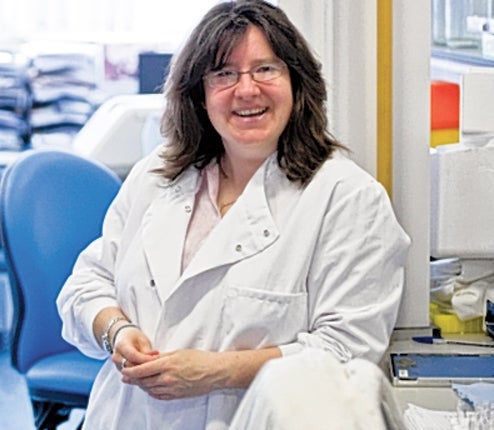
British scientists have turned stem cells from spare IVF embryos into red blood cells as part of a project to manufacture synthetic blood on an industrial-scale. It is believed to be the first time in Britain that human red blood cells have been created from embryonic stem cells and it marks a milestone in a project aimed at producing blood for medical transfusions.
The aim of the £3m project is to develop an alternative source of O-negative blood, the universal donor group that can be transfused into the vast majority of the population without fear of rejection.
The project, funded by the Wellcome Trust, has used more than a hundred spare IVF embryos from fertility clinics to establish several embryonic stem cell lines that replicate continuously in the laboratory.
One of these lines, known as RC-7, has been transformed from embryonic cells into blood stem cells before being converted into the functioning red blood cells that contain the oxygen-carrying pigment haemoglobin.
Professor Marc Turner, the director of the Scottish National Blood Transfusion Service in Edinburgh and leader of the project, said that synthetic blood made on an industrial scale would overcome the problem of blood shortages and the risk of transmitting new infections between donors and recipients. "We've proved the principle that from these embryonic stem cell lines we can generate red blood cells," Professor Turner said. "At the end of this three-year period we would envisage generating up to a unit [a pint] of red cells from embryonic stem cells at clinical grade which fulfil all the in vitro characteristics of red cells."
If all goes to plan, the first clinical trials of synthetic blood made from embryonic stem cells could begin within five years. The aim then is to scale-up the manufacturing process to produce more than two million pints a year using industrial bio-reactors.
It would raise the possibility of producing the entire supply of blood for the UK from a single "universal blood donor" who only ever existed as a four-day-old IVF embryo.
However, there are still obstacles to overcome. The scientists have to show, for instance, that the embryonic stem cells are cultured with laboratory reagents that have not been in contact with animal cells, which would risk contamination with animal diseases.
"The regulators, the Medicines and Healthcare Products Regulatory Agency and the European Medicines Agency, would need to be comfortable that the cells were produced to sufficient quality and safety before they would allow the first studies in humans," Professor Turner said.
As part of the process of gaining regulatory approval, the project has produced four embryonic stem cell lines deemed good enough to be used in human clinical trials – conforming to the "good manufacturing practice" (GMP) grade. They have been made by Roslin Cells, a spin-off company from the Roslin Institute in Edinburgh where Dolly the sheep was cloned.
Jo Mountford, a stem cell scientist at Glasgow University, confirmed that the synthetic red cells made in her laboratory from the RC-7 embryonic stem cell line produced by Roslin Cells contained the haemoglobin pigment. "We have cells that are clearly red so we're happy with that. We've managed to go 90 per cent down the path towards fully differentiated, adult red blood cells," Dr Mountford said.
One problem still to be resolved is to get the synthetic red cells to eject their nuclei, as happens naturally. This enables the cells to carry oxygen more efficiently and to pass through the narrow capillaries of the blood vessels.
Dr Mountford said that the haemoglobin in the synthetic red cells also shows signs of being more similar to foetal than adult haemoglobin, but she believes that further research will lead to mature, enucleated red blood cells with adult haemoglobin. "We're confident that we'll get the numbers of mature red blood cells that we need for clinical trials," she said.
Only one of the four embryonic stem cells lines produced at GMP grade has been tested for its blood type, Professor Turner said. The line, known as RC-9, is blood type B-positive and although it is not the universal donor type it can still be used for research.
The work on red cells is being watched with interest by researchers trying to convert embryonic stem cells into other specialised tissues. In many ways, red blood cells pose fewer problems than nerve, muscle or liver cells which contain cell nuclei and carry the risk of becoming cancerous, Professor Turner said. "If we can crack it with red cells, it takes us a long way. It doesn't solve it with other tissues but it takes us a long way to cracking it with other tissues, such as liver and so on."
A key requirement for synthetic blood is that it should be just as cheap, or cheaper, to produce than donated blood. It currently costs about £180 to make a pint of donated blood ready for transfusion, but the extra costs associated with testing and donation bring the total figure to about £500 per pint.
Join our commenting forum
Join thought-provoking conversations, follow other Independent readers and see their replies
Comments
Bookmark popover
Removed from bookmarks