Solar storm 'could cause more damage than Hurricane Katrina'
A powerful solar flare hit the Earth last week – and experts are now warning that the next one could be catastrophic
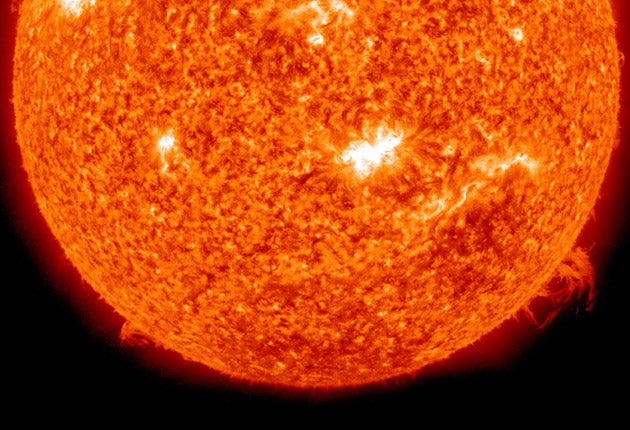
Havoc wreaked by a solar storm – such as the one that occurred last week – could be equivalent to a "global hurricane Katrina" that would cost up to $2 trillion dollars in damage to communications satellites, electric power grids and GPS navigation systems, scientists said yesterday.
Thursday's solar flare was the biggest for four years and ejected billions of tons of matter travelling at a million miles per hour towards Earth.
When it hit our magnetic field it generated magnetic storms and power surges which disrupted communications and grounded flights.
Senior government advisers have warned that the world has never been more vulnerable to the effects of such an events, which buffets the complex and delicate electronic technology that now controls almost all aspects of modern society.
An increasing reliance on electronic equipment, such as GPS satellite navigation and the computers controlling smart grids for electricity distribution, has meant that solar storms can now produce unprecedented damage on a global scale, they said.
Professor Sir John Beddington, the government's chief scientific adviser, said that the growth in the use of complex electronic machinery over the past 10 years has made society far more susceptible to catastrophic disruption than a decade ago when the last solar activity cycle reached its peak."Space weather has to be taken seriously. We've had a relatively quiet period of space weather and we expect that quiet period to end," Sir John told the American Association for the Advancement of Science in Washington.
"At the same time, over that period the potential vulnerability of our systems has increased dramatically, whether it is the smart grid in our electricity system or the ubiquitous use of GPS systems," he said.
The approximately 11-year solar cycle is now emerging from one of its quietest periods in 50 years and is expected to reach a solar maximum in 2013, when the number of solar flares on the Sun which generate electromagnetic storms reaches a peak.
"[Last week's] event was the strongest solar flare in four years and as a consequence airlines re-routed flights away from polar regions in anticipation of the possibility that their radio communications would not be operable," said Jane Lubchenco, the head of the US National Oceanic and Atmospheric Administration (NOAA). "In addition to that, communications problems were reported on flights from Hawaii to southern California and the flare disrupted communications in parts of the western Pacific region and Asia.
"Clearly this is something we need to take seriously. That particular event was not a very serious one, but as we enter a period of higher solar activity it is reasonable to expect more and more events and they may vary in magnitude," she said.
"This is an area that we're beginning to pay much more attention to, not only because we are entering a solar maximum, but because so much more of our technology is vulnerable than was the case even 10 years ago when we had the last solar maximum," she added.
Thomas Bogdan, director of the Space Weather Prediction Centre in Boulder, Colorado, said that GPS systems are highly vulnerable to the massive bursts of electromagnetic radiation from the Sun, which energise the charged particles of the Earth's ionosphere.
"That ionosphere sits between us and the GPS satellites and the thicker that ionosphere, the longer the time delay between the GPS satellite and when you pick it up," Dr Bogdan said. "In the worst-case situation, on the day-lit side of the Earth, we could see the loss of GPS not only for navigation but for its critical timing capability used in business transactions."
About 10 or 20 hours after the initial blast of electromagnetic radiation, a second burst of high-energy charged particles will hit the Earth.
These have the ability to induce dangerous electric currents in power lines and oil pipelines, Dr Bogdan said. A 14-year-old early-warning satellite is the only way of directly detecting the potential magnitude of the danger this wave of charge particles within a solar storm poses to pipelines and electronic systems on Earth, he said. "Any storm coming from the Sun has to pass over that spacecraft before it hits Earth. If it takes 20 hours to go from the Sun to Earth, it's going to take about 20 minutes to go from that spacecraft to Earth. So our last warning is a 20-minute warning, which will tell us how big, how strong, how nasty that storm might be," he told the meeting.
"The trouble is, it's 14 years old and what keeps me awake at night is worrying about whether that satellite would be running next morning when I get up," he said.
Sir John Beddington added: "There are two things we need to be thinking about. We need to think about prediction – the ability to categorise and give warning about when particular types of space weather is likely to occur. The second is about engineering. Thinking about particular sectors and their vulnerability to particular types of space weather – that is a complicated issue and we need to think hard about how to do that," he said.
"What is absolutely critical is that we do have to take space weather seriously. This is an international issue and it is international collaboration that is how we are going to deal with it."
Join our commenting forum
Join thought-provoking conversations, follow other Independent readers and see their replies
Comments
Bookmark popover
Removed from bookmarks