Science

Rain (AM and PM) 7° London Hi 9°C / Lo 7°C

Solved: the mystery of why locusts swarm

Neurochemical transforms loner insects into collective menace
By Steve Connor, Science Editor

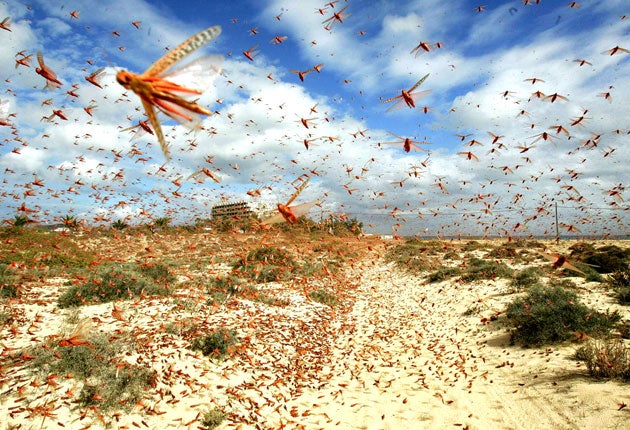
Holidaymakers in Fuerteventura were greeted by this terrifying sight in November 2004 when a 100 million-strong swarm of pink locusts descended from the skies

REUTERS/CORBIS

Holidaymakers in Fuerteventura were greeted by this terrifying sight in November 2004 when a 100 million-strong swarm of pink locusts descended from the skies

They first became famous in the Book of Exodus as the eighth of the 10 plagues of Egypt, but it has taken another few thousand years – and the skills of modern scientists – to work out why desert locusts suddenly swarm in vast numbers.

Desert locusts usually live shy, solitary lives. But every now and again they join together in gregarious bands that actively seek out each other until they form hungry swarms. These can contain a billion or more individuals that each day can devour their own body weight, with devastating consequences for crops and vegetation.

How this dramatic transformation comes about has been a mystery since biblical times – which is why locust plagues were often seen as acts of God. Now scientists have discovered a link to a neurochemical called serotonin, found in the brains of many animals including humans.

A study by the universities of Oxford, Cambridge and Sydney has found a build-up of serotonin in the nerves of the middle part of the locust's body controlling its legs and wings causes, within the space of a couple of hours, the solitary locust to turn into its swarming alter-ego.

The finding opens the possibility of stopping the process long before it happens, by blocking the action of serotonin.

This could be used to prevent the massive destruction of crops that occurs when locusts swarm – a threat affecting the livelihoods of one-tenth of the world's population. Globally there are about a dozen species of swarm-forming locust in a belt covering some 20 per cent of the world's landmass, from north Africa to China.

Last November, a locust swarm 3.7 miles long devastated agricultural production in parts of Australia, and in 2004 half the crops of Mauritania were lost as a result of similar locust swarms.

The solitary and gregarious forms of the desert locust are so different both in looks and behaviour that they were considered to be separate species until 1921, when scientists proved otherwise.

The transition usually happens after rainfall has caused an explosion in numbers. During a subsequent drought, the solitary locusts are forced closer together on smaller patches of remaining vegetation. It is this enforced mingling that triggers the physical change from solitary to gregarious, said Steve Rogers of Cambridge University, a member of the group behind the study, which is published in the journal Science.

"The gregarious phase is a strategy born of desperation and driven by hunger – swarming is a response to find pastures new," said Dr Rogers.

"We have now found the mechanism that controls the process. We've opened the black box of how this works," he said.

Swidbert Ott, a member of the Cambridge team, said: "Serotonin profoundly influences how humans behave and interact, so to find the same chemical causes a normally shy insect to form huge groups is amazing."

The crimson tide

Holidaymakers at Fuerteventura in the Canary Islands were greeted by a terrifying sight in November 2004 when a 100 million-strong swarm of pink locusts descended from the skies (pictured above). Tourists fled the beach near the resort of Corralejo when the insects, which had laid waste to huge swaths of farmland in Mauritania, crossed the Atlantic.

3.7 miles

The length of a swarm of locusts that devastated crop production in parts of Australia last year.

Post a Comment

View all comments that have been posted about this article.

Offensive or abusive comments will be removed and your IP logged and may be used to prevent further submission. In submitting a comment to the site, you agree to be bound by the Independent Minds Terms of Service.

Comments

Solved: the mystery of why locusts swarm
[info]doomedhuman wrote:
Friday, 30 January 2009 at 12:22 am (UTC)
Let's just eliminate something that has been built into nature for reasons we may never understand. I'm sure the minimal consequences to the food chain won't be a problem at all.
Re: Solved: the mystery of why locusts swarm
[info]rjbo wrote:
Friday, 30 January 2009 at 09:10 am (UTC)
"Let's just eliminate something that has been built into nature for reasons we may never understand."

Yeah, those Smallpox outbreaks are sadly missed.
[info]neil_mcgowan wrote:
Friday, 30 January 2009 at 12:43 am (UTC)
Now tell us why 55 million allegedly sensible people suddenly swarmed to believe they were under attack by Saddam Hussein? :(
Locusts
[info]andykenworthy wrote:
Friday, 30 January 2009 at 12:54 am (UTC)
Yep, find it, break it, then see what happens. Great plan.
Solved: the mystery of why millions swarm to Disneyland
[info]ben105 wrote:
Friday, 30 January 2009 at 05:48 am (UTC)
A study by the universities of Oxford, Cambridge and Sydney has found a build-up of serotonin in the nerves of the middle part of the human's body controlling its legs and head causes, within the space of a couple of hours, the solitary human to turn into its swarming alter-ego.
Serotonin profoundly influences how humans behave and interact, so to find the same chemical causes a normally shy human to form huge groups is amazing.
Surely something is learnt from history
[info]forwardplanning wrote:
Friday, 30 January 2009 at 07:03 am (UTC)
In the name of 'Science', Man is forever fiddling with nature, often with negative effects. Just because we could, doesn't mean we should.

Re: Surely something is learnt from history
[info]freeethinker wrote:
Friday, 30 January 2009 at 09:38 am (UTC)
In the name of 'Science', Man is forever fiddling with nature, often with negative effects. Just because we could, doesn't mean we should.


what do you suggest then?

everybody just sit on their backsides and do nothing just in case there is a "negstive effect".

scientists beaver away "fiddling" with nature to try to improve our lives, find cures for all kinds of maladies that curse the human existence, yes sometimes their work may have a negative outcome but mostly it is positive and to the benefit of us all.
E's
[info]kuma2000 wrote:
Saturday, 31 January 2009 at 07:29 pm (UTC)
So are we going to give the locusts MDMA to destroy serotonal receptors? Does it not worry that they may still swarm together for a mutual enjoyment of a series of repetitive beats?
Solved: the mystery of why locusts swarm
[info]pmvazquez wrote:
Friday, 6 February 2009 at 12:52 am (UTC)
I would just be curious about why every one of these individuals get into swarming aletr-ego at similar times. Is it that they mimic other's behaviour - therefore is this partial state, intentional?
The mystery of locusts swarm
[info]jelly_knight wrote:
Thursday, 11 June 2009 at 11:39 pm (UTC)
Locust?s attacks can have devastating effects on crops. Yes, they were created for some reason, but we can?t just allow them to destroy crops and accept that it is a will of God to leave us without crop, and therefore food and income. Farmers work hard and they need to have some means to ?defend? their crops. OK they have discovered what causing it, but what do we need to do to prevent it? Jell from buy to let re mortgage.

Most popular