Solved: the mystery of why Stradivarius violins are best
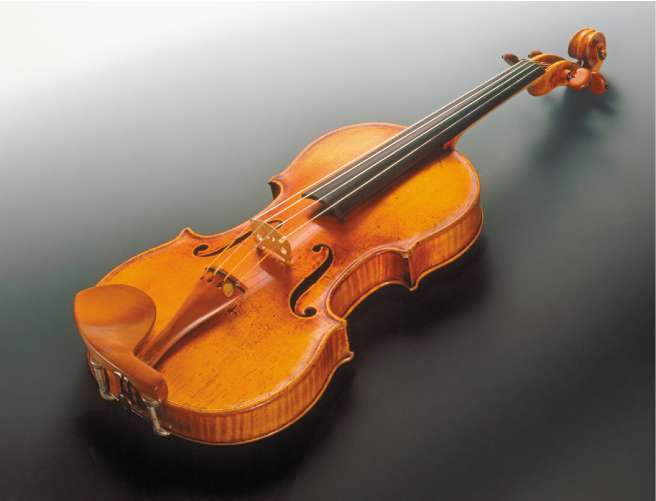
They are said to produce unparalleled sound quality. Until now, however, no one has been able to explain why 300-year-old Stradivarius violins have never been matched in terms of musical expressiveness and projection.
A study has found that the secret may be explained by the consistent density of the two wooden panels used to make its body, rather than anything to do with the instrument's overall contours, varnish, angle of the neck, fingerboard or strings.
Scientists compared five antique violins made by the Cremonese masters Antonio Stradivari and Giuseppe Guarneri Del Gesu with seven modern-day instruments by placing them in a medical scanner that could accurately gauge the density of the two wooden plates that make up the top and the back of the body.
They found that, overall, the density of the two groups of violins was the same, but what differed significantly was that the two plates of the older instruments had a more uniform density compared to the more inconsistent densities of the modern plates.
The top plate of a violin is usually made of spruce and the back of maple. The scientists believe that the homogenous density of the Cremonese violins gives them the edge in terms of stiffness and sound-damping characteristics, which both help to produce superior musical notes.
The classical violins made by the two Cremonese masters have become the benchmark against which the sound of all other violins are compared. Yet by general consensus no instrument maker since that time has been able to replicate the sound quality of those early violins, said Berend Stoel of Leiden University in the Netherlands.
"The vibration and sound-radiation characteristics of a violin are determined by an instrument's geometry and the material properties of the wood. New test methods allow the non-destructive examination of one of the key material properties, the wood density, at the growth ring level of detail," Dr Stoel said.
The CT scanner used by the scientists is normally employed to study the density of the tissue within a patient's lungs using X-rays. However, Dr Stoel, working with a professional instrument-maker, Terry Borman, of Fayetteville in Arkansas, was able to build up a picture of a violin's density variations using CT scans, which carried no risk to the valuable instruments.
"Wood density is difficult and invasive to measure directly, as an isolated part of the instrument, wrapped in a waterproof container, must be immersed in water to estimate its volume, and its density is calculated by dividing its weight by this volume," Dr Stoel said.
On top of this, this conventional approach to measuring wood density is not able to measure variations within a single plate – which appears to be the difference that may explain the quality of the antique instruments.
Dr Stoel, whose study is published in the online journal Public Library of Science, said the density variations within the wood are caused by the type of wood growth. Early growth in spring is less dense than summer growth, and the antique instruments appear to have a more balanced mix of early and late growth.
"Early growth wood is primarily responsible for water transport and thus is more porous and less dense than late growth wood, which plays more of a structural support role of much more closely packed tracheids [the light and dark grain lines of wood]," he said.
The rise to fame of a master instrument maker
Antonio Stradivari (c1644-1737) is, with his Italian compatriot Giuseppe Guarneri Del Gesu, the most famed of luthiers. He began crafting stringed instruments in 1680, establishing his workshop in Cremona, Italy, where he stayed until his death aged 93, father to 11 children. He made more than 1,100 instruments – violins, but also cellos, a few violas and a harp – 650 of which survive today. His creations were inscribed with Latin slogans along the lines of Antonius Stradivarius Cremonensis Faciebat Anno [date]. The instruments considered his most expressive were made in the first quarter of the 18th century, but long before then he had established his fame with the "Viotti violin" – first played by Giovanni Battista Viotti at the Tuileries Palace in Paris in 1782, and now valued at £3.5m. Toby Faber, the author of a biography of Stradivari, Five Violins, One Cello and a Genius, believes: "Before Viotti, Stradivari was just one violin-maker among many. After him, everyone wanted to play a Strad." On 16 May 2006, Christie's auctioned a Stradivarius called The Hammer for a record $3.54m (£1.75m).
Join our commenting forum
Join thought-provoking conversations, follow other Independent readers and see their replies
Comments
Bookmark popover
Removed from bookmarks