Steve Connor: Don't believe the hype over climate headlines
Lab Notes
A story published 10 years ago in The Independent (ind.pn/8Xiaa8) has gone viral on the internet.
Climate contrarians have been making much of an article published on 20 March 2000 – the last day of winter – with the headline: "Snowfalls are now just a thing of the past."
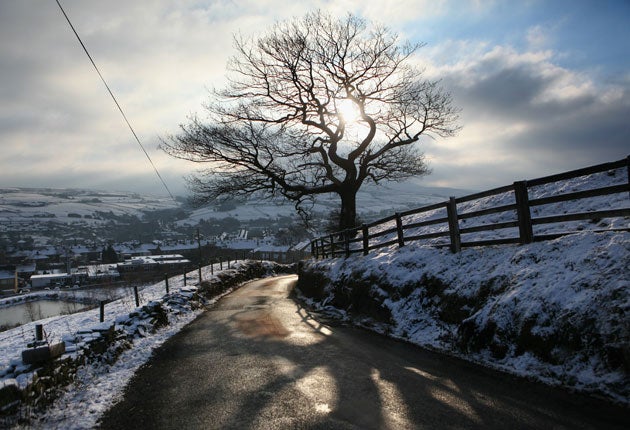
Self evidently, snow has not become a thing of the past, judging from the amount that fell in Britain in December. Contrarians who dismiss the scientific evidence for climate change have been busy copying the article far and wide in an attempt to expose the "hype" of global warming.
The article quoted David Viner, then a scientist at the Climatic Research Unit at the University of East Anglia, who warned that within a few years winter snowfall will become "a very rare and exciting event". Dr Viner was also quoted as saying: "We're really going to get caught out. Snow will probably cause chaos in 20 years time."
There are a number of recurring themes at play here that are worth analysing. The first is to do with headlines and the difference between journalism and science.
Headlines are meant to draw people into a story and have to conform to quite rigid restrictions on space in the printed medium – where this headline first appeared. They are meant to be accurate, but they can never do full justice to the nuances of reporting. This is even more true when it comes to the more complex nuances of science. The headline in this case is not what the story itself said, as Dr Viner made clear. The story was about the frequency of snowfalls, and how "snow is starting to disappear from our lives", which the it stated clearly.
A more accurate headline would be something like: "Snowfalls are becoming less frequent in our little corner of the world but that doesn't necessarily mean that snow will disappear from our lives completely and forever." Unfortunately, any sub-editor who would suggest such a tediously long headline is unlikely to last very long.
The second issue is about the difference between weather and climate. Just as one swallow does not make a spring, one hot summer or cold winter does not prove or disprove climate change. Climate is what we expect over a long period – often too long to be retained by human memory – whereas weather is what we get from one day to the next.
We remember the weather but it's more difficult to put it into a climate context. Vladimir Putin was once rather scornful of the idea of climate change, saying that Russia could benefit from a warmer world. He changed his tune last summer when record temperatures in Moscow generated fires that engulfed the city in smog.
If Mr Putin had consulted his own scientists, who have built quite extensive records over long periods of time on the Siberian permafrost and Arctic sea ice, he would have a better idea of climate change. It is no good judging the climate from one hot summer or cold winter; you need to analyse the long-term records.
Take a look, for instance, at the Arctic sea ice, as monitored by the US National Snow and Ice Data Centre. There is an unambiguous decline over the past 30 years. Indeed, last December saw the lowest sea ice cover for this winter month since satellite records began.
Scientists still don't really understand what effect the retreat of the Arctic sea ice will have on regional weather patterns. Vladimir Petoukhov, of the Potsdam Institute for Climate Impact Research in Germany, recently produced a computer modelling study showing that the lack of sea ice over the Barents and Kara seas could result in more frequent high pressure systems that send cold Arctic air over Britain and Western Europe in winter – exactly the type of weather pattern we've recently experienced.
The global climate system is an inherently chaotic affair. Scientists who make predictions about the future climate do so in the knowledge that they can only attach probabilities to their scenarios, much like weather forecasts.
So a headline saying that "snowfalls are now just a thing of the past" is not a scientific prediction or statement. It is a newspaper headline, and should be treated as an invitation to read the entire story, which in this case clearly pointed out that snowfalls are becoming less frequent in Britain. This is still the case even with the experience of having two snowy winters on the run.
Join our commenting forum
Join thought-provoking conversations, follow other Independent readers and see their replies
Comments
Bookmark popover
Removed from bookmarks