Steve Connor: We need a global debate on population
Lab Notes
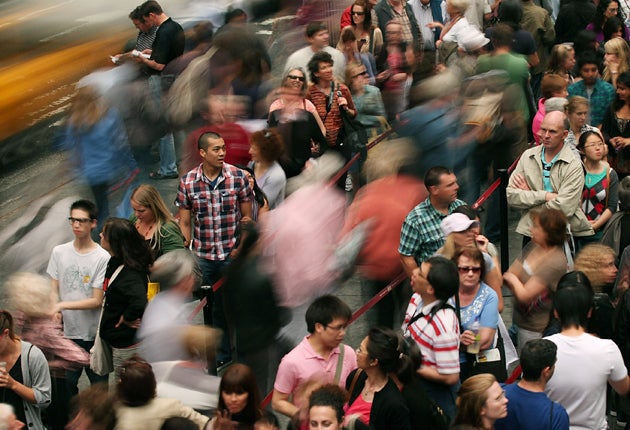
A growing number of scientists are going where politicians fear to tread by calling for a wider public debate on the sensitive issue of the global human population, which is set to rise from the present 6.8 billion to perhaps 9 billion by 2050.
Lord Rees, the president of the Royal Society, brought the subject up in his excellent Reith Lectures; Sir David Attenborough has become a champion of those who believe population has been relegated as an environmental issue; and more recently Professor Aubrey Manning, presenter of the BBC's Earth Story, has stated that the sheer number of humans on the planet is the greatest menace the world faces.
Scientists have a reputation for saying things as they are, not as they should be. Politicians, forever looking for short-term solutions to keep them in office, do not, as a rule, look further than the middle distance. Yet population is one of those over-the-horizon threats without enemies, as Lord Rees put it. It is a disaster in slow motion, and all politicians seem to do is provide the sort of platitudes articulated by Michael Heseltine, who recently fielded a question on Radio 4 by saying that the problems associated with population never turn out to be as bad as predicted – which is probably true if you can enjoy your own Oxfordshire arboretum.
No doubt Heseltine and his fellow politicians who are in favour of doing nothing about population will cite the words of John P Holdren, President Obama's science adviser, who wrote these words in 1969 when he was a young ecologist: "If the population control measures are not initiated immediately, and effectively, all the technology man can bring to bear will not fend off the misery to come."
Misery, what misery? You can of course imagine the political class arguing that scientists have consistently got it wrong about overpopulation. But the next 40 years are going to be very different to the previous 40 years, and many scientists fear that there will indeed be extreme misery to come if the world does not take population more seriously.
The facts speak for themselves. The UN estimates that the global population will rise from 6.8 billion in 2009 to 8.3 billion by 2030, with much of the increase in the poorest countries, notably sub-Saharan Africa, which is set for a 51 per cent increase in the same period – four times that of the UK.
World food production will have to increase by 50 per cent to meet rising demand; water availability will have to increase by 30 per cent; and global energy demands by 50 per cent. Politicians may think that science and technology will provide what is needed, as it has done in the past at a cost to the environment, but many scientists are not so sure.
Holdren himself came up with a simple equation to try to quantify the sustainability of a given population level: I=PxAxT – where I represents the impact on the environment, P the population size, A the affluence or level of consumption per head, and T the technology that determines how efficiently resources are used. The equation simply says that the impact on the environment is a factor of the number of people, how much they consume and how efficient the consumption is.
It is a crude equation, but the aim was to show how we can limit the impact on the environment by intervening at any of these three levels. What is clear is that a continuing increase in human numbers makes everything else we do to reach sustainability far more difficult. As David Attenborough says: "I've never seen a problem that wouldn't be easier to solve with fewer people, or harder, and ultimately impossible, with more."
Just in case anyone thinks that this is just a problem for poor countries in Africa, they should read last week's report on population by Forum for the Future. Official statistics show that the UK population grew by 2 million between 2001 and 2008, its fastest rate of growth since the post-war 'baby boom'. Over the period from 2008 to 2033, the British population is set to grow from 61.4m to 71.6m, with 2029 being the year when there will be 70 million people living officially in Britain – there could be another 1 million or so living here illegally.
That means we will have to accommodate another city the size of Bristol every year. About two thirds of this projected increase is expected to be either directly or indirectly due to future migration, according to Forum for the Future. Politicians should be forced to debate this issue, rather than relying on people being cowed by suggestions that to do so is somehow pandering to illiberal, xenophobic and racist elements who have hijacked the subject for their own nefarious ends.
I was intrigued to hear "experts" on urban foxes say it's highly unusual for these animals to attack children, after the tragic case involving twin baby girls in east London. Country folk have a different, and less romantic view of the fox. The author Thomas Firbank, whose 1937 book I Bought a Mountain described the hard life of a Welsh hill farmer, described the bloody devastation that a fox can cause: "There is nothing which so angers a farmer as to find decapitated lambs wantonly killed for sport after they have been safely reared through the many natural hazards of their mountain birth."
Join our commenting forum
Join thought-provoking conversations, follow other Independent readers and see their replies
Comments
Bookmark popover
Removed from bookmarks